Who are the neoconservatives?
The neoconservative movement, which is generally
perceived as a radical (rather than “conservative”) Republican right,
is, in reality, an intellectual movement born in the late 1960s in the
pages of the monthly magazine Commentary, a media arm of the American Jewish Committee, which had replaced the Contemporary Jewish Record in 1945. The Forward, the oldest American Jewish weekly, wrote in a January 6th, 2006 article signed Gal Beckerman: “If
there is an intellectual movement in America to whose invention Jews
can lay sole claim, neoconservatism is it. It’s a thought one imagines
most American Jews, overwhelmingly liberal, will find horrifying. And
yet it is a fact that as a political philosophy, neoconservatism was
born among the children of Jewish immigrants and is now largely the
intellectual domain of those immigrants’ grandchildren”. The
neoconservative apologist Murray Friedman explains that Jewish dominance
within his movement by the inherent benevolence of Judaism, “the idea that Jews have been put on earth to make it a better, perhaps even a holy, place” (The Neoconservative Revolution: Jewish Intellectuals and the Shaping of Public Policy, 2006).
Just as we speak of the “Christian Right” as a political force in the
United States, we could also therefore speak of the neoconservatives as
representing the “Jewish Right”. However, this characterization is
problematic for three reasons. First, the neoconservatives are a
relatively small group, although they have acquired considerable
authority on and within Jewish representative organizations, including
the
Conference of Presidents of Major American Jewish Organizations. In 2003, journalist Thomas Friedman of the
New York Times counted twenty-five members saying, “
if you had exiled them to a desert island a year and half ago, the Iraq war would not have happened”.
The neoconservatives compensate for their small number by multiplying
their Committees, Projects, and other think tanks, which certainly give
them a kind of ubiquity.
Second, the neoconservatives of the first generation mostly came from
the left, even the extreme Trotskyist left for some such as Irving
Kristol, one of the main editors of
Commentary. During the late 1960s the
Commentary
editorial staff begins to break with the liberal, pacifist left, which
they suddenly find decadent. Norman Podhoretz, editor of
Commentary
from 1960 until his retirement in 1995, was a militant anti-Vietnam
dissenter until 1967, but then in the 70s became a fervent advocate of
an increased defense budget, bringing the journal along in his wake. In
the 1980s, he opposed the policy of détente in his book
The Present Danger:
in the 1990s, he calls for the invasion of Iraq, and then again in the
early 2000s. In 2007, while his son John Podhoretz was taking over as
editor of
Commentary, he asserted once again the urgency of a U.S. military attack, this time against Iran.
Third, unlike evangelical Christians who openly proclaim their
unifying religious principles, neoconservatives do not display their
Judaism. Whether they’d been Marxists or not, they appear mostly
non-religious. It is well-know that their major influence is the
philosophy of Leo Stauss, so much so that they are sometimes referred to
as “the straussians”; Norman Podhoretz and his son John, Irving Kristol
and his son William, Donald Kagan and his son Robert, Paul Wolfowitz,
Adam Shulsky, to name just a few, all expressed their debt to Strauss.
Leo Strauss, born to a family of German Orthodox Jews, was both pupil
and collaborator of political theorist Carl Schmitt, himself a
specialist of Thomas Hobbes and advocate of a “political theology” by
which the State must appropriate the attributes of God. Schmitt was an
admirer of Mussolini, and the legal counsel of the Third Reich. After
the Reichstag fire in February 1933, it was Schmitt who provided the
legal framework that justified the suspension of citizen rights and the
establishment of the dictatorship. It was also Schmitt, in 1934, who
personally obtained from the Rockefeller Foundation a grant for Leo
Strauss to study Thomas Hobbes in London and Paris, and then finally end
up teaching in Chicago.
The thinking of Leo Strauss is difficult to capture, and certainly
beyond the purview of this work. Moreover, Strauss is often elliptic
because he believes that Truth is harmful to the common man and the
social order and should be reserved for superior minds. For this reason,
Strauss rarely speaks in his own name, but rather expressed himself as a
commentator on classical authors, in whom he discovers many of his own
thoughts. Moreover, much like his disciples Allan Bloom (
The Closing of the American Mind,
1988) and Samuel Huntington, he is careful to clothe his most radical
ideas in ostensibly humanist principles. Despite the apparent
difficulty, three basic ideas can easily be extracted from his political
philosophy, no different from Schmitt. First, nations derive their
strength from their myths, which are necessary for government and
governance. Second, national myths have no necessary relationship with
historical reality: they are socio-cultural constructions that the State
has a duty to disseminate. Third, to be effective, any national myth
must be based on a clear distinction between good and evil; it derives
its cohesive strength from the hatred of an enemy nation. As recognized
by Abram Shulsky and Gary Schmitt in an article “
Leo Strauss and the World of Intelligence” (1999), for Strauss, “
deception is the norm in political life” – the rule they applied to fabricating the lie of weapons of mass destruction by Saddam Hussein when working inside the
Office of Special Plans.
In his maturity, Strauss was a great admirer of Machiavelli, who he believes he understood better than anyone. In his
Thoughts on Machiavelli, he parts from the intellectual trend of trying to rehabilitate the author of
The Prince
against the popular opinion regarding his work as immoral. Strauss
recognizes the absolute immorality of Machiavelli, which he sees as the
source of his revolutionary genius, “
We are in sympathy with the
simple opinion about Machiavelli, not only because it is wholesome, but
above all because a failure to take that opinion seriously prevents one
from doing justice to what is truly admirable in Machiavelli; the
intrepidity of his thought, the grandeur of his vision, and the graceful
subtlety of his speech”. The thought of Machiavelli is so radical and pure, says Strauss, that its ultimate implications could not be spelled out: “
Machiavelli
does not go to the end of the road; the last part of the road must be
travelled by the reader who understands what is omitted by the writer”. Strauss is the guide who can help his neoconservative students do that, for “
to discover from [Strauss’] writings what he regarded as the truth is hard; it is not impossible”.
This truth that Machiavelli and Strauss share is not a blinding light,
but rather a black hole that only the philosopher can contemplate
without turning into a beast: there is no afterlife, and neither good
nor evil; therefore the ruling elite shaping the destiny of their nation
need not worry about the salvation of their own souls. Hence
Machiavelli, according to Strauss, is the perfect patriot.

- Breaking
away from the classical political theory which sought to make virtue
the condition of power, Machiavelli (1469-1527) asserted that only the
appearance of virtue counts, and that the successful prince must be a
“great simulator” who manipulates and cons people’s mind”. The ruler he
most admired was Cesar Borgia, who after having appointed the cruel
Ramiro d’Orco to subdue the province of Romania, had him executed with
extreme cruelty, thus diverting the hatred of the people on another and
reaping his gratitude.
Neoconservatism is essentially a modern Jewish version of
Machiavelli’s political strategy. What characterizes the neoconservative
movement is therefore not as much Judaism as a religious tradition, but
rather Judaism as a political project, i.e. Zionism, by Machiavellian
means. Note that, in an article in the
Jewish World Review on
June 7th, 1999, the neoconservative Michael Ledeen defends the thesis
that Machiavelli was a crypto-Jew, as were at the time thousands of
families nominally converted to Catholicism under threat of expulsion of
death. “
Listen to his political philosophy, and you will hear the Jewish music”,
wrote Ledeen, citing in particular Machiavelli’s contempt for the
nonviolent ethics of Jesus and his admiration for the pragmatism of
Moses, who was able to kill countless men in the interests of enforcing
his new law.
Obviously, if Zionism is synonymous with patriotism in Israel, it
cannot be an acceptable label in American politics, where it would mean
loyalty to a foreign power. This is why the neoconservatives do not
represent themselves as Zionists on the American scene. Yet they do not
hide it all together either. Elliott Abrams,
Deputy National Security Adviser in the administration of Bush’s son, wrote in his book
Faith or Fear (1997): “
Outside
the land of Israel, there can be no doubt that Jews, faithful to the
covenant between God and Abraham, are to stand apart from the nation in
which they live. It is the very nature of being Jewish to be apart —
except in Israel — from the rest of the population”. It is hard to
come with a better definition of Zionism, the corollary of which is the
apartheid practiced against non-Jewish peoples in Palestine, defended in
the same year by Douglas Feith in his “
Reflections on Liberalism, Democracy and Zionism”, pronounced in Jerusalem, defending the right of Israel to be an
“ethnic nation”: “
there is a place in the world for non-ethnic nations and there is a place for ethnic nations”.
If one is entitled to consider the neoconservatives as Zionists, it
is especially in noting that their foreign policy choices have always
coincided perfectly with the interests of Israel (as they see it).
Israel’s interest has always been understood as dependent on two things:
the immigration of Eastern Jews and the financial support of the Jews
of the West (American and, to a lesser extent, European). Until 1967,
the national interest pushed Israel toward the Soviet Union, while the
support of American Jews remained quiet. The socialist and collectivist
orientation of the Labor Party in power naturally inclined them in this
direction, but Israel’s good relations with the USSR were primarily due
to the fact that the mass immigration of Jews was only possible through
the good will of the Kremlin. During the three years following the end
of the British mandate on Palestine (1948), which had hitherto limited
Jewish immigration out of consideration for the Arab population, two
hundred thousand Polish Jewish refugees in the USSR were allowed to
settle in Palestine, with others coming from Romania, Hungary and
Bulgaria.
The Six Day War was a decisive turning point: in 1967, Moscow
protested against Israel’s annexation of new territories, broke
diplomatic relations with Tel Aviv and stopped the emigration of its
Jewish citizens, which had accelerated in the previous month. It is from
this date that
Commentary became, in the words of Benjamin Balint, “
the contentious magazine that transformed the Jewish left into the neoconservative right”.
The neoconservatives realized that, from that point, Israel’s survival –
and its territorial expansion – depended on the support and protection
of another super-power, the U.S. military, and concomitantly that their
need for Jewish immigrants could only fe fulfilled by the fall of
communism. These two objectives converged in the deepening of military
power of the United States. This is why Irving Kristol engaged the
American Jewish Congress in 1973 to fight George McGovern’s proposal to reduce the military budget by 30%: “
this
is to drive a knife into the heart of Israel. [...] Jews don’t like a
big military budget, but it is now an interest of the Jews to have a
large and powerful military establishment in the United States. [...]
American Jews who care about the survival of the state of Israel have to
say, no, we don’t want to cut the military budget, it is important to
keep that military budget big, so that we can defend Israel”. We now understand better what reality Kristol was referring to, when he famously defined a neoconservative as “
a liberal who has been mugged by reality”.
In the late 60s, the neoconservative support the militarist fringe of
the Democratic Party, headed by Senator Henry Scoop Jackson, a
supporter of the Vietnam War who challenged McGovern in the 1972
primaries. Richard Perle, parliamentary assistant to Jackson, wrote the
Jackson-Vanik amendment, which made food aid to the Soviet Union
conditional upon the free emigration of Jews. It is also within the
office of Scoop Jackson that an alliance between the neoconservatives
and the Rumsfeld-Cheney tandem will be forged, before Rumsfeld and
Cheney took advantage of the Watergate scandal to join the Republican
camp and infiltrate the White House. Perle placed his protégés Paul
Wolfowitz and Richard Pipes in
Team B, whose report was published in
Commentary.
During the Carter period, neoconservatives allied with evangelical
Christians, viscerally anti-communist and generally well disposed
towards Israel, the foundation of which they see as a divine miracle
foreshadowing the return of Christ. The contribution of the
neoconservatives to the Reagan victory allowed them to work within the
government to strengthen the alliance between the United States and
Israel; in 1981, the two countries signed their first military pact,
then embarked on several shared operations, some legal and others not
so, as evidenced by the network of arms trafficking and paramilitary
operations embedded within the Iran-Contra affair. Anti-communism and
Zionism had become so linked in their common cause, that in 1982, in his
book
The Real Anti-Semitism in America, the director of the Anti-Defamation League Nathan Perlmutter could turn the pacifism of the “
peacemakers of Vietnam vintage, [the] transmuters of swords into plowshares”, into a new form of anti-Semitism.
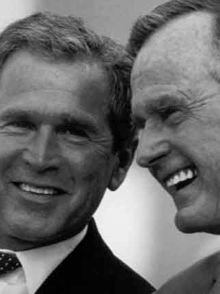
- Andrew
Cockburn reports in his book on Rumsfeld (2007) this conversation
between the two George Bush : “What’s a neocon?” asks W. “Do you want
names, or a description?”, says Poppy. “Description” “Well, I’ll give it
to you in one word: Israel.”
With the end of the Cold War, the national interest of Israel changed
once again. Their primary objective became not the fall of communism,
but rather the weakening of Israel’s enemies. Thus the neoconservatives
underwent their second conversion, from anti-communism to islamophobia,
and created new think tanks such as the
Washington Institute for Near East Policy (WINEP) led by Richard Perle, the
Middle East Forum led by Daniel Pipes (son of Richard), the
Center for Security Policy (CSP) founded by Frank Gaffney, and the
Middle East Media Research Institute
(MEMRI). President George H.W. Bush, however, cultivated friendships
with Saudi Arabia and was not exactly a friend of Israel; he resisted in
September of 1991 against an unprecedented pro-Israel lobbying campaign
that called for $10 billion to help Jews immigrate from the former
Soviet Union to Israel. He complained in a televised press conference on
September 12th that “
one thousand Jewish lobbyists are on Capitol Hill against little old me”, thereby causing Tom Dine, the Executive Director of
AIPAC, to exclaim that “
September 12, 1991, is a day that will live in infamy”. Bush also resisted the neoconservatives’ advice to invade Iraq after
Operation Desert Storm. Finally, Bush’s
Secretary of State James Baker was too receptive to Arab proposals throughout the
Madrid Conference
in November 1991; the neoconservatives, as a result, sabotaged Bush’s
chances for a second term and supported Democrat Bill Clinton. After
eight years of Clinton, they finally completed their victory by having
Bush’s son George W. elected and forcing him into the second Irak war.
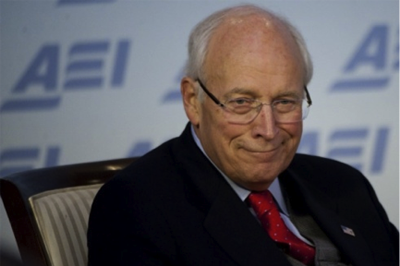
- The
American Enterprise Institute for Public Policy Research (AEI), founded
in 1943 by businessmen opposed to the New Deal, was overtaken by the
neocons in the 70s, who tripled its budget. Some weeks before launching
the war against Iraq, President George W. Bush congratulated them : “At
the American Enterprise Institute some of the finest minds in our nation
are at work in some of the greatest challenges to our nation. You do
such good work that my administration has borrowed twenty such minds”.
During Clinton’s two terms, while the
Madrid agreements were buried by the
Oslo Accords
negotiated directly with an overwhelmed Yasser Arafat, neoconservatives
prepared their return with Rumsfeld and Cheney, and threw all their
weight behind their ultimate think tank, the
Project for the New American Century (PNAC). William Kristol, son of Irving, also founded in 1995 a new magazine,
The Weekly Standard,
that immediately became the dominant voice of the neoconservatives
thanks to funding from the pro-Israeli Rupert Murdoch. In 1997, it would
be the first publication to call for a new war against Saddam Hussein.
During the Clinton years, neoconservatives, although consulted by the
White House, were not part of it. And so it is relevant to mention that,
during this same time, the FBI was investigating an Israeli mole in the
White House, who was allegedly using the code name “Mega” and enjoying
privileged access to the
Security Council. According to the investigator Gordon Thomas, quoted by the
New York Post on March 5th1998, the FBI investigation was stopped when
“Israel blackmailed President Clinton with private recordings of his steamy conversations with Monica Lewinsky”.

- To
spread their war agenda, neoconservatives could rely of Rupert
Murdoch’s powerful News Corporation, which owned 175 written
publications selling more than 40 millions newspapers each week, and 35
TV channels reaching 110 million viewers on four continents. En 2003,
all of them were in favor of the war against Iraq. Murdoch is a friend
of Ariel Sharon and a loyal supporter of the Likud party. He is also
close to Tony Blair, who is the godfather of one of his children.
Speeches and mirrors
The 2007 book by John Mearsheimer and Stephen Walt,
The Israel Lobby and U.S. Foreign Policy, shocked the American public by exposing the considerable influence of pro-Israel groups, the oldest of which being the
Zionist Organization of America, and the most influential since the 70s, the
American Israel Public Affairs Committee
(AIPAC). The authors demonstrate that “the Lobby” has been the major
force driving the United States into the Iraq war and, more generally,
into a foreign policy that lacks coherence and morality in the Middle
East. The authors’ thesis is yet incomplete because they leave absent
the complementary role played from within State by the neoconservatives,
who form the other arm of the pliers now holding the American foreign
policy.
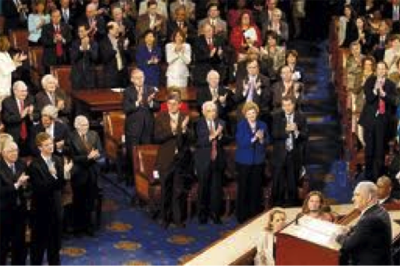
- “We,
the Jewish people control America, and the Americans know it”, Prime
Minister Ariel Sharon said to minister of Foreign Affairs Shimon Peres
on October 3, 2001, according to Israeli radio Kol Yisrael. His
successor Benjamin Netanyahu proved it on May 24, 2011 by receiving 29
standing ovation by the American Congress, including at each of those
sentences: “in Judea and Samaria, the Jewish people are not foreign
occupiers” ; “No distortion of history could deny the 4,000-year-old
bond between the Jewish people and the Jewish land” ; “Israel will not
return to the indefensible boundaries of 1967” ; “Jerusalem must never
again be divided. Jerusalem must remain the united capital of Israel ».
These two forces — the crypto-Zionists infiltrated in the government
and the pro-Israel lobby — sometimes act in criminal conspiracy, as
illustrated by the charge against Larry Franklin in 2005, who, as a
member of the
Office of Special Plans working under Douglas
Feith, passed classified defense documents to two AIPAC officials,
Steven Rosen and Keith Weissman, who in turn transmitted them to a
senior official in Israel. Franklin was sentenced to thirteen years in
prison (later reduced to ten years of house-arrest), while Rosen and
Weissman were acquitted. Most neoconservatives are active members of the
second most powerful lobby pro-Israel, the
Jewish Institute for National Security Affairs
(JINSA), of which Dick Cheney and Ahmed Chalibi are also members, among
others responsible for instigating the Iraq invasion. JINSA was founded
in 1976 by American army officers, intellectuals, and politicians, with
one of its stated aims “
to inform the American defense and foreign
affairs community about the important role Israel can and does play in
bolstering democratic interests in the Mediterranean and the Middle East”. Colin Powell, according to his biographer Karen DeYoung, privately rallied against this “
separate little government” composed of “
Wolfowitz, Libby, Feith, and Feith’s ‘Gestapo Office’”, which he also called “the JINSA crowd”.
In 2011, Powell’s former
Chief of Staff Lawrence Wilkerson
openly denounced the duplicity of neoconservatives such as David Wurmser
and Douglas Feith, whom he considered like “
card-carrying members of
the Likud party. […] I often wondered if their primary allegiance was
to their own country or to Israel. That was the thing that troubled me,
because there was so much that they said and did that looked like it was
more reflective of Israel’s interest than our own”. In fact, a
significant number of neoconservatives are Israeli citizens, have family
in Israel or have resided there themselves. Some are openly close to
Likud, the nationalist party in power in Israel, and several have even
been official advisors to Netanyahu; many are regularly praised for
their work on behalf of Israel by the Israeli press. Paul Wolfowitz, for
example, was nominated “
Man of the Year” by the pro-Likud
Jerusalem Post in 2003, and
« the most hawkishly pro-Israel voice in the Administration » by the American Jewish daily newspaper
The Forward.
The duplicity of the neoconservatives is brought to light by a
document revealed in 2008 by authors such as James Petras and Stephen
Sniegoski (see bibliography); it is a 1996 report by the Israeli think
tank
Institute for Advanced Strategic and Political Studies, entitled “
A Clean Break: A New Strategy for Securing the Realm”,
sent to the new Israeli Prime Minister, Benjamin Netanyahu. The team
responsible for the report was led by Richard Perle, and included
Douglas Feith, David Wurmser and his wife Meyrav Wurmser. Perle
personally gave the report to Netanyahu on July 8th, 1996. The same
year, the authors signed the founding manifesto of PNAC in the U.S., and
four years later, they would be positioned in key posts of the U.S.
military and U.S. foreign policy. As its title suggests, the report
Clean Break
invites Netanyahu to break with the Oslo Accords of 1993, which
committed Israel to the return of the territories it occupied since 1967
and to retract illegal settlements. The new Prime minister should
instead “
engage every possible energy on rebuilding Zionism” and reaffirm Israel’s right over the West Bank and the Gaza Strip: “
Our
claim to the land — to which we have clung for hope for 2,000 years —
is legitimate and noble. […] Only the unconditional acceptance by Arabs
of our rights, especially in their territorial dimension, ‘peace for
peace,’ is a solid basis for the future”. The authors of
Clean Break
therefore encourage Netanyahu to adopt a politics of territorial
annexation, not only contrary to the official position of the United
States and the United Nations, but also contrary to public commitments
made by Israel. Even though he signed the “roadmap” intended to lead to
an independent Palestinian State in September 1999, and maintained his
position at the
Camp David summit in July 2000, Netanyahu followed the advice of
Clean Break
and secretly worked to sabotage the process. During a private interview
filmed without his knowledge in 2001, he bragged how he undercut the
peace process:
“I’m going to interpret the accords in such a way that
would allow me to put an end to this galloping forward to the ’67
borders”. He also said:
“I know what America is. America is a thing you can move very easily, move it in the right direction. They won’t get in our way."

- “Richard
Perle is a traitor. There’s no other way to put it”, wrote journalist
Seymour Hersh in The New Yorker (March 17, 2003), referring to his lies
about Iraq. Perle responded by calling Hersh, on CNN, “the closest thing
American journalism has to a terrorist”. In 1970, the FBI caught Perle
transmitting to the Israeli ambassy classified information obtained from
Hal Sonnenfeldt, member of the National Security Council. Perle also
worked for the Israeli arm firm Soltam, before advising the Israeli
Prime Minister.
The recommendations to the Israeli government to sabotage the peace process in Palestine are presented by the authors of
Clean Break as part of a larger plan to allow Israel to “
shape its strategic environment”, by “
removing Saddam Hussein from power in Iraq”,
weakening Syria and Lebanon, and finally Iran. When Perle, Feith and
Wurmser moved to key positions in the U.S. government, they arranged for
the United States to implement the program themselves, without Israel
having to pay a single drop of blood. If there are differences between
the
Clean Break report written for the Israeli government in 1996 and the report
Rebuilding America’s Defenses
written by the same authors for the U.S. government in 2000, it is not
in the program itself, but rather the argued reasons. First,
Clean Break
does not have Iraq as a threat, but as the weakest of the enemies of
Israel, the least dangerous and the easiest to break. In a follow-up to
Clean Break, entitled
Coping with Crumbling States: A Western and Israeli Balance of Power Strategy for the Levant, Wurmser emphasizes the fragility of Middle East States, particularly Iraq: “
the residual unity of the nation is an illusion projected by extreme repression of the state”.
Thus the same action of first overthrowing Saddam is recommended to
Israel and the United States, but for opposite reasons. The weakness of
Iraq, which is the reason for Israel, does not constitute a valid reason
for the United States; and so it was therefore necessary to present
Iraq to the Americans as a mortal threat to their country. Netanyahu
himself authored an article in the
Wall Street Journal in September 2002, under the title “
The Case for Toppling Saddam”, describing Saddam as “
a
dictator who is rapidly expanding his arsenal of biological and
chemical weapons, who has used these weapons of mass destruction against
his subjects and his neighbors, and who is feverishly trying to acquire
nuclear weapons”. Nothing of such a threat, however, is mentioned
in Israeli internal documents, which also make no mention of any further
connection between Iraq and Al-Qaeda, nor even Al-Qaeda in general. The
perspective on Iraq in
Clean Break was the realistic one, while
the motives given America was pure propaganda: by the time American
troops moved into Iraq, the country had been ruined by a decade of
economic sanctions that had not only rendered its army powerless, but
also destroyed its once exemplary education and health care systems,
taking the lives, according to UNICEF, of half a million children. It
follows, therefore, that the speech given.
The second fundamental difference between the strategy recommended
for Israelis and the propaganda sold to the Americans: while the second
highlights both the security interest of the United States, and the
noble ideal to spread democracy in the Middle East, the first ignores
these two themes. The changes proposed by the
Clean Break authors
are not expected to bring any benefit to the Arab world. Instead, the
goal is clearly to weaken Israel’s enemies by sharpening ethnic,
religious and territorial disputes between countries and within each
country. After the fall of Saddam, foreseen in
Coping with Crumbling States, Iraq would be “
ripped apart by the politics of warlords, tribes, clans, sects, and key families”, for the benefit of Israel. Furthermore, it is not democracy that
Clean Break
recommended for Iraq, but rather restoring a pro-Western monarchy. Such
an outcome would obviously be unacceptable to the Americans, but when
Lewis Paul Bremer, as head of the
Coalition Provisional Authority
(CPA) in 2003, brought about the destruction of the military and
civilian infrastructure in the name of “de-Bassification”, it was viewed
as a success from the eyes of the Likud. Better still, by dissolving
the army, Bremer indirectly created a disorganized pool of resistance of
some 400 000 angry soldiers, ensuring chaos for a few years. Daniel
Pipes had the gall to write, three years after the invasion of Iraq:
“
the
benefits of eliminating Saddam’s rule must not be forgotten in the
distress of not creating a successful new Iraq. Fixing Iraq is neither
the coalition’s responsibility nor its burden”. And besides, he adds, “
when
Sunni terrorists target Shiites and vice-versa, non-Muslims are less
likely to be hurt. Civil war in Iraq, in short, would be a humanitarian
tragedy but not a strategic one” (
New York Sun, February 28,
2006). Under Bremer’s leadership, 9 billion dollars disappeared in
fraud, corruption and embezzlement, according to a report by the
Special Inspector General for Iraq Reconstruction Stuart Bowen, published January 30th, 2005.

- In
2001, Lewis Paul Bremer was the chairman of the National Commission on
Terrorism who appeared on NBC two hours after the “collapse” of the Twin
Towers, to calmly explain that “Bin Laden […] has to be a prime
suspect” and that “there are at least two States, Iran and Iraq, which
should at least remain on the list as essential suspects”. When the
reporter from NBC drew a predictable parallel between the attack and
Pearl Harbor, Bremer confirmed: “It is the day that will change our
lives. It is the day when the war that the terrorists declared on the US
[...] has been brought home to the U.S.”
The difference between the neocons’ Israeli and Amercian discourses
finds its explanation in the Israeli document itself, which recommends
Netanyahu present Israeli strategy “
in language familiar to the
Americans by tapping into themes of American administrations during the
cold war which apply well to Israel”; the Netanyahu government should “
promote Western values and traditions. Such an approach […] will be well received in the United States”.
The references to moral values are thus nothing more than tactics to
mobilize the United States. Finally, while the authors of the Israeli
report stressed the importance of winning the sympathy and support of
the United States, they also declare that their strategy will ultimately
free Israel from American pressure and influence: “
such
self-reliance will grant Israel greater freedom of action and remove a
significant lever of [United States] pressure used against it in the
past”.
Passing off a threat against Israel as though it were a threat
against the United States is a trick to which Netanyahu had no need to
be converted; he has been employing it since the 1980s to rally
Americans alongside Israel in the “international war on terrorism”, a
concept which he can claim to have invented in his books
International Terrorism: Challenge and Response (1982) and
Terrorism: How the West can Win (1986). In their book
An End to Evil
(2003), Richard Perle and David Frum likewise work to embed the fears
of Israelis into the minds of Americans; for example, they ardently urge
Americans to “
end this evil before it kills again and on a genocidal scale. There is no middle way for Americans: It is victory or holocaust”.
It is, however, impossible for anyone to be consistently hypocritical,
and it happens eventually that neoconservatives recklessly open their
thoughts to the public. This is what happened to Philip Zelikow,
Councelor to Condoleezza Rice and Executive Director of the Commission
on September 11, when, speaking about the Iraqi threat during a
conference at the University of Virginia September 10, 2002, he let
slip: “
Why would Iraq attack America or use nuclear weapons against
us? I’ll tell you what I think the real threat is and actually has been
since 1990: it’s the threat against Israel. And this is the threat that
dare not speak its name, because the Europeans don’t care deeply about
that threat, I will tell you frankly. And the American government
doesn’t want to lean too hard on it rhetorically, because it is not a
popular sell”. That’s really it in a nutshell: the United States
must be led to make war with the enemies of Israel, and in order to
that, Americans must be convinced that Israel’s enemies are America’s
enemies.
In addition, it is necessary that the Americans believe that these
enemies hate their country for what it claims to represent (i.e.
democracy, freedom, etc.), not because of its support for Israel. The
signatories of the PNAC letter to President Bush on April 3rd, 2002
(including William Kristol, Richard Perle, Daniel Pipes, Norman
Podhoretz, Robert Kagan, and James Woolsey) go as far as claiming that
the Arab world hates Israel because it is a friend of the United States,
rather than the reverse: “
No one should doubt that the United States
and Israel share a common enemy. We are both targets of what you have
correctly called an “Axis of Evil.” Israel is targeted in part because
it is our friend, and in part because it is an island of liberal,
democratic principles — American principles — in a sea of tyranny,
intolerance, and hatred”. It is a well-known fact that
America had no enemies in the Middle East before its covenant with
Israel in the late 60s. On September 21st, 2001, the
New York Post published an editorial by Netanyahu propagating the same historical falsification: “
Today we are all Americans. […] For the bin Laden’s of the world, Israel is merely a sideshow. America is the target”. Three days later
The New Republic responded with a headline on behalf of the Americans:
“We are all Israelis now”.
The post-9/11 propaganda has created a relationship fused by emotion.
Wrongly, Americans have understood September 11th as an expression of
hatred towards them from the Arab world and have thus experienced
immediate sympathy for Israel, an emotional link neoconservatives
exploit without limit; Paul Wolfowitz declared April 11th, 2002: “
Since
September 11th, we Americans have one thing more in common with
Israelis. On that day America was attacked by suicide bombers. At that
moment every American understood what it was like to live in Jerusalem,
or Netanya or Haifa. And since September 11th, Americans now know why we
must fight and win the war on terrorism”.
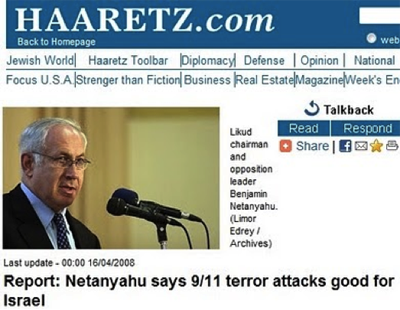
- Questionned
on September 11 about the event of the day by James Bennet for the New
York Times, Netanyahu let go: “It’s very good […] it will generate
immediate sympathy. […], strengthen the bond between our two peoples”.
He confirmed it 8 years later, at Bar-Ilan University: “We are
benefiting from one thing, and that is the attack on the Twin Towers and
Pentagon, and the American struggle in Iraq”, adding that these events
“swung American public opinion in our favor”. (Ma’ariv, April 17, 2008).
One of the goals is to encourage Americans to view the oppression of
the Palestinians as part of the fight against Islamic terrorism. As
Robert Jensen said in the documentary
Peace, Propaganda and the Promised Land by Sut Jhally et Bathsheba Ratzkoff (2004): “
Since
the Sept 11th attack on the US, Israel’s PR strategy has been to frame
all Palestinian action, violent or not, as terrorism. To the extent that
they can do that, they’ve repackaged an illegal military occupation as
part of America’s war on terror”. On December 4th, 2004,
Prime Minister Ariel Sharon justified his brutality against the people
of Gaza by claiming that Al-Qaeda had established a base there; but then
on December 6th, the head of Palestinian Security Rashid Abu Shbak
revealed in a press conference telephone banking traces proving that the
secret services of Israel had themselves tried to create fake Al-Qaeda
cells in the Gaza Strip, hoping to recruit Palestinians under the name
of bin Laden. The recruits had received money and (defective) weapons
and, after five months of indoctrination, were instructed to claim a
future attack in Israel on behalf of “the Al-Qaeda group of Gaza”.
Israeli services had intended, it seems, to mount an attack (whether
real or false) against their own people and do so under the name of
Al-Qaeda, in order to justify retaliation against Palestine.

- Three of the Palestinians charged with conspiring with Israel to form Al-Qaeda cells in the Gaza strip.
In April 2003, a report titled
Israeli Communications Priorities 2003, commissioned to the communications agency
Luntz Research Companies & The Israel Project, by the
Wexler Foundation, a Zionist organization specializing in cultural exchanges, offers linguistic recommendations to “
to integrate and leverage history and communications for the benefit of Israel” with the American public. The document recommends, for example, to speak frequently of “Saddam Hussein” which are “
the two words that tie Israel to America”, and
“two of the most hated words in the English language right now”. “
For
a year — a SOLID YEAR — you should be invoking the name of Saddam
Hussein and how Israel was always behind American effort to rid the
world of this ruthless dictator and liberate their people”. The
report also repeatedly suggests that a parallel between Saddam Hussein
and Yasser Arafat need be established. By an ultimate sophistication,
Michael Ledeen disputes in his book
The War Against the Terror Masters
(2003) the common idea that peace in Palestine is the condition for
peace in the Middle East; the opposite, he claims, is true: “
If we
destroy the terror masters in Baghdad, Damascus, Tehran, and Riyadh, we
might have a chance of brokering a durable peace [in Palestine]”.
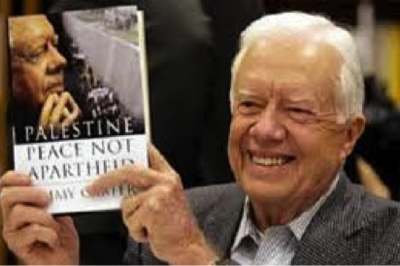
- Double
speech is a characteristic of Israel leadership, according to former
President Carter’s bitter experience, as he recalls in Palestine: Peace
not Apartheid (2006): “The overriding problem is that, for more than a
quarter century, the actions of some Israeli leaders have been in direct
conflict with the official policies of the United States, the
international community, and their own negociated agreements”.
The road to World War IV
Iraq was first on the list. Since the first Gulf war, neocons have
been demonizing Saddam Hussein’s regime. David Wurmser, for example,
published in 1999, after other islamophobic books,
Tyranny’s Ally: America’s Failure to Defeat Saddam Hussein. In 2000, the
American Enterprise Institute published
Study of Revenge: Saddam Hussein’s Unfinished War Against America,
whose author, Laurie Mylroie, expresses her debt to Scooter Libby,
David Wurmser, John Bolton, Michael Ledeen, and above all Paul Wolfowitz
and his wife Clare Wolfowitz, also member of AEI
. Mylroie goes
as far as accusing Saddam Hussein of being the mastermind of
anti-American terrorism, blaming him (without proofs) for the 1993
bombing of the WTC, for the 1995 Oklahoma City bombing, and for the
attack against the
USS Cole in Yemen in 2000. What threatens the United States, according to her, is
“an undercover war of terrorism, waged by Saddam Hussein“, itself
“a phase in a conflict that began in August 1990, when Iraq invaded Kuwait, and that has not ended”.
Richard Perle described this book as
“splendid and wholly convincing”.
Neoconservatives lost no time in exploiting against Iraq the trauma
of 9/11 after creating it. As soon as September 19th , Richard Perle
invited to join in a
Defense Policy Board meeting neocons Paul
Wolfowitz and Bernard Lewis (inventor before Huntington of the
self-fulfilling prophecy of the “Clash of Civilizations”), but neither
Colin Powell nor Condoleezza Rice. The assembly agreed to overthrow
Saddam Hussein as soon as the initial phase of the Afghanistan war is
over. In a letter to President Bush written under the letterhead of
PNAC, they reminded President Bush of his historical mission: “
even
if evidence does not link Iraq directly to the attack, any strategy
aiming at the eradication of terrorism and its sponsors must include a
determined effort to remove Saddam Hussein from power in Iraq. Failure
to undertake such an effort will constitute an early and perhaps
decisive surrender in the war on international terrorism”.
The argument of a linked between Saddam and Al-Qaïda is here toned
down and, in the summer 2002, Bush and British Prime Minister Tony Blair will simply evoke
“broad linkages”.
Perle, however, kept claiming, against all evidence, that supposed 9/11
terrorist Mohamed Atta had met with Iraqi diplomat Ahmed Khalil Ibrahim
Samir in Prague in 1999. On Seeptember 8th, 2002 in Milan, Perle even
made up a scoop for the Intalian newspaper
Il Sole :
“Mohammed Atta met Saddam Hussein in Baghdad prior to September 11. We have proof of that”.
Rumors of a link between Saddam and Al Qaeda was finally traded for a more elaborate
casus belli:
Saddam’s Weapons of Mass Destruction. To force this new lie onto the
American State Department and public opinion, Cheney et Rumsfeld renewed
their winning strategy of
Team B, consisting in overaking the
CIA through a parallel team of pseudo-experts, to produice the
terrifying report they needed: this will be the
Office of Special Plans (OSP), established within the
Near Est and South Asia
(NESA) of the Pentagon, under the control of neocons William Luti,
Abram Shulsky, Douglas Feith, and Paul Wolfowitz. Lieutenant Colonel
Karen Kwiatkowski, who worked for NESA at that time, testified in 2004
of the incompetence of OSP members, whom she saw
“usurp measured and
carefully considered assessments, and through suppression and distortion
of intelligence analysis promulgate what were in fact falsehoods to
both Congress and the executive office of the président. [...] This was
creatively produced propaganda”.
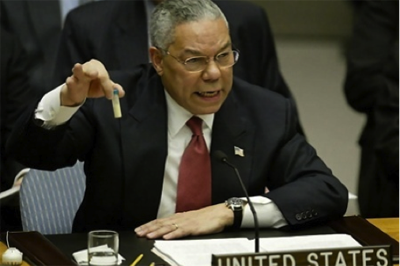
- On
February 5th, 2003, Secreatry of State Colin Powell engages his
reputation in convincing the General Assembly of the United Nations that
Saddam Hussein’s WMD poses a threat to the world. He will later regret
his speech, calling it “a blot on my record”, and claiming to have been
deceived himself.
Just as some neoconservatives see the failure of U.S. forces in Iraq
as a pretext to threaten Iran, others find the failure to recover
Saddam’s “weapons of mass destruction” a pretext to accuse Syria. In
2003, they passed on the ridiculous allegations of Ariel Sharon, who
said that Iraq had secretly transferred their WMDs to Syria, along with
their nuclear scientists. On November 11th, 2003, Congress passed the
Syria Accountability and Lebanese Sovereignty Restoration Act, imposing economic sanctions intended “
to halt Syrian support for terrorism, end its occupation of Lebanon, [and] stop its development of weapons of mass destruction”.
The aggression against Syria didn’t begin until 2012, under the guise
of a civil war, but it had been premeditated since at least February
2000, when David Wurmser, in an article for the
American Enterprise Institute entitled “
Let’s Defeat Syria, Not Appease It” was calling for a conflict through which “
Syria will slowly bleed to death”.
Since September 2001, Iran has also been placed in the crosshairs of
the neoconservatives. They seem to echo the sentiments of Israeli Prime
Minister Ariel Sharon, who, in the London
Times on November 2nd, 2002 called Iran the “
center of world terror” and called for threats against Iran “
the day after the U.S. invades Iraq”.
The failure of U.S. troops to silence the resistance in Iraq forced the
postponement of the attack on Iran. But Daniel Pipes took the bad news
in good spirits, cheerfully stating in the
New York Sun (February 28th, 2006) that the Iraqi civil war will invite
“Syrian and Iranian participation, hastening the possibility of an American confrontation with those two states”. In spring 2008, President Bush publicly took up this new neoconservative chorus:
“The
regime of Teheran has a choice to make. […] If Iran makes the wrong
choice, America will act to protect our interests and our troops and our
Iraqi partners”. We should remember that in May 2003, through the
Swiss ambassador in Tehran, the Iranian government sent to Washington a
proposal known as the “Grand Bargain”, which, in exchange for the
lifting of economic sanctions against Iran, promised cooperation with
the United States to stabilize Iraq and to establish there a secular
democracy, and was prepared to further concessions, including peace with
Israel. Bush and Cheney, however, prevented Powell from responding
positively to the gesture. And therefore, summarized his
Chief of Staff Lawrence Wilkerson: “
the secret cabal got what it wanted: no negotiations with Tehran”.
In parallel to this kind of diplomatic obstinacy, false pretenses of
war have been regularly created. We know from Gwenyth Todd, advisor on
the Middle East linked to the
U.S. Navy Fifth Fleet stationed in
the Persian Gulf, that after being barely appointed commander of the
fleet in 2007, Vice Admiral Kevin Cosgriff ordered his aircraft carriers
and other ships into aggressive maneuvers in order to strike panic into
the Iranians, hoping for a shot fired that would allow them to engage
in war for which the pro-Israel lobby was eagerly waiting. Cosgriff
wanted to “
put a virtual armada, unannounced, on Iran’s doorstep”, without even informing Washington, according to the
Washington Post, August 21st, 2012. On January 6th, 2008, the Pentagon announced that Iranian boats fired on American ships
USS Hooper and
USS Port Royal on patrol in the Strait of Hormuz, while broadcasting threatening messages such as: “
I am coming to you”, and “
you will explode after two minutes”.
The television showed one of the Iranian boats dumping small white
objects into the water, presenting the situation as one of hostility, as
though the white objects were mines. Referring to this exceptionally “
provocative and dramatic” incident, the Chairman of the
Joint Chiefs of Staff Mike Mullen expressed concern about “
the threat posed by Iran”, including “
the threat of mining those straits”, and affirmed his willingness to use “
deadly force”
if necessary. In reality, the situation presented by the media and
Mullen was completely untrue. The Iranian boats that patrolled the area
and often passed American ships on a daily basis, had issued no threat
whatsoever. Vice Admiral Cosgriff admitted that American crews had, in
fact, noted that there was nothing to worry about, since the Iranian
boats carried “
neither anti-ship missiles nor torpedoes”. Nor did the threatening radio messages come from these vessels: “
We don’t know for sure where they came from”, admitted the spokesman for the
Fifth Fleet Lydia Robertson.

- Gwenyth
Todd, who opposed and denounced the provocative strategy of newly
appointed commander of the U.S. Navy Fifth Fleet, fled the United States
out of fear for her life and now lives in Autralia.
The 2009 Iranian elections and the ensuing protests in Tehran
presented an occasion for a new tactic of psychological warfare, this
time using Internet-based social networks and relayed by the American
media. Within a few days, the death of a young woman that took place
during the protests was appropriated as a horrifying symbol of the kind
of oppression taking place in the Islamic regime. Neda Agha-Soltan was
killed June 20th, 2009 by a sniper from the paramilitary, while exiting
her car with her music teacher. A video of her agony and death, filmed
live by mobile phone, was transmitted instantly around the world on
Facebook and YouTube. Several rallies were held around the world in her
honor. There was talk of her being awarded the Nobel Peace Prize. Her
fiancé, a photographer named Caspian Makan, meets Shimon Peres in Israel
and says: “
I come to Israel as an ambassador of the Iranian people, a messenger of peace”, adding, “
I have no doubt that the spirit and soul of Neda was with us during the presidential meeting”.
Unfortunately, there emerge blatant inconsistencies: 1. There are
actually three videos of Neda’s agaonizing death, which resemble several
“takes” of the same scene. 2. A BBC interview with the doctor who
attended her death is full of contradictions. 3. The autopsy concluded
that Neda was killed at point blank range. 4. Finally, the face that
became a global icon is actually that of another young girl, Neda
Soltani. Many surmised that Neda Agha-Soltan, a apprentice actress,
agreed to act her own death in exchange for a promising career abroad,
but was shot for real immediately after.
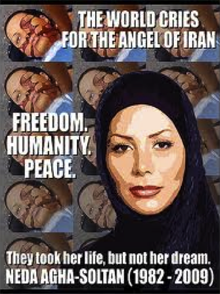
- The
stolen face of Neda Soltani, who tried in vain to suppress her picture
from the web. Fearing for her life, she emigrated to Germany, where she
published her story in My Stolen Face.
Finally, Iran is indicted, since the beginning of the first Bush
presidency, for its civilian nuclear research program, claims being made
that it is only a front for secret military operations. The 2005
publication of a first
National Intelligence Estimate
(NIE) report was the subject of intense media attention regarding Iran
and its supposed interests; though its revision in 2007 should have
calmed what were alarming implications from the 2005 version, it was
largely ignored, as was the fact that religious leaders of Iran, begun
by Ayatollah Khomeini, had issued several fatwa banning nuclear weapons
and other weapons of mass destruction. Meanwhile, nothing is mentioned
regarding the illegal Israeli program that operates still
unacknowledged, one that has allowed Israel to stockpile an estimated
200 atomic bombs to date.

- On
the 1st of February 2007, in front of the Senate Foreign Relations
Committee, Brzezinski denounced the Iraq war as la guerre d’Irak comme
“a historic, strategic, and moral calamity […] driven by Manichean
impulses and imperial hubris”. As a veteran of deep politics, he can see
what is coming next: “some provocation in Iraq or a terrorist act in
the U.S. blamed on Iran; culminating in a "defensive" U.S. military
action against Iran that plunges a lonely America into a spreading and
deepening quagmire eventually ranging across Iraq, Iran, Afghanistan,
and Pakistan”.
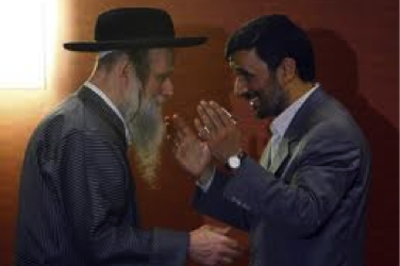
- Iran
counts the largest Jewish population in the Middle East after Israel.
Despite generous offers from Israel, most of these 30,000 Iranian Jews
refused to emigrate and remain loyal to their country. This does not fit
with the repeated accusation of the Iranian government as consumed by
anti-Semitism, and “preparing another Holocaust of the Jewish state”, as
written in Israeli newspaper Ha’aretz (November 14, 2006).
Among the countries targeted by the neocons after 9/11, we must not
forget to mention the two best allies of the U.S. in the Middle East,
which is proof that the neocons do not have U.S. interests at heart. The
plan to accuse and threaten Saudi Arabia was clearly built in the 9/11
false flag scenario, as is evidenced by the fact that Osama bin Laden
and 15 out his 19 highjakers were Saudis. David Wurmser first opened
fire in the
Weekly Standard with an article titled
“The Saudi Connection”, pretending that the Saudi royal family was behind the attack. The
Hudson Institute
had long been preparing the ground by violently denouncing all the sins
(reals and imaginary) of the Saudi dynasty, under the lead of its
co-founder Max Singer (today director of research at the
Institute for Zionist Strategies in Jerusalem). In June 2002, the Institut sponsored a seminar called
“Discourses on Democracy: Saudi Arabia, Friend or Foe?”, where all answered pointed to
foe as the right answer. A special event honored the publication of the book
Hatred’s Kingdom: How Saudi Arabia Supports the New Global Terrorism, by
the Israeli Dore Gold, once an advisor to Netanyahu and Sharon and an
ambassador to the United Nations. On July 10th, 2002, neocon Laurent
Murawiec, of the
Hudson Institute and
Committee on the Present Danger, was invited to speak before Richard Perle’s
Defense Policy Board to explain that Saudi Arabia represented
“the kernel of evil, the prime mover, the most dangerous opponent”, and to recommend that the U.S. army invade it, occupy it and dismember it. He summarized his
“Grand Strategy for the Middle East” by these words:
“Iraq is the tactical pivot. Saudi Arabia the strategic pivot. Egypt the prize”.
The neocons are, in fact, the original inspirators of the
soft
challenge to the 9/11 official story, which admits the responsibility
of Al Qaeda but points to links between the Bushes, the Saudies, and the
bin Ladens. In their 2003 book,
An End to Evil: How to Win the War on Terror, Richard Perle and and David Frum (Bush’s speech
-writer) write that
“The Saudis qualify for their own membership in the axis of evil”, and ask President Bush
to”tell the truth about Saudi Arabia”, meaning
that Saudi princes finance Al Qaeda. To understand the absurdity of
such a claim, let us recall that Osama, who called the Saudi princes
traitor to Islam for tolerating U.S. military bases since the Gulf war,
was stripped of his Saudi nationality in 1994 and banned from the bin
Laden clan. In a
Declaration of War Against the Americans Occupying the Land of the Two Holy Places, published
in 1996, bin Laden called for the overthrow of the Saudi dynasty and,
in 1998, he admitted his role in the 1995 bombing of the National Guard
headquarter in Riyad. Osama is the sworn enemy of the Saudis. It is
unthinkable that the Saudis would have conspired with Osama bin Laden.
On the contrary, it is plausible that the Saudis would have conspired
with the Bushes
against Osama bin Laden, to blame him for a
terror attack in order to hunt him in Afghanistan — and, in the process,
destroy the Taliban regime who had become an obstacle to the UNOCAL
pipeline project: a win-win project fot the Bushes and their Saudi
friends. However, the Bushes (no friends to Israel) have been outsmarted
by the neocons, whose goals have little to do with oil and nothing to
do with stability in Saudi Arabia. Here is probably the real purpose of
having George W. Bush elected President, and the true meaning of neocon
Michael Ledeen’s famous remark:
“He became president, but he didn’t know why, and on sept 11, he discovered why”.
Bin Laden is a multi-use
patsy. Blaming him for 9/11 made it
possible to threaten and blackmail Saudi Arabia, but also Pakistan,
another U.S. ally. For if the Talibans are behind bin Laden, Pakistan is
behind the Talibans. No official accusation was made against Pakistan,
but General Ahmed Mahmud, director of ISI (Pakistan’s CIA) was
implicated by an information leaked from India (an ally to Israel,
against their common enemy Pakistan), by the
The Times of India on October 9th, 2001:
“US authorities sought his removal after confirming the fact that
$100,000 were wired to WTC hijacker Mohamed Atta from Pakistan by [ISI
agent] Ahmed Omar Saïd Sheikh at the instance of General Mahmud”.
Since
Mohamed Atta is nothing but a patsy in this whole affair, the
information can only be interpreted as a way to blackmail the ISI and
Pakistan into supporting the official 9/11 story and collaborating with
the U.S. to destroy the Talibans. If the ISI
did pay Atta for
some reason, then Atta’s name was picked as ringleader of the terrorists
precisely for that reason, as a lever against Pakistan. Mahmud, who had
travelled often to Washington since 1999, was there precisely between
September 4 and 11, 2001. He allegedly met George Tenet, Director of the
CIA, Marc Grossman, Under-Secretary of State for Political Affairs, and
perhaps Condoleezza Rice (who denies). At the moment of the attacks, he
was at a breakfast
meeting
including Bob Graham, Chairman of the
Senate Intelligence Committee, and Porter Goss, Chairman of the
House Intelligence Committee;
“We were talking about terrorism, specifically terrorism generated from Afghanistan”, said Graham, who with Goss will be appointed to the 9/11 Commission.

- General
Ahmed Mahmud. We don’t know what ultimatum he was given on September
11, but he resigned the next month and disappeared from public life to
join the religious movement Tablighi Jamaat.
The fake assassination of bin Laden (or assassination of fake bin
Laden) in May 2011 in Pakistan in is another proof that the 9/11 master
plotters intended to keep maximum pressure on Pakistan. It allowed to
accuse Pakistan, after Afghanistan, of having welcomed and protected bin
Laden for 10 years, which constitutes in the eyes of Americans real
treason and a cause for war. Several books are written in this vein,
such as
Deadly Embrace: Pakistan, America, and the Future of Global Jihad by ex-CIA Bruce Riedel
. According to Riedel, bin Laden’s quiet life in a suburb of Abbohabad suggest
“an astonishing degree of duplicity” on the part of Pakistan, who might well be
“the
secret patron of global jihad on a scale almost too dangerous to
conceive. We would need to rethink our entire relationship with Pakistan
and our understanding of its strategic motives”.
All these wars and threats of wars under false pretexts in
the wake of 9/11 betray a desire to inflame conflicts in the Middle
East rather than to control resources, let alone encourage stability.
Michael Ledeen himself declares in his article “
The War on Terror will not end in Baghdad” in the
Wall Street Journal, on September 4th, 2002: “
We
do not want stability in Iran, Iraq, Syria, Lebanon, and even Saudi
Arabia: we want things to change. The real issue is not whether, but how
to destabilize”.
What could be the motivation for these incessant accusations and
two-faced policies? It’s not simply a mindless killing spree, and is
rather a project designed by a group of exceptionally intelligent men,
under a particular rationality with precise and realistic goals — but to
what purpose? Osama bin Laden replied to this question in an article
published by the London Arabic newspaper
Al-Quds al-Arabi on February 23rd, 1998 (partially translated by Bernard Lewis in
Foreign Affairs, November-December 1998). Referring to “
the Crusader-Jewish alliance”, bin Laden speaks of “
their
attempts to dismember all the states of the region, such as Iraq and
Saudi Arabia and Egypt and Sudan, into petty states, whose division and
weakness would ensure the survival of Israel”. Indeed, it appears
that a Zionist cabal is interested in a new kind of world war, one that
would weaken and fragment all the enemies of Israel for decades to come,
putting it in a position to surpass even the United States, who would
be ruined by their ruthless military spending (just like the USSR in the
80s) and hated across the globe. Little, it would seem, stands in the
way of the final phase of the Zionist plan: a thorough ethnic cleansing
and the annexation of the whole of Palestine. Not without some irony,
the neoconservative Stephen Schwartz, author of
The Two Faces of Islam: The House of Saud, from Tradition to Terror (2003), attributed to Saudi Arabia a plan that would spread terror throughout the world (while recognizing Saudi Arabia
“incapable of defending its own territory”) and blamed Islam for the emergence of a World War whose bloody unfolding will mean: “
The
war against terrorist Wahhabism is therefore a war to the death, as the
second world war was a war to the death against fascism”.
In an article in the
Wall Street Journal dated November 20th, 2001, the neoconservative Eliot Cohen speaks about the war against terrorism as “
World War IV”,
a framing soon echoed by other neoconservatives. In September 2004, at a
conference in Washington attended by neoconservatives Norman Podhoretz
and Paul Wolfowitz entitled “
World War IV: Why We Fight, Whom We Fight, How We Fight”, Cohen said: “
The enemy in this war is not ‘terrorism’ […] but militant Islam”.
Like the Cold War (considered to be a third world war), this Fourth
World War, as seen prophetically by Cohen, has ideological roots, will
have global implications and will last a long time, involving a whole
range of conflicts. The rhetorical device of this “fourth” global
conflict has also been popularized by Norman Podhoretz, in “
How to Win World War IV” published in
Commentary in February 2002, followed by a second article in September 2004, “
World War IV: How It Started , What It Means, and Why We Have to Win”, and finally in 2007 in a book called “
World War IV: The Long Struggle Against Islamofascism”.
The Bible and the Empire
Clearly, the strategists of Likud and their neoconservative allies
intend to forge their legacy as those who waged and won the global
annihilation of the Islamic civilization. How does one account for such
hubris? One explanation lies in the very nature of the State of Israel
and the leadership role held by its military since day one, not unlike
the American
National Security State. David Ben Gurion, who
combined the functions of Prime Minister and Defense Minister, saw the
whole fate of Israel integrally intertwined with its failure or success
in the defeat of an Arab enemy: “
Why should the Arabs make peace? If I
were an Arab leader I would never make terms with Israel. That is
natural: […] we have come here and stolen their country. Why should they
accept that? They may perhaps forget in one or two generations’ time,
but for the moment there is no chance. So, it’s simple: we have to stay
strong and maintain a powerful army. Our whole policy is there.
Otherwise the Arabs will wipe us out” (Nahum Goldmann,
The Jewish Paradox: A Personal Memoir, 1978). Thus, circumstances decree that Israel is and will be a security state.
It is, of course, also a colonizing state. Even when Levi Eshkol
replaced Ben Gurion in 1963 as Prime Minister, his government could not
oppose the military’s will of annexing new territories, as revealed
Ariel Sharon to journalist Ze’ev Schiff shortly after the Six Days War: “
We
could have locked the ministers in the room and gone off with the key.
We would have taken the appropriate decisions and no one would have
known that the events taking place were the result of decisions by major
generals” (
Ha’aretz, June 1st, 2007).
Sharon is the man who, in the eyes of Israel and the world, most
aptly embodies the spirit of the Israeli military and its security
apparatus. He commanded Unit 101, which, on October 14th, 1953 razed the
village of Qibya, Jordan, with dynamite, killing 69 civilians in their
homes. In 1956, during the Suez Canal crisis, a unit under his command
executed more than 200 Egyptian prisoners and Sudanese civilians. In
1971, charged with putting an end to ongoing resistance in the Gaza
Strip, his troops killed more than 100 Palestinian civilians. And in
September 1982, acting as the Minister of Defense, he launched the
invasion of Lebanon, where, after his slaughter of refugees in two
Palestinian camps in West Beirut he was given the nickname, “the butcher
of Sabra and Chatila”. The Prime Minister at that time was Menachem
Begin, once the leader of the Irgun terrorist militia, who coordinated
both the attack on the King David Hotel in 1946, and the Deir Yassin
massacre in 1948.
Begin, Sharon and Netanyahu’s Likud has never stopped campaigning for
a Greater Israel and against a proposed Palestinian state. While
Foreign Minister to Netanyahu from 1996 to 1999, Sharon described the
Oslo Accords as “national suicide” and rather advocated the “biblical
borders”, thereby encouraging illegal settlements: “
Everybody has to
move, run and grab as many hilltops as they can to enlarge the
settlements because everything we take now will stay ours” he said
on November 15th, 1998. When he came to power in February 2001, with
Netanyahu in turn becoming Foreign Minister, Sharon deliberately
sabotaged the peace process and set off the second intifada through a
series of calculated provocations. When on March 28th, 2001, 22 nations
gathered in Beirut under the auspices of the Arab League and agreed to
recognize Israel if it only complied with Resolution 242, the next day,
the Israeli army invaded and besieged Yasser Arafat in his headquarters
in Ramallah. Six months later, September 11th brought the fatal blow to
any hope of peace.
The Likud and its political allies among religious extremists are not
merely opposed to the secession of Palestine; they are driven by an
almost imperial vision of Israel’s destiny. In December 1981, Ariel
Sharon expressed in a speech for the
Institute for Strategic Affairs at Tel Aviv University: “
Beyond
the Arab countries in the Middle East and on the shores of the
Mediterranean and the Red Sea, we must expand the field of Israel’s
strategic and security concerns in the eighties to include countries
like Turkey Iran, Pakistan, and areas like the Persian Gulf and Africa,
and in particular the countries of North and Central Africa” (as translated from Hebrew in the
Journal of Palestine Studies).
This speech will be canceled at the last minute because of the
controversy over the annexation of the Syrian territories at Golan
Heights, but it will be published shortly after the in daily
Ma’ariv. This “Sharon doctrine” is found in a number of Hebrew texts, translated and published by the dissident Israel Shahak in
Open Secrets: Israeli Nuclear and Foreign Policies (1997). In an essay entitled “
A Strategy for Israel in the Eighties” written for the
World Zionist Organization
in February 1982, Oded Yinon, a former senior official in the Ministry
of Foreign Affairs, put forward a strategy to exert control over the
Middle East through the fragmentation of Israel’s neighbors, beginning
with Lebanon: “
The total disintegration of Lebanon into five regional
localized governments is the precedent for the entire Arab world
including Egypt, Syria, Iraq, and the Arab peninsula, in a similar
fashion. The dissolution of Egypt and later Iraq into districts of
ethnic and religious minorities following the example of Lebanon is the
main long-range objective of Israel on the Eastern Front. The present
military weakening of these states is the short-term objective. Syria
will disintegrate into several states along the lines of its ethnic and
sectarian structure, as is happening in Lebanon today.”
The ideology behind Likud’s strategy and its neoconservative allies
is an intransigent version of Zionism. Zionism, as its name suggests
(Zion is the name given to Jerusalem 152 times in the Hebrew Bible), is
before anything else a biblical dream, shaped by the biblically defined
borders of
Eretz Israel. “The Bible is our mandate”, proclaimed
Chaim Weisman, the future first President of Israel, at the Versailles
Conference in 1919. In Germany in the late 19th century, the biblical
notion of a “chosen people” was translated by the founding fathers of
Zionism into a racial ideology, correlative and in competition with the
fantastical dream of a superior pan-Germanic Aryan race. Zionism, like
Nazism, opposed the assimilationist trend of the majority of German
Jews. Zeev Jabotinsky wrote in 1923, two years before Hitler’s
Mein Kampf:
“A
Jew raised in the midst of Germans can certainly adopt German customs
and speak the German language. He can become totally immersed in this
German milieu, but he will always be a Jew, because his blood, his body
and his racial type, his entire organic system, is Jewish”. We now
know that these kinds of claims are categorically unscientific: Israeli
settlers from Eastern Europe can not claim any biological descent from
among the ancient Hebrews in Judea or Samaria, unlike the Palestinians
they’ve evicted from their ancestral lands, and perhaps the Sephardic
Jews from North Africa, once called
“human garbage” by the Prime Minister Levi Eshkol and submitted to eugenic policies in the 1950s (Haim Malka,
Selection and Discrimination in the Aliya and Absorption of Moroccan and North African Jewry, 1948-1956, 1998).
The Zionism of Zev Jabotinsky is as important a key as the
Machiavellianism of Leo Strauss in decrypting the mentality of the men
who, in Israel and in the United States, are trying to reshape the
Middle East. It is, at least, a key to understand the ultimate goals of
Benjamin Netanyahu, whose father, Ben Zion Netanyahu (born Mileikowsky
in Warsaw), was the personal secretary of Jabotinsky. March 31st, 2009,
Netanyahu appointed Foreign Minister Avigdor Lieberman, from the
Yisrael Beiteinu party that presents itself as “
a national movement with the clear vision to follow in the brave path of Zev Jabotinsky”. Lieberman is intent upon,
“fighting Hamas just as the United States fought the Japanese during the Second World War”.
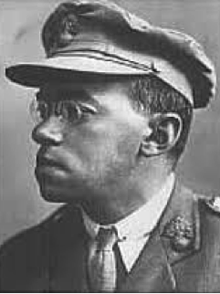
- Zev
Jabotinsky writes in The Iron Wall: We and the Arabs: “All
colonization, even the most restricted, must continue in defiance of the
will of the native population. Therefore, it can continue and develop
only under the shield of force which comprises an Iron Wall which the
local population can never break through. This is our Arab policy. To
formulate it any other way would be hypocrisy. […] Zionism is a
colonizing adventure and therefore it stands or it falls by the question
of armed force”.
Zionism has outlived Nazism because, after the war, it was able to
shamelessly capitalize on the terrible persecution of Jews in Europe and
usurp the representation of the Jewish community. To do that, it had to
force the forgetting of its active involvement with the Nazi regime in
the 30s, which then saw the immigration of Jews to Palestine the
“solution to the Jewish problem” (see Lenni Brenner’s
51 Documents: Zionist Collaboration with the Nazis,
2009). The pervasive legitimacy of Zionism has also relied heavily upon
its biblical roots. Despite being agnostic, David Ben Gurion (born
Grün), was indoctrinated by the biblical story, to the point of adopting
the name of a Judean general who fought the Romans; “
There can be no worthwhile political or military education about Israel without profound knowledge of the Bible”, he is quoted stating (Dan Kurzman,
Ben-Gurion, Prophet of fire, 1984). While envisioning an attack against Egypt in 1948, he wrote in his diary: “
This will be our revenge for what they did to our ancestors in Biblical times” (Ilan Pappe,
The Ethnic Cleansing of Palestine,
2008). The planned ethnic cleansing by Ben Gurion in 1947-48, which
forced the fleeing of 750,000 Palestinians (more than half of the native
population), was deeply reminiscent of that which was ordained by
Yahweh against the Canaanites: “dispossess them of their towns and
houses” (Deuteronomy 19:1), and, in the towns that resist, “not leave
alive anything that breathes” (Deuteronomy 20:16-17).
This dream instilled by the biblical God to His chosen people is not
only racist, it is also militarist and imperialist. These verses from
the second chapter of Isaiah (reproduced in Micah 4:1-3) are often held
up to show the pacifist trend of the biblical prophecy: "they shall beat
their swords into plowshares, their spears into pruning hooks. Nation
will not take up sword against nation, nor will they train for war
anymore” (Isaiah 2:4); but in taken in context, we see that this
Pax Judaica will
come only when “all the nations shall flow” to the Jerusalem temple,
from where “shall go forth the law” (Isaiah 2:1-3). This vision of a new
world order with Jerusalem at its center resonates within the Likudnik
and neoconservative circles. At the Jerusalem Summit, held from October
12th to 14th, 2003 in the symbolically significant King David Hotel, an
alliance was forged between Zionist Jews and Evangelical Christians
around a “theopolitical” project, one that would consider Israel,
according to the “Jerusalem Declaration” published on the official
website of the Summit, “
the key to the harmony of civilizations”, replacing the United Nations that’s become a “
a tribalized confederation hijacked by Third World dictatorships”: “
Jerusalem’s
spiritual and historical importance endows it with a special authority
to become a center of world’s unity. [...] We believe that one of the
objectives of Israel’s divinely-inspired rebirth is to make it the
center of the new unity of the nations, which will lead to an era of
peace and prosperity, foretold by the Prophets”. Three acting
Israeli ministers spoke at the summit, including Benjamin Netanyahu, and
Richard Perle, the guest of honor, received on this occasion the Henry
Scoop Jackson Prize.
Jerusalem’s dream empire is expected to come through the nightmare of
world war. The prophet Zechariah, often cited on Zionist forums,
predicted that the Lord will fight “all nations” allied against Israel.
In a single day, the whole earth will become a desert, with the
exception of Jerusalem, who “shall remain aloft upon its site” (14:10).
Zechariah seems envision what God could do with nuclear weapons: “And
this shall be the plague with which the Lord will smite all the peoples
that waged war against Jerusalem: their flesh shall rot while they are
still on their feet, their eyes shall rot in their sockets, and their
tongues shall rot in their mouths” (14:12). It is only after the carnage
that will world finally find peace, providing their worship of “the
Lord Almighty”: “Then every one that survives of all the nations that
have come against Jerusalem shall go up year after year to worship the
King, the Lord of hosts, and to keep the feast of booths. And if any of
the families of the earth do not go up to Jerusalem to worship the King,
the Lord of hosts, there will be no rain upon them...” (14:16-17)

- Evangelical
Christians, who welcome the End of the World as good news, find in the
Book of Revelation plenty to feed their fantasy, especially with the
Angel Faithful and True of chapter 19, coming with “the armies of
heaven”, with eyes “like a flame of fire”, “a robe dipped in blood”, and
in his mouth “ a sharp sword with which to smite the nations”.
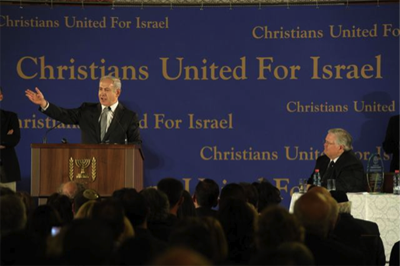
- With
more than 50 millions members, Christians United for Israel is a major
politica force in the U.S.. Its Chairman, pastor John Haggee, declared:
“The United States must join Israel in a pre-emptive military strike
against Iran to fulfill God’s plan for both Israel and the West, [...] a
biblically prophesied end-time confrontation with Iran, which will lead
to the Rapture, Tribulation, and Second Coming of Christ”.
Is it possible that this biblical dream, mixed with the
neo-Machiavellianism of Leo Strauss and the militarism of Likud, is what
is quietly animating an exceptionally determined and organized
ultra-Zionist clan? General Wesley Clark testified on numerous occasions
before the cameras, that one month after September 11th, 2001 a general
from the Pentagon showed him a memo from neoconservative strategists “
that
describes how we’re gonna take out seven countries in five years,
starting with Iraq, and then Syria, Lebanon, Libya, Somalia and Sudan
and finishing off with Iran”. Is it just a coincidence that the
“seven nations” doomed to be destroyed by Israel form part of the
biblical myths instilled in Israeli schoolchildren? According to
Deuteronomy, when Yahweh will deliver Israel “seven nations greater and
mightier than yourself […] you must utterly destroy them; you shall make
no covenant with them, and show no mercy to them. You shall not make
marriages with them…” (7:1-2). “And he will give their kings into your
hand, and you shall make their name perish from under heaven” (7:24).
General Wesley Clark
Attached documents


(e)SP_A0012_edited.jpg)