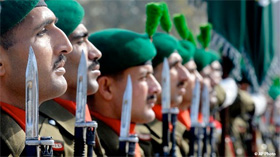
The Anarchic Republics of Pakistan and Afghanistan....
http://www.opinion-maker.org/2010/09/pakistans-descent-into-anarchy/
SEP , 2010
THERE IS perhaps no other political-military elite in the world whose aspirations for great-power regional status, whose desire to overextend and outmatch itself with meager resources, so outstrips reality as that of Pakistan. If it did not have such dire consequences for 170 million Pakistanis and nearly 2 billion people living in South Asia, this magical thinking would be amusing....
This is a country that sadly appears on every failing-state list and still wants to increase its arsenal from around 60 atomic weapons to well over 100 by buying two new nuclear reactors from China. This is a country isolated and friendless in its own region, facing unprecedented homegrown terrorism from extremists its army once trained, yet it pursues a “forward policy” in Afghanistan to ensure a pro-Pakistan government in Kabul as soon as the Americans leave.
For a state whose economy is on the skids and dependent on the IMF for massive bailouts, whose elite refuse to pay taxes, whose army drains an estimated 20 percent of the country’s annual budget, Pakistan continues to insist that peace with India is impossible for decades to come. For a country that was founded as a modern democracy for Muslims and non-Muslims alike and claims to be the bastion of moderate Islam, it has the worst discriminatory laws against minorities in the Muslim world and is being ripped apart through sectarian and extremist violence by radical groups who want to establish a new Islamic emirate in South Asia.
Pakistan’s military-intelligence establishment, or “deep state” as it is called, has lost over 2,300 soldiers battling these terrorists—the majority in the last 15 months after much U.S. cajoling to go after at least the Pakistani (if not the Afghan) Taliban. Despite these losses and considerable low morale in the armed forces, it still follows a pick-and-choose policy toward extremists, refusing to fight those who will confront India on its behalf as well as those Taliban who kill Western and Afghan soldiers in the war next-door. An army that has received nearly $12 billion in direct military aid from the United States since 2001, and has favored-nation status from NATO, still keeps the leaders of the Afghan Taliban in safe refuge. Pakistan’s civilians, politicians and intellectuals are helpless; they cannot make the deep state see sense as long as the West continues its duplicitous policies of propping up the military-intelligence establishment in opposition to popular society while demanding that the Pakistani civilian government wrest back control of the country.
Now there is a serious and deadly overlap—Pakistan’s extremists are determined to topple the political system and the deep state. The army is not oblivious to this reality, but it seems unwilling or unable to tackle the real issues at hand. “This is nothing but a creeping coup d’état by the forces of darkness, a coup that will spare no one,” wrote analyst Kamran Shafi in the Dawn newspaper this summer. “It is them against everyone else—an Islamic Emirate of Pakistan is the goal,” he added.
The deep state is failing its own people, who are in turn becoming more traumatized by the incessant violence, the lack of justice or security, and the perennial economic crisis. This only leads the civilian government to be even more inept, inconsequential and incapable of improving governance.
THE MOTHER of all insurgencies is taking place in the seven tribal agencies of Bajaur, Mohmand, Khyber, Orakzai, Kurram, and North and South Waziristan in the northwest-frontier region where the Pakistani Pashtun tribes—under the nomenclature of the Pakistani Taliban—are at war with the state. Amnesty International recently said that 4 million Pakistanis in this and adjoining regions are living under Taliban rule. Every time the army claims to have cleared one agency, the Taliban rebound in another with a vengeance.
Also operating from these northern bases are a dozen groups from Kashmir, Karachi and Punjab which were once trained by the military’s Inter-Services Intelligence (ISI) to fight in Indian Kashmir. They have now turned against their former handlers. The Pashtun Taliban have joined with their more sophisticated, better educated urban comrades to plan horrific acts of terrorism in Pakistani cities. Together they want to overthrow the state and establish an extremist Islamic system.
The Pakistani Taliban do not just kill police and soldiers in their barracks or even innocent civilians in mosques. On June 8 they launched a brazen attack on a convoy of trucks carrying NATO war materials for troops in Afghanistan in heavily populated northern Punjab—torching 50 vehicles. There is now talk of the Taliban shutting down Karachi port, where 80 percent of NATO supplies arrive. The public fear is that the army is losing control of the country as the extremists become ever stronger, ever more daring and ever more capable.
If local tribesmen even attempt collaboration with the state, deadly reprisals ensue. In the supposedly “Taliban-free” Mohmand Agency, people received U.S.-donated foodstuffs on July 8. The next day, while tribal elders gathered to discuss helping the army combat the Taliban, two suicide bombings killed over 100 people and wounded another 115.
Since 2004, the area has been hemorrhaging people. Out of a total population of 3.5 million, more than 1 million have fled the tribal agencies while another half a million left during the recent fighting only to become internally displaced refugees in nearby towns.
Amid the Pakistani Taliban, vicious Sunni sectarian groups prosper, galvanizing hatred of all minorities, Muslim and non-Muslim alike. The Ahmadi sect follows the teachings of a nineteenth-century religious reformer, promoting a peaceful variant of Islam. And yet in the 1970s, the Pakistani government declared the Ahmadis a non-Muslim minority and many Pakistanis today view them as heretics to Islam. On May 28 in Lahore, upwards of nine gunmen and suicide bombers blasted their way into two mosques and killed 90 Ahmadis, wounding another 110. The other minority groups, whether they be Shia, Christian, Hindu or Sikh, have lived in even greater fear since.
The Christian community, which makes up less than 2 percent of the population, is already a target. In July 2009, eight Christians were burned alive in the small Punjab town of Gojra, and in riots that followed an entire Christian neighborhood was scorched. The 17 militants arrested for these crimes were not brought to trial, and the police, facing local pressure, later let them go. A year later, riots erupted again in Faisalabad, Punjab, after two Christians were killed while being held in police custody. Since then, any Christians who can have been seeking political asylum abroad in droves.
An even-worse fate has befallen Shia Muslims. Prominent Shia technocrats—politicians, doctors, architects, bureaucrats and judges—have been singled out for assassination in all major cities, while in December 2009, 43 Shias were massacred by Sunni extremists in Karachi.
Thus the Pakistani Taliban have a two-pronged offensive: the first is to politically undermine the state and its organs through terror; the second is to commit sectarian violence against all those they believe are not true Muslims. This intolerance has developed deep roots in Pakistan over the past three decades, and it has now been boosted by the jihadist policies of al-CIAda and the Pakistani Taliban. The government’s inability to deal with sectarian threats has led to some Muslim groups arming themselves and taking the law into their own hands. This only leads to further loss of control by the state.
AS ISLAMIC extremist violence spreads, the very fabric of the country is falling apart. Mapping how widespread and varied the violence is gives but a hint of the disaster facing Pakistani society. Growing poverty, inflation and unemployment have led to an unprecedented increase in suicides—sometimes of entire families. One hundred ninety-one people killed themselves in the first six months of this year; at more than one death a day, it is one of the highest rates in the world. And when 113 of those happen in the country’s richest province (Punjab), it is obvious not a single Pakistani is surviving this unscathed—no matter how seemingly privileged. Violence against women is also on the rise; 8,500 violent incidents took place last year. One thousand four hundred of those were murders. Another 680 were suicides.
Freedom of information is quickly coming to a halt. Journalists receive regular threats if they do not report the statements of extremist groups, while extremist literature, newspapers and pamphlets continue to flood the market with no attempts by the state to stop them. And now leading electronics markets in major cities have been repeatedly bombed and shop owners warned to stop selling computers and TVs. Rather than combat the threat, the government has succumbed, closing down Facebook for three weeks starting in May and announcing that major web sites like Google and Yahoo will be censored for “anti-Islamic material.” This is shuttering a vibrant society and slowly turning a country that long strived for democratic openness into a closed state held hostage by radical Islam.
Meanwhile, the lack of services is creating its own anarchy. In Karachi, with a population of 18 million, violence is so endemic and its perpetrators so diverse that it is difficult to summarize. What we do know is that beyond Islamic extremism, the city is in the grip of heavily armed mafias and criminal gangs, who kill over control of water supplies, public transport, land deals and the drug trade. Car theft is rampant. The most lucrative business is kidnapping for ransom. The independent Human Rights Commission of Pakistan reports that there were 260 targeted killings in Karachi in the first six months of this year, compared to 156 last year. Eight hundred eighty-nine murders were reported in the same period. Because the city is the melting pot of the country, much of the violence is between ethnic groups who live in virtual ghettos and compete for the scarce resources of the city.
Ethnic violence is translated into interparty political assassinations. The Muhajir-dominated Muttahida Qaumi Movement (MQM) which rules Karachi is made up of Urdu-speaking migrants from India. They are in a bloody war with an MQM offshoot and in intense rivalry with the largest Pashtun secular political group (the Awami National Party) as well as with the majority Sindhi population. The Muhajirs blame the Pashtuns for introducing the Taliban to Karachi, and ethnic killings are multiplying; party workers of all groups are being targeted.
There is another civil war going on in Baluchistan Province between Baluch separatists and the army. A province long deprived of development, political freedom and revenue, this is the fifth insurgency by the Baluch tribes against the army since Pakistan’s founding. The ISI maintains that Indian agents based in Afghanistan and the Arabian Gulf states are arming and funding the Baluch. The insurgents launch ambushes and assassinations, and lay land mines every day. They have begun killing prominent non-Baluch who long ago settled in the province. School teachers, university professors and officials have proven the easiest targets—and this in a province that professes a literacy rate of only 37 percent (20 percent for women) compared to the national average of 54 percent. This summer Interior Minister Rehman Malik said that four separatist Baluch “armies” funded by India had forced 100,000 people to migrate from the province. Baluch militants killed 252 non-Baluch settlers from January to June of this year, also assassinating 13 army officers. The army in turn has brutalized Baluch society and several thousand young Baluch are said to be missing, presumed in prison and being tortured. The army’s insistence that the entire Baluch problem is caused by India and that the Baluch have no grievances of their own simply leads to further escalation of violence and further alienation of the population. The province erupted in days of riots and strikes after prominent Baluch nationalist leader Habib Jalib was gunned down in Quetta in mid-July.
The local justice system in Pakistan is in dire straits. Policemen, judges and lawyers are frequently intimidated by terrorist groups. Evidence is rarely collected against the arrested perpetrators of attacks, and either the police or judges release the suspects. If not, the terrorists are quite capable of freeing their own by force from jails, courthouses and hospitals. After the Ahmadi killings, terrorists attacked a hospital where one of their arrested comrades was being treated under heavy police guard. In June, terrorists attacked a Karachi courthouse, freeing four members of their group undergoing trial for the earlier massacre of 43 Shias in the city.
It is now a cliché to describe how a worsening economy and the lack of education and job opportunities have helped spawn Islamic extremism in Pakistan and elsewhere. Yet it is a trope worth repeating.
PAKISTAN’S GEOPOLITICAL assertiveness in the midst of all this chaos is a result of the military’s overwhelming power. It may be losing its hold on vast amounts of territory to the extremists, but it is taking control of Pakistan’s national security and foreign policy away from the government. As the country is now led by weak and widely considered to be incompetent and corrupt civilian rule with President Asif Ali Zardari, the husband of slain leader Benazir Bhutto, at the helm, the armed forces have found it relatively easy to carry out their own programs.
Following its election, the ruling Pakistan Peoples Party (PPP) sought to reform the policies of the Musharraf era. This included improving relations with India, Iran and Afghanistan and ending Pakistan’s regional isolation. They failed.
Zardari’s overtures regarding India were rebuffed, not only by New Delhi, but also by the Pakistan army—such civilian initiatives are considered an encroachment on military territory. And the November 2008 massacre in Mumbai by Pakistani extremists paralyzed engagement with India for nearly two years. India accuses the ISI of having a direct role in the massacre, which Pakistan denies. Yet Lashkar-e-Taiba, the militant group behind the massacre, has not been curbed.
The situation in Afghanistan isn’t much better. Although Zardari improved personal relations with President Hamid Karzai, it had little impact on the army’s posture—an anti-Karzai, anti-ruling-government strategy. Only recently has the army decided that with a U.S. troop withdrawal starting next year, Karzai and the Afghan Taliban need to be brought together. The Afghan Taliban leadership has had sanctuary and support from the military since its retreat into Pakistan in 2001. Though former-President George W. Bush never attempted to tackle this conundrum, President Barack Obama has privately acknowledged what must be done, trying hard to bring Kabul and Islamabad together. Certainly, any recent success can’t be chalked up to the civilian leadership in Pakistan. The army says it wants to see a stable and peaceful Afghanistan after the U.S. withdrawal, and to that end it is trying to promote talks between Karzai and the various factions of the Taliban. However, many Afghans remain suspicious of an army that wants an Afghanistan free of Indian influence.
Zardari and the PPP no longer make any moves that oppose the army’s foreign-policy aims. And over the past two years, a strident judiciary, at times backed by the military, has whittled away at the president’s power, trying repeatedly to undermine Zardari or force him to resign by resurrecting old corruption charges against him and by asserting its influence over the constitution—which is in fact Parliament’s prerogative. This judicial collision with parts of the government has further stymied the country’s reputation and put off aid donors and investors. It is destroying Pakistan’s democratic character. Making matters worse, the all-powerful General Ashfaq Parvez Kayani has just received a three-year extension to his term as army chief. It was a move that stunned the country. Many Pakistanis concluded that this further reduced the power of civilian authority.
Political instability is precisely what Pakistan does not need. The country requires a sustained period of democracy under civilian governance—even if it is a bad, poorly functioning democracy. If Zardari is unpopular or ineffective, then he should be removed in the next election, not through a judicial or military coup.
FOR DECADES, a cyclical pattern of military rule followed by its collapse and replacement by elected but weak civilian governments has occurred. In time, they too fall—often with a prod from the ISI—and the military returns. Repeated military rule has resulted in the decline of political parties, the exile or execution of civilian leaders, their lack of experience or knowledge when they do come to power, and the unwillingness of young professionals to get involved in politics. The political class has seen no new blood for a generation.
The PPP suffers from all these problems and more. However, it remains the only national party in Pakistan, for it has support in all the provinces—Baluchistan, Sindh, Punjab and the former North-West Frontier (now called Khyber-Pakhtoonkhwa). Every other party, including the Pakistan Muslim League–N (the main opposition group), has degenerated. They are now nothing more than regional organizations representing local ethnicities or territories. Only the political alliance the PPP has forged in Parliament can claim to forward a national agenda; it includes regional parties belonging to all ethnic groups. If the government had the total support of the military and the judiciary, there would be a chance of greater stability and better policy options.
Despite the severe problems it faces, the PPP has accrued some political successes in which lie hope for the future. After much delay and procrastination, Parliament passed the Eighteenth Amendment to the constitution in April 2010 that incorporates over 100 changes to the 1973 version of the document, virtually restoring it to its original form and doing away with authoritarian amendments made by successive military dictators.
From having a de facto presidential form of government under military rule, Pakistan has now reverted back to having a parliamentary form of government with the elected PPP Prime Minister Yousaf Raza Gilani as the chief executive. The amendment also introduces a new judicial commission to choose judges for the higher courts (justified surely, but it has unsurprisingly angered the judiciary and further prolonged the conflict between it and the PPP).
The amendment also grants an unprecedented degree of autonomy to the four provinces, increases decentralization, and brings many social subjects such as health care and education under provincial control for the first time. This has long been the demand of the three smaller provinces which have felt deprived by the concentration of wealth and power in Punjab. Now the government is giving an additional 10 percent of the federal tax take to the provinces under a new National Finance Commission Award. And Punjab made a rare sacrifice by giving part of its share to the poorer provinces. Over 70 percent of federal taxes now revert back to Baluchistan, Sindh, Punjab and Khyber-Pakhtoonkhwa. For the first time there is relative peace between the center and the periphery.
In an effort to continue these steps toward stability, the PPP has moved to give greater autonomy to the northern areas abutting China. This is especially remarkable because they are part of the territory involved in the Kashmir dispute between Islamabad and New Delhi. Because of the areas’ proximity to India, Pakistan has exercised control over the region, which has never had self-government. That is now changing.
What is still missing is a plan to bring the Federally Administered Tribal Areas (FATA)—the seven tribal agencies—into the mainstream of governance. Currently this territory has considerable autonomy from Islamabad; the government of the former North-West Frontier Province has no jurisdiction over FATA. Instead, the area is ruled by the president and laws drafted by the British during the Raj. This has led to a power vacuum that has produced a terrorist safe haven. Even though the army claims to have a counterterrorism strategy for the area, it is a plan that cannot work until the army is willing to accept a political agenda that brings FATA under the central government’s control.
DESPITE THE incompetence of the government, the groundwork is now being laid for a genuine democratic dispensation through provincial autonomy, decentralization and the rebuilding of democratic institutions—theoretically making it more difficult for the army to seize power again.
If these steps are matched with equivalent advances in restoring economic stability, reviving local and foreign investment, combating terrorism and Islamic extremism on a nationwide basis, and modernizing the judicial and police systems, Pakistan has a far brighter future than is currently portrayed.
For now, a staggering foreign debt of $54 billion is crippling the country. An estimated growth rate of 4.1 percent for 2009–10 (a negligible improvement from last year’s 1.3 percent) means Pakistan is likely stuck in this financial quagmire. An energy crisis that leads to 14 hours a day of electricity cuts has crippled industry, farming and exports.
The irresponsible handling of the economy is only deepening the crisis. This year’s $38 billion budget has seen a 30 percent increase in military expenditures from last year. This clearly leaves little money for health and education. With 28 percent of the funds reserved for servicing foreign debt, nearly 60 percent of the budget is taken up by that and defense. The entire development pool of $9.2 billion is provided by foreign donors.
Pakistan needs financial aid desperately. Europe is extremely hostile to further bailouts of the country because it is well aware that the military is still spending more money arming itself against India than it is spending to fight the Taliban. On a recent trip to the European Union in Brussels, Prime Minister Gilani was sharply taken to task for his failure to provide good governance and greater transparency on how aid dollars are being utilized.
It is to the credit of the current U.S. administration that it sees and understands that progress is being made, and is providing both financial aid and political support to deepen these changes. For the first time, under the Kerry-Lugar bill, there is U.S. aid that is specifically earmarked for civilian rebuilding rather than military spending.
However, no real change is possible without a change taking place in the army’s obsessive mind-set regarding India, its determination to define and control national security, and its pursuit of an aggressive forward policy in the region rather than first fixing things at home.
It is insufficient for the army to merely acknowledge that its past pursuit of foreign-policy goals through extremist proxies has proven so destructive; it is also necessary for the army to agree to a civilian-led peace process with India. Civilians must have a greater say in what constitutes national security. Until that happens, the army’s focus on the threat from New Delhi prevents it from truly acknowledging the problems it faces from extremism at home.
The army’s track record shows that it cannot offer political or economic solutions for Pakistan. Indeed, the history of military regimes here shows that they only deepen economic and political problems, widen the social, ethnic and class divide, and alienate the country from international investment and aid.
Today there is much greater awareness among the Pakistani people that extremism poses a severe threat to the country and their livelihoods. There is also a much greater acceptance that ultimately civilian rule is better than military or mullah dictatorship. What is still lacking in the war against extremism, however, is a consistent and powerful message from both the government and the army that they will combat all terrorists—not just those who threaten their security. Pakistan’s selective approach to extremism has to end before it can defeat the problem and move on to become what its founders originally intended it to be....
Drug and transport mafias - all across what today the Pentagon calls AfPak - united in merry convergence. The Taliban, since taking power in 1996, were encouraged by transporters to open roads for mass smuggling. It was the Quetta (Balochistan's capital) transport mafia that forced the Taliban to capture the Persianized Herat, and thus totally control the way to Turkmenistan. What a Pakistani diplomat had told me in Islamabad still rings true to this day; "It's this mafia that ultimately controls the fate of governments in Pakistan and Afghanistan."
The border "control" between Chaman, in Balochistan, and Spinbaldak, in Afghanistan, was a joke (and remains so to this day); a monster frat party drenched in endless cups of green tea. Everybody knows everybody else. Up to 400 trucks and lorries used to cross the border every day. Most of the Bedford and Mercedes trucks were stolen - with fake license plates. There was no invoice for anything inside them. The drivers would have crossed as many as six international borders with a fake driver's license, no road permit and no passport. Nobody paid customs or taxes of any kind.
Obviously, this was not a recommend spot for Westerners. We were met with accusations of being "UN spies". Only after a handful of altercations in Urdu were we "adopted" by some clans - who immediately started to peddle their wares. I could have bought a Toyota Corolla 92 for only $3,000, a Nihonkkai Japanese fire truck for less than $5,000, a Toyota Land Cruiser 96 for $10,000 or a Yamaha bike as good as new for only $700.
Abdul Qadir Achkazi was a key figure in the family of a terribly influential local warlord. He was a cosmopolitan - he'd been to Tokyo, Singapore, Dubai and had a "martyr" bother in the anti-USSR jihad. Reclined on a cushion over the dusty carpet inside his container office, serving the umpteenth cup of green tea, he laid down the free-trade law.
All this stuff came by ship from Yokohama to Bandar Abbas in Iran, via Dubai in the United Arab Emirates. The transport of a container full of dodgy goods was $4,000, maximum. In Bandar Abbas, the container paid a harbor tax. From Bandar Abbas, it crossed the Iran-Afghan border and arrived in Spinbaldak on top of a lorry. Entering Afghanistan, the importer paid the Taliban up to $7,000 in taxes per container, or $3,000 if these were toys. For each imported Toyota, the Taliban got a cool $1,000. From Bandar Abbas to Spinbaldak, transport expenses would run to $600, paid before entering Herat - the Taliban's golden goose.
Abdul told me that all clients in this free-trade special were Pakistanis. And almost all traders had double nationality. Best-sellers at the time were cassette players, CDs and computers (nowadays it must be iPhones).
The absolute majority of traders confirmed that most deliveries were in Quetta - but they could deliver wherever the client wanted; after all they controlled their own transport networks. In this case, there would be an extra of 30%. If the merchandise was apprehended by police, the client would get all his money back. But anyway in Spinbaldak, as Abdul said, "Everything is legal. There's no Taliban interference because all taxes have been paid." In front of a container selling a pile of good old Sony Trinitrons, a group told me, "We fought the Russians. Today we support the Taliban."
The border with Iran, in Islam qila, a wasteland battered by endless sandstorms worked in the same register. Iranian lorries got rid of their containers, immediately lugged on to Afghan trucks that inevitably would fall prey to the sandstorms. The layout of Afghan "customs" was a row of transportation companies' offices. Faced with a few questions, the Iranian officials were as polite as a mortal Pasdaran enemy of still living Saddam Hussein.
It was only in 2000 that Pakistan actually woke up to the billions of dollars in taxes it was losing in this free-for-all. The informal economy at the time was 51% of gross domestic product (not much has changed). Smuggling was - and remains - an immense network trespassing Central Asia, Iran and the Persian Gulf (that's one of the reasons why sanctions against Iran will never work).
Already in 2000 it was pure wishful thinking to believe that powerful tribal lords could not live without Pakistan - to which they were and remain interlinked by trade and property they bought outside of the tribal areas. Tribal chiefs raved about this huge, illegal duty-free corridor - and they still profit from it.
The porosity of Pakistan's borders - from the Khyber pass to Balochistan - benefited the Afghan mujahideen during the anti-USSR jihad, but at the same time allowed the infiltration all across Pakistan of the Kalashnikov culture. The Hindu Kush as much as the Durand Line, natural or human barriers, nothing has prevented a continuous flux of horrors to flow from Central Asia to South Asia.
So what was the purpose of the Islamic Emirate of Afghanistan? Well, I did learn that Talibanistan was conditioned by three "values": war, trade and pious morality. The Taliban did manage to recreate in almost the whole country the mindset of a madrassa.
Those taxes over free trade filled their coffers. And an internal jihad - against Tajiks, Uzbeks, Hazaras - justified the regime. The legitimacy of the state and politics was absolutely zero; that is, any notion of citizenship or freedom was also absolutely zero. Only belief and obedience were legitimate. Ten years later, I still think this is a demented, (non)political experiment for the history books.
Well, we finally hit the Balochistan border, between pyramids of multinational tires and a traffic jam of donkey carts piled up with stereos. The Taliban control post was a small, fly-infested room. The official was asleep. When he awoke, he asked for exist visas. We improvised – showing him a letter from the Foreign Ministry in Kabul. It took him an eternity not to read our letter. But he eventually stamped our passports. We hit the main street like Gary Cooper in High Noon. A black-turbaned Taliban passed by. I couldn't resist; "Welcome home." We grabbed a Mad Max cab and burned rubber in the dust of this 7th-century black hole - and the time-machine brought us back to the year 2000.
Where's my refugee Buddha?
"Oh, I have Buddhas from Bamiyan."
The news - as cool, calm and collected as a Taliban rocket launch - took a while to sink in. The Cousin of the Mine King of Balochistan was still smiling. We had been in Quetta, frontier capital of the Pakistani side of Balochistan, only for a few hours.
In Afghanistan, we had been arrested (twice), menaced with a trial by a military court, accused of being UN spies. We were exhausted, and as far as Bamiyan was concerned, frustrated. Taliban officials in Kabul had denied us a visa do visit Bamiyan, allegedly because of "security reasons". At the time I lived in Buddhist Thailand. Apart from trying to understand what makes a warped madrassa worldview tick in the beginning of the Third Millennium, I had always longed to see the Bamiyan Buddhas.
But I never made it to Bamiyan. Instead, Bamiyan came to me.
At the Quetta Serena Hotel - a plush compound straight from Santa Fe, New Mexico - the Cousin of the Mine King showed up in style: chauffeur-driven in a Toyota Hi-Lux. This could only foment our paranoia: Toyotas Hi-Lux constituted the entire Taliban motorized Walhalla, and when we were arrested by the religious police in Kabul stadium in the middle of a soccer match for (not) taking photos, we were taken to interrogation in the back seat of a Toyota Hi-Lux. But the Cousin of the Mine King had other plans.
"Let's go meet some nomads."
A few hours later, we were in a tent sipping tea with a family of Balochistan borderland nomads. Compared to the destitute Ghazni nomads we had seen in Afghanistan, fleeing from the worst drought in the past 30 years, these ones were positively de luxe. The head of the family even tried to sell me a falcon: customers from the United Arab Emirates were snatching them at the time for as much as 1 million rupees.
The head nomad reveals himself to be an Afghan trader in the Punjab. His take on Afghanistan is extremely self-assured: the Taliban are falling apart, and the country has now split into three factions. All of them are responsible for the widespread destruction, as much as the whole population.
Back in Quetta, after the nomad warm-up, we are taken through a mud-brick labyrinth to a house in the middle of a desert wasteland. Kids swarm in the dusty "streets". One of them disappears inside a shack and emerges with a statue. And another. And then another. We are now contemplating the private collection of the Cousin of the Mine King. It features astonishing Greco-Buddhist boddhisatvas, hellenic arhats with their ribs protruding, and even part of a frieze. Some could be 3rd or 4th century, some even older. They are all pre-Bamiyan Buddhas.
The Cousin of the Mine King is naturally evasive. He would love to sell his collection to a Western museum - but can't get it out of the country. The Guimet Museum of Asian Arts in Paris had recently reopened after lavish restoration work worth $50 million; they would kill for this "private collection". He "obtained most of the statues from the Bamiyan valley". Some of them "came from the Kabul museum". The methods were effective: "We just went there and took them".
With the boddhisatvas still in our minds, the Cousin of the Mine King take us to meet the Great Man himself. We are ushered into his living room, decorated with a silk Qom almost the size of a tennis court, and worth the gross domestic product of whole Afghan provinces. The Mine King is a Baloch from the borderlands - a member of the Sanjirani tribe. He controls coal, onyx, marble and granite mines. And he goes straight to the point.
"Afghanistan is a tribal society. We should leave it like that." For him, the only solution for the country would be the return of King Zahir Shah: "But that was already proposed in the early 1990s. Now itดs too late." The Mine King regards the Taliban as "very nice people". But he worries about the future, considering the vast amount of weapons in the country: "If there is a total collapse in Afghanistan, the ashes will be coming straight to Pakistan" (how prophetic was he, 10 years ago?)
The Mine King waves us goodbye, dreaming of enjoying New York City nightlife. Then a few months passed. I always thought that somewhere in the wasteland outskirts of Quetta, a few Afghan Buddhas were still sleeping half-buried in the sand. Then in March 2001 I knew for sure they had escaped the fate of the Bamiyan Buddhas, bombed to ashes by the Taliban. But as the Mine King himself remarked, these ashes, brought by the winds, headed straight into Pakistan.

Ten years ago, and even by March 2001, not many people were fully aware that a geopolitical New Great Game was already unraveling in Central Asia. The Taliban were - and remain - just one of the (minor) players. They could obliterate Buddhist art that predates Islam itself. But Buddhism teaches us that everything is impermanent.
Ten years ago the Cousin of the Mine King could be the target of a few accusations; a few months later, he could be seen as a man who saved a significant part of the world heritage from the Taliban smashing orgy. And more impermanence: considering Central Asian volatility, the bombers themselves, sooner rather than later, were reduced to ashes in the New Great Game.
Or were they? Ten years later, they seem to be stronger than ever. Against all the firepower of the US and the North Atlantic Treaty Organization, they seem to believe they may even get their Talibanistan back. General Petraeus, go back to the future and eat your heart out.
Ahmed Rashid, a Pakistani journalist and writer, is the author most recently of Descent into Chaos: The U.S. and the Disaster in Pakistan, Afghanistan, and Central Asia(Penguin, 2009). His book Taliban: Militant Islam, Oil and Fundamentalism in Central Asia (Yale, 2010) has been updated and republished on the tenth anniversary of its original release.


 Who were these Saudi volunteers? They were urban, typically from the cities of the Red Sea coast (Hijaz), as that is where influential religious networks existed. They ranged broadly across the social structure from working class to well-to-do. Few were poor or especially religious.


