Saturday, February 4, 2012

NATO Wants To Cover the World With Drones


Global Hawk RQ-4B reconnaissance drone: Range: 8,700 nautical miles

NATO nations finally agree deal on drone project

BRUSSELS

Feb 3 (Reuters) – NATO agreed on Friday to implement a drone-based high-altitude surveillance project after two decades of wrangling over how to share the funding.

The Alliance Ground Surveillance project (AGS) project, which is scheduled to come into use from 2015, will have its main base at Sigonella in Italy and several associated command-and-control base stations.

NATO Secretary-General Anders Fogh Rasmussen said that under an agreement reached at a meeting of NATO defence ministers in Brussels, a group of nations would acquire five Global Hawk RQ-4B reconnaissance drones produced by U.S. firm Northrop Grumman and powered by Rolls-Royce engines.

Northrop Grumman ISS International is the main contractor, while the German arm of EADS, Italy’s Galileo Avionica — a unit of Finmeccanica — and the Canadian arm of General Dynamics are also involved.

The 13 countries participating in the project are Bulgaria, the Czech Republic, Estonia, Germany, Italy, Latvia, Lithuania, Luxembourg, Norway, Romania, Slovakia, Slovenia, and the United States.

U.S. Defence Secretary Leon Panetta welcomed the deal.

“It’s good deal, big deal, done deal,” he was quoted as saying in a Twitter message posted by the U.S. ambassador to NATO.

Rasmussen, who has been a champion of such cooperative defence projects, said NATO’s operation in Libya last year had shown the need for such a capability.

“This will give our commanders the ability to see what is happening on the ground, at long range, over periods of time, around the clock, in any weather,” he said.

The drones fly at 60,000 feet and can stay aloft for over 24 hours.

The U.S. Air Force recently decided to scrap its Northrop Grumman drone programme and keep its Cold War-vintage U-2 spy planes flying into the 2020s, according to a government official and a defense analyst....

Jewish Led Bipartisan Study Pushes US Govt. To Enable Israeli Bombing Preparations

3 02 2012

[The Republicans are pushing the position of total war as the only alternative to Obama's plans, both in the Middle East and in Afghanistan. They are behind the push to bomb Taliban bases in Pakistan. If the Neocon right-wing hyper-patriots have their way we will see global thermonuclear war in our lifetimes.]

http://www.bipartisanpolicy.org/sites/default/files/BPC%20Iran%20Report.pdf

TaSk Force co-chairS
Senator Charles Robb

Christopher Carney
Former U.S. Representative from
Pennsylvania

Ambassador Eric Edelman
Former Under Secretary
of Defense

Secretary Dan Glickman

Larry Goldstein
Founder of Energy Policy Research

Stephen Rademaker
Former Assistant Secretary of State

Mortimer Zuckerman

Stuart Levey
provided valuable commentary and insight. Robert Kagan helped shape the report
by asking pointed questions and offering thoughtful comments. We are indebted to
Michael Rubin for his extensive edits and comments in the drafting of the report.

US push to give Israel smart bombs for Iran attack

A GBU-31 bunker-buster bomb.

A GBU-31 bunker-buster bomb.

A bipartisan US policy group wants to provide Israel with 200 additional bunker-buster bombs to increase the credibility of a military strike aimed at thwarting Iran’s nuclear program.

The proposal is part of a report issued today by the Bipartisan Policy Center’s National Security Project, a non-profit research group in Washington.

The group, led by former Democratic Senator Charles Robb of Virginia and retired General Charles Wald, a former deputy commander of US European Command, called for providing Israel 200 GBU-31 bunker-buster bombs and two or three KC-135 aerial refueling tankers. Israel already has about a dozen of the tankers needed to enable Israeli warplanes to strike targets in Iran, according to the report.

“The pressure on Iran to negotiate in good faith will be maximised to the extent Iran believes that not just the United States, but also Israel, is capable of and prepared to deliver a crippling blow to its nuclear program,” the group said.

A more credible military threat from Israel is required, because Iran “could have the capacity to produce enough highly enriched uranium for a nuclear device in as little as two months” and “develop nuclear weapons capability” this year, according to the report.

“This program is the most immediate national-security threat to the United States,” Robb said in presenting the report at a news conference.

“While we do not advocate an Israeli military strike, we believe a more credible Israeli threat can only increase the pressure on Iran to negotiate,” Wald said in a written statement.

The report was issued as policy makers in Congress express increased concern about Iran’s nuclear program.

Senator Dianne Feinstein of California, chairman of the Senate Intelligence Committee, said yesterday that this will be “a critical year” for preventing Iran from developing a nuclear weapon.

President Barack Obama, in his State of the Union address last month, said he will “take no options off the table” to ensure Iran does not develop nuclear weapons.

To thwart Iran, the Bipartisan Policy Center endorsed a “triple-track” strategy of diplomacy, economic sanctions, and “credible, visible preparations for a military option of last resort.”

While Israel already has about 100 GBU-28 bunker-buster munitions, the addition of 200 precision-guided GBU-31 bombs — which have a Boeing GPS tail-kit — would increase the likelihood that any strike “would score a direct hit on its target,” the report said.

Alireza Nader, an analyst at the Rand Corporation, who was co- author of a study on Israel and Iran, said sending Israel more bombs would be a mistake.

“It’s actually counterproductive,” Nader said. “It might compel the Iranian government to accelerate the nuclear program. They see a potential weapons capability as a deterrence against the United States and Israel.”

Nader said diplomacy and sanctions are a wiser course, with recent sanctions having “raised the cost of weaponisation for the Islamic Republic” as its economy weakens.

The National Security Project group, while endorsing more sanctions, expressed skepticism about their effectiveness in curbing Iran’s nuclear program.

“Even new ‘crippling’ sanctions are unlikely to threaten the viability of the Iranian regime — the one motivation for Tehran to negotiate in good faith,” its report found.

Other members of the National Security Project task force include Dan Glickman, a former chairman of the House Intelligence Committee; Ambassador Eric Edelman, a former undersecretary of defence for policy; retired General Ron Keys, a former commander of Air Combat Command; Stephen Rademaker, a former assistant secretary of state for arms control and nonproliferation; and Mortimer Zuckerman, chief executive officer and board chairman of Boston Properties Inc.

Bloomberg

http://www.bipartisanpolicy.org/sites/default/files/BPC%20Iran%20Report.pdf

NATO’s “Reverse Multimodal Transit” from Afghanistan Will Be Through Russia....


Kommersant Reveals NATO’s “Reverse Multimodal Transit” from Afghanistan Will Be Through Russia....

“Kommersant”: The U.S. will withdraw from Afghanistan via Russia, bypassing Uzbekistan?

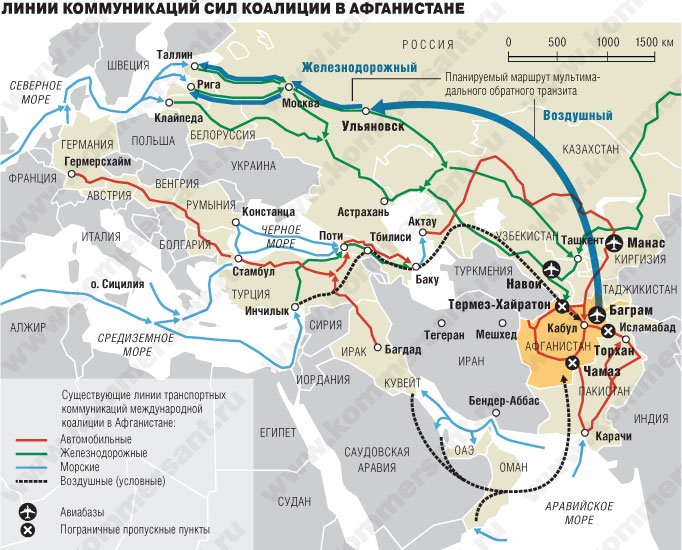
Own sources in the Russian Foreign Ministry told the correspondent of the Moscow newspaper “Kommersant” that Russia and NATO came to the final negotiations on the so-called “reverse multimodal transit” from Afghanistan . ”We are discussing this issue with NATO – confirmed a senior diplomat .- The multimodal transit back – it’s a way to increase the extraction efficiency of the NATO contingent in Afghanistan, using different modes of transport within the same route.” According to others, in the near future disposal of the Government on this subject must approve Vladimir Putin.

Routes

Figure © «Kommersant»

Now, the magazine writes, when the acute issue of withdrawal from Afghanistan, U.S. forces and NATO, the Western countries think about the safe route of return transit, which would have a good bandwidth. ”This theme is also important because of Uzbekistan, whose territory is actively used for the supply of goods to Afghanistan, does not want to miss them in the opposite direction,” – writes “Kommersant” .

“The Uzbeks are afraid of importation of drugs and weapons. Go after entire trains with military equipment, to check which is not so simple “ - said in an interview with an unnamed Russian diplomat said.

Moscow appears to be similar does not suffer from phobias. Negotiations on this subject, talk to her friends Russian diplomats began eighteen months ago with the proposal of the American side to think of such a scheme, which would reduce the time of rail transportation. ”The idea was to pick up in Central Russia, the city where you could create a logistical base to the customs terminal – Foreign Ministry official said .- Goods from Afghanistan would be thrown back by air, and then went by train to Riga or Tallinn.” According to interlocutors, “b” for the organization of trans-shipment point considered several options. Decided to stay at Ulyanovsk, whose airport is suitable for such purposes in terms of location of railway lines.

Thus, under the new scheme, according to the newspaper “Kommersant”, the goods will be NATO, bypassing Uzbekistan, delivered aircraft, including Russian, from Afghanistan to Russia, which will form the trains for shipment to Europe. ”It will save much time and money Westerners. Planes have to fly at much shorter distances, and therefore do not need to refuel on the way “- explains the interest of NATO officials in a similar route, the Russian Foreign Ministry official.

Apart from the obvious economic benefits of transit through Russia, the publication mentions political gain. ”Moscow has always been able to say that taking an active part in stabilizing the situation in Afghanistan, providing a seamless supply partners, first of all necessary forces and then to comfort care,” – writes “Kommersant” .

Note earlier refusal to grant its territory of Uzbekistan for the return transit of troops and equipment from NATO in Afghanistan is not reported. In contrast, post-Soviet states of Central Asia, in particular, Uzbekistan, Tajikistan, Kyrgyzstan and Turkmenistan, were considered by observers as the most likely U.S. allies in the issue of how to supply troops in Afghanistan by the northern route of supply and withdrawal of troops after the war. One of the indirect evidence for this is that yesterday the U.S. State Department lifted restrictions on military assistance to Uzbekistan. The relevant document was signed by Secretary of State Hillary Clinton.

The international news agency “Fergana”

Friday, February 3, 2012

The roots of the "aspens" are, once again, connected by the neocons....


February, 2012 -- The roots of the "aspens" are, once again, connected by the neocons....

"Fool me once . . ."

WMR, DC.

In September 2005, Vice President Dick Cheney's chief of staff, I. Lewis "Scooter" Libby penned a letter to his friend Judy Miller, the New York Times reporter who was jailed for refusing to testify in the investigation of the leak of Valerie Plame Wilson's CIA identity to the media and Bush White House officials. Libby wrote: "Out west, where you vacation, the aspens will already be turning. They turn in clusters, because their roots connect them. Come back to work — to life."

Libby and Miller were part of the neocon cabal that helped steer the United States into a costly and insane war on and occupation of Iraq. Apparently, the "aspens" are, once again, turning and linking their roots through the influential Aspen Institute.

Just a few days before Walter Isaacson, the president of the Aspen Institute, announced that he was stepping down as the Chairman of the Broadcasting Board of Governors (BBG) to work on a "big writing project," former NSA and CIA director Michael Hayden and former Homeland Security Secretary Michael Chertoff were engaged in a lively conversation over dinner at the Black Salt restaurant in northwest Washington discussing a project at the Aspen Institute. Hayden has been vocal recently hyping the threat to the United States from Iran. Our source at the restaurant said that Hayden and Chertoff were overheard at the dinner, at which their wives were in attendance, repeatedly discussing Aspen.

Aspen's Board of Trustees includes former Secretary of State Madeleine Albright, chair of the Albright Stonebridge Group and Albright Capital Management LLC; former Secretary of State Condoleezza Rice; James Schine Crown, President of Henry Crown and Company, a Chicago-based privately owned investment company; Michael Eisner, former chairman of Disney Corporation and an ardent supporter of Israel; former Representative Jane MOSSAD Harman, Director and President of the Woodrow Wilson Center, board member of Newsweek Daily Beast Company, and a known Mossad asset in Washington's political power structure; David Koch, executive vice president of Koch Industries, the major financial backer of right-wing causes; Leonard Lauder, chairman emeritus of Estee Lauder Companies and another major backer of Israel; Frederic Malek, major Republican financier and member of the board of the America-Israel Friendship League; Michael Powell, former chairman of the Federal Communications Commission; and Margot Pritzker, Chair of the Zohar Education Project Inc. which is a project to translate the Zohar, the canonical work of Jewish mysticism, into Zioconned English....

Isaacson's resignation from the BBG, which controls America's propaganda media operations, including the Voice of America, Radio Free Europe/CIA-Liberty, Radio Free Asia, Radio Farda (which broadcasts to Iran), and Radio/TV Marti, took everyone by surprise. Isaacson, a former chairman and CEO of CNN and managing editor of Time magazine, is a major player in the neocon media propaganda network. Last year, Isaacson said Russia's RT, Venezuela's Telesur, Iran's Press TV, and China's CCTV were "enemies" of the United States....LOL

Based on recent developments, it appears that the Aspen Institute and Isaacson are engaged in a major propaganda effort to demonize Iran, much in the same way Iraq under Saddam Hussein was demonized as a threat to the United States in order to justify the 2003 U.S. attack on that country.

On February 1, the Bipartisan Policy Center, which is linked closely to the Aspen Institute and funded by the "Big Three" CIA foundations -- Carnegie, Rockefeller, and Ford -- called for the United States to militarily destroy Iran's nuclear program. The BPC report also called for an increase in U.S. military assets in the Gulf region and stepped up covert operations against the Iranian government. The BPC report followed by one day a warning by Director of National Intelligence James Clapper that Iran posed a domestic terrorist threat to the United States....lol, just like Al-CIAda and 9/11....

The Aspen Institute's propaganda effort aimed at Iran came at the same time Israeli officials hyped a supposed Iranian nuclear weapons threat, information carried without skepticism by the U.S. corporate media. Israeli Deputy Prime Minister Moshe Yaalon contradicted U.S. Defense Secretary Leon Panetta by insisting that all Iranian underground nuclear facilities were vulnerable to military attack. Panetta insisted that even the most powerful bunker-buster bombs in the U.S. arsenal could not penetrate Iranian underground facilities. Israeli military intelligence chief Major General Aviv Kochavi said Iran has already produced enough enriched uranium to produce four nuclear weapons. Kochavi's opinion is contradicted by CIA intelligence and International Atomic Energy Agency (IAEA) conclusions that Iran's enriched uranium comes no where close to weapons grade quality.

Echoing the bogus intelligence offered up about Iraq having a first strike missile capability against the United Kingdom and United States, Yaalon dusted off that old canard by insisting that Iran is developing missiles with a range of 6,250 miles that could hit the United States.

It appears that Isaacson's "big writing project" is to generate another barrage of propaganda to justify a U.S. military strike on Iran. As George W. Bush once said, with great difficulty, "There's an old saying in Tennessee — I know it's in Texas, probably in Tennessee — that says, fool me once, shame on — shame on you. Fool me — you can't get fooled again." ....


Exposed: The Zioconned Arab agenda in Syria...


Exposed: The Zioconned Arab agenda in Syria...
By Pepe Escobar

Here's a crash course on the "democratic" machinations of the Arab League - rather the GCC League, as real power in this pan-Arab organization is wielded by two of the six Persian Gulf monarchies composing the Gulf Cooperation Council, also known as Gulf Counter-revolution Club; Qatar and the House of Saud.

Essentially, the GCC created an Arab League group to monitor what's going on in Syria. The Syrian National Council - based in North Atlantic Treaty Organization (NATO) member countries Turkey and France - enthusiastically supported it. It's telling that Syria's neighbor Lebanon did not.

When the over 160 monitors, after one month of enquiries, issued their report ... surprise! The report did not follow the official GCC line - which is that the "evil" Bashar al-Assad government is indiscriminately, and unilaterally, killing its own people, and so regime change is in order.

The Arab League's Ministerial Committee had approved the report, with four votes in favor (Algeria, Egypt, Sudan and GCC member Oman) and only one against; guess who, Qatar - which is now presiding the Arab League because the emirate bought their (rotating) turn from the Palestinian Authority.

So the report was either ignored (by Western corporate media) or mercilessly destroyed - by Arab media, virtually all of it financed by either the House of Saud or Qatar. It was not even discussed - because it was prevented by the GCC from being translated from Arabic into English and published in the Arab League's website.

Until it was leaked.
Here it is, in full.

The report is adamant. There was no organized, lethal repression by the Syrian government against peaceful protesters. Instead, the report points to shady armed gangs as responsible for hundreds of deaths among Syrian civilians, and over one thousand among the Syrian army, using lethal tactics such as bombing of civilian buses, bombing of trains carrying diesel oil, bombing of police buses and bombing of bridges and pipelines.

Once again, the official NATOGCC version of Syria is of a popular uprising smashed by bullets and tanks. Instead, BRICS members Russia and China, and large swathes of the developing world see it as the Syrian government fighting heavily armed foreign mercenaries. The report largely confirms these suspicions.

The Syrian National Council is essentially a Muslim Brotherhood outfit affiliated with both the House of Saud and Qatar - with an uneasy Israel quietly supporting it in the background. Legitimacy is not exactly its cup of green tea. As for the Free Syrian Army, it does have its defectors, and well-meaning opponents of the Assad regime, but most of all is infested with these foreign mercenaries weaponized by the GCC, especially Salafist gangs.

Still NATOGCC, blocked from applying in Syria its one-size-fits-all model of promoting "democracy" by bombing a country and getting rid of the proverbial evil dictator, won't be deterred. GCC leaders House of Saud and Qatar bluntly dismissed their own report and went straight to the meat of the matter; impose a NATOGCC regime change via the UN Security Council.

So the current "Arab-led drive to secure a peaceful end to the 10-month crackdown" in Syria at the UN is no less than a crude regime change drive. Usual suspects Washington, London and Paris have been forced to fall over themselves to assure the real international community this is not another mandate for NATO bombing - a la Libya. US Secretary of State Hillary Clinton described it as "a path for a political transition that would preserve Syria's unity and institutions".

But BRICS members Russia and China see it for what it is. Another BRICS member - India - alongside Pakistan and South Africa, have all raised serious objections to the NATOGCC-peddled draft UN resolution.

There won't be another Libya-style no fly zone; after all the Assad regime is not exactly deploying Migs against civilians. A UN regime change resolution will be blocked - again - by Russia and China. Even NATOGCC is in disarray, as each block of players - Washington, Ankara, and the House of Saud-Doha duo - has a different long-term geopolitical agenda. Not to mention crucial Syrian neighbor and trading partner Iraq; Baghdad is on the record against any regime change scheme.

So here's a suggestion to the House of Saud and Qatar; since you're so seduced by the prospect of "democracy" in Syria, why don't you use all your American weaponry and invade in the dead of night - like you did to Bahrain - and execute regime change by yourselves?

North Korea stands to be a major winner if Israeli hotheads lose patience and drive Israel into attacking Iranian nuclear facilities.

With Iran said in some quarters to be only months away from emerging as the world's 10th nuclear weapons power, North Korea reportedly is producing more middle-range missiles for export for Iran's defense in the event of a Middle East war that would make the conflicts in Iraq and Afghanistan look like brush fires.

North Korea also is producing more missiles for export to Syria, whose embattled regime has the support of Iran and would be a major Iranian ally in the event of a shooting conflict between Israel and Iran.

It's against that background that James Clapper, the United States Director of National Intelligence, warned that North Korea, ostensibly under new "supreme leader" Kim Jong-eun, would carry on business as usual when it came to exporting missiles, for years one of the North's biggest-selling export products. Clapper, at a congressional hearing, specifically cited Iran and Syria as two markets for North Korean missiles and supporting material.

North Korean missile exports are believed to have shrunk over the past year as revolt in Arab countries that were once major clients has reduced the number of potential markets.

Another problem for the North is how to ship the missiles, or their components, against the threat of blockage of such shipments by nations banded together in the Proliferation Security Initiative under which countries can block shipments.

North Korean vessels have been turned back in a couple of highly publicized incidents, but many more are believed to have finished the long journey. North Korea is also believed to have shipped missiles and other sophisticated weapons via its only real ally, China.

Analysts for years have suspected China of opening up its air space to North Korean planes with military cargoes on board - a claim that China has denied.

The prospect of broadening sales of missiles to long-time clients Iran and Syria, however, is just one way in which North Korea would benefit from war in the Middle East. With US forces inevitably drawn into conflict there, the North could be sure the US would not want to take any chances on risking a second Korean war and might want to transfer a major portion of the 28,500 US troops still left in the South to the Middle East.

At the same time, Kim Jong-eun has been visiting military units, giving a sense that he identifies with the troops while also trying to show he's really in charge and wants to learn much more than his father was able to teach him in the last two years before Kim Jong-il's death was announced on December 19.

The appearance of the pudgy Jong-eun, straining at the seams of a dark blue suit designed to make him look all the more like his grandfather, the late Kim Il-sung, definitely shows his commitment to songun, the "military first" policy propounded by Kim Jong-il in his strongest role - that of chairman of the National Defense Commission.

Kim Jong-eun's aging handlers, believed to be led by Jang Song-thaek, the husband of his father's sister, seem anxious to demonstrate the continuity of songun but also to remain open for dialogue - on their terms. The sense is growing that North Korea might be open somehow to resuming six-party talks on its nuclear program, last held more than three years ago, or even to an exchange with South Korea.

Dialogue, though, won't come easy in view of the North's efforts at intimidation in the run-up to two important anniversaries - the 70th of the birth this month of Kim Jong-il and the 100th in April of the birth of Kim Il-sung, who died in 1994. North Korea emitted mixed signals in an extraordinary "open questionnaire" that it put out this week posing questions for South Korean leaders.

In the name of "the policy department of the National Defense Commission", which Kim Jong-il as chairman once made the center of his power, began with the rhetorical question of whether the "traitors" led by South Korea's President Lee Myung-bak were "ready to deeply repent of its heinous crimes concerning the great loss to the Korean nation and make apologies for them" - an allusion to South Korea's refusal to mourn the death of Kim Jong-il while banning delegations from going to Pyongyang to offer condolences.

The only exceptions were a delegation led by the widow of Kim Dae-jung, the president who initiated the "Sunshine" policy of reconciliation, and the widow of Chung Mong-hun, the chairman of Hyundai Asan, the company that Chung Ju-yung, founder of the Hyundai empire, formed to do business with North Korea.

The second question harked back to the inter-Korean summits between Kim Dae-jung and his successor, Roh Moo-hyun, both of whom went to Pyongyang for meetings with Kim Jong-il that ended in flowery statements full of promises that would never be fulfilled. Did the South Korean "authorities" intend to live up to the "joint declaration" of June 15, 2000, in which Kim Dae-jung and Kim Jong-il vowed to enter a new era of peace and reconciliation?

Question three asked, "Can the Lee group promise the world it can no longer hurt the DPRK [Democratic People's Republic of Korea] over Cheonan warship case and Yeonpyeong Island shelling incident.?"

That was a particularly loaded reference to the sinking of the South Korean corvette the Cheonan in March 2010 in which 46 sailors died - an episode that South Korea blames on a torpedo fired by a North Korean midget submarine - and the shelling of Yeonpyeong Island in the Yellow Sea in November 2010 that killed four South Koreans.

The North has denied anything to do with the shelling of the Cheonan and said the South provoked the attack on the island by firing cannons close to the North Korean shore several kilometers away.

Question four was whether "the south Korean authorities could make a policy decision to stop big joint military exercises targeted against the DPRK?" This is a reference to annual war games, many conducted on computers, involving thousands of US and South Korean troops - the lower case "s" is no mistake.

Behind the bluff and bluster of such tendentious questions presumably lies the hand of Jang Song-thaek. He remains vice chairman of the National Defense Commission on which Kim Jong-eun does not have a seat. Jong-eun, still in his late 20s, is acting chairman of the military commission of the Workers' Party - not regarded as the key post - even though he is referred to as "supreme leader" and "supreme commander".

If the questions seemed deliberately contrived to defy and upset the South Koreans, they also suggested that somehow dialogue on one level or another might be possible. They also indicated that dialogue would probably go nowhere while Kim Jong-eun went on ingratiating himself with the military - and the US worried about spreading its forces too thin in the event of a war that Washington doesn't want with Iran.

Donald Kirk,


Hidden hand, clean hand in Russian politics...


Hidden hand, clean hand in Russian politics...
By John Helmer

MOSCOW - Ignore the plot entirely, but try this Joseph Stalin point from a novel called Archangel.

The story by Robert Harris, written in 1998, is about a semi-alcoholic professor of Russian history - an Englishman, with a New York address - who is hot on the trail of the Russian dictator's personal notebooks, which he thinks were spirited out of the Kremlin by Lavrenty Beria, while Stalin was in his dacha dying.

Buried by Beria's chauffeur in his backyard, the notebooks stay where they are in what becomes the Tunisian Embassy in Moscow, after Beria is shot by the politburo. But the notebooks turn out to be those of a girl from Arkhangelsk. Stalin impregnates her in order to leave an heir, which he does, spawning a man scarcely more believable than the others in the plot. Almost everyone in on the story dies, starting with Stalin.

"I have never read a thriller based in Russia which has such an authentic feel" - Orlando Figes, Evening Standard, London - skip this nonsense, and go back instead to this:
If one Russian in six believed that Stalin was their greatest ruler, that meant he had about twenty million supporters ... And even if you halved that figure, just to get down to the hard core, that still left ten million. Ten million Stalinists in the Russian Federation, after forty years of denigration?
This was written in 1997, 15 years ago. The fiction, along with Stalin's heir, are deader than dead. But here's a fact - positive sentiment towards Stalin among Russians is roughly double or triple today what it was then. And if the facts can be stuck to long enough to be analyzed, before the false moralizing and politicking set in, here are some more of them:

Poll data collected by the All-Russia Public Opinion Research Center (VTsIOM) reported in April of 2011 Russian answers to the question: Did Stalin do more good than bad for Russia? In 2007 15% polled said they believed he had. In 2001, this view was expressed by 26%. Then 33% of the Russians questioned said he had done “more bad than good”.

In January 2011, according to VTsIOM this proportion had fallen to 27%; in April, three months later, 24%. VTsIOM doesn't say so, but if Stalin is getting "better" at a rate of 1% of the thinking population per month, this month in 2012 just 15% of Russians believe Stalin did "more bad than good".

Last April, VTsIOM also reported that 45% of their poll sample think that further de-Stalinization would be an unconstitutional restriction on Russians' freedom of speech and belief. Another 28% refused to say what they think of Stalin or de-Stalinization. They may be split down the middle between those afraid to admit anything good about Stalin, and those still afraid of saying anything bad.

In April 2011, reporter Yuri Pronko asked: "How do you assess the role of Stalin in the history of our country?" His sample of 1,500 was aimed at young people between 18 and 21, living outside Moscow and St Petersburg. With a choice of answering positive or negative, 75% said positive.

The Levada Center, another nationally known polling company, reported in April of 2011 that 45% of Russians believe that Stalin was a positive figure in history. The proportion was going down, the pollster reported. In 2010 it had been 51%; in 2009, 49%.

In December 2011, analysts working for Masterforex-V, one of the largest foreign currency brokers in Moscow, reported evidence they believe indicates a rise in positive sentiment. They claim Stalin would have won the Rossiya-1 Name of Russia contest if both Nevsky and Stolypin hadn't been boosted artificially.

They also claim that there has been mass support for putting pictures of Stalin on municipal buses. According to the analysis, one of the principal reasons for Stalin's rise today is that the terror purges of the 1930s he is castigated for prevented the widespread corruption that is the most castigated feature of current Russian life.

This isn't the place to debate what color Stalin's hands were, really. What is important now is what a third to half of all Russians think of their color in relation to the problems they believe are uppermost in Russia today; and the priorities for the future they will vote for on March 4 in the presidential election.

What Russians mean when they express their opinion of Stalin is that they want clean hands, fair hands in command - not hidden, not weak, not corrupt ones. Most Russians suspect everyone contending for political power to have all three. But they think they know what Prime Minister Vladimir Putin's hands can do - the others are more hidden, weaker, and most likely more corrupt. The future in the hands of the opposition, if they were to be voted into power, would thus be more uncertain, more unstable, more corrupt than now. In what country of the world can an electorate be persuaded to vote in favor of that?

Do the arithmetic: if about 6% of Russia's current population (9 million) are 75 or over, and thus old enough to remember the terror of the 1930s, World War II and Stalin's death, those with personal reason to fear another Stalin are fast dying out, accelerated to their end by corrupt hospital administrators, doctors, and nurses who are afraid of nothing, and are quite safe from being shot for their capital crimes.

The 14% (20 million) who are 65 and over are thus divided between those who remember the human destruction of the war more vividly than those for whom the terror comes first. But they too are disappearing. They cannot make much impact when national samples are compiled for the polls. What remains is what the pollsters have found - the large, possibly growing share of the population under 65 for whom Stalin and his hands are symbols.

But these are not symbols the outside world understands at all. Not to understand this (or misrepresent it as a form of Russian fascism) results in the mistake the media of the outside world repeatedly and vainly try to foist on the current election contest between Putin and the opposition - both those registered in the race and those recorded in the streets and on the Internet.

One of those symbols, the strong hands, the prime minister (born October 7, 1952) understands full well. In 2009, this is what Putin had to say:
It is clear that from 1924 to 1953 the country, then led by Stalin, changed radically. It turned from an agrarian country into an industrial one. However, not too many peasants survived. But there really was industrialization. We won the Great Patriotic War. And whatever they say, the victory was achieved. Even if we go back to the losses, you know, no one can now throw a stone at those who organized and headed this victory, because if we had lost this war, the consequences for our country would have been much more disastrous.
The other symbol Stalin now stands for - clean hands - could be expropriated by any presidential candidate or opposition figure who announced that if voted into power, he will rid Russia of the oligarch system, corrupt concentration of wealth, illegal capital theft, export of jobs, destruction of environment, unfairness everywhere, etc, etc.

Naturally, this can't be expected from the oligarch candidate for president, Mikhail Prokhorov. It might be expected of Gennady Zyuganov, the Communist Party candidate, but he discredited himself in supporting Mikhail Khodorkovsky after his arrest in 2003. There hasn't been a serious Russian politician with this program since Sergei Glazyev teamed up with Dmitry Rogozin in 2007.

In retrospect, it is clear that Rogozin has understood better than Glazyev the merit of patience. Rogozin was the brains behind General Alexander Lebed's successful but short run for president in 1996. After serving in the state duma and then as Russia's ambassador to the North Atlantic Treaty Organization in Brussels since 2008, he has been quietly promoted and returned home to be deputy minister of defense in charge of the military-industrial complex. There are one or two others like him. Let's wait and see where their hands end up after March 4.

John Helmer has been a Moscow-based correspondent since 1989, specializing in the coverage of Russian business.

Note
Joseph Stalin (1878-1953), premier of the Soviet Union from 1941 until his death, was among the Bolshevik revolutionaries who brought about the October Revolution in Russia in 1917. As general secretary of the Communist Party of the Soviet Union's central committee from 1922, he was responsible for the forced collectivization of farming that contributed in 1932-33 to the Soviet famine. His determination to crush political opposition to his rule led to the Great Purge of the late 1930s in which hundreds of thousands of people, including Red Army leaders convicted of participating in plots to overthrow the Soviet government, were executed.

Thursday, February 2, 2012

Fear and loathing in the American Gulf; US tells Israelis it won't join their war....


Fear and loathing in the American Gulf; US tells Israelis it won't join their war....
By Pepe Escobar

Persian Gulf? Khaleej-e-Fars? Forget it; time to call it the American Gulf - to the delight of the vultures, jackals and hyenas of war, Israeli and Anglo-American. The House of Saud wouldn't be too displeased either.

So much for the Pentagon's "pivoting" strategy from the Middle East to East Asia - recently announced by United States President Barack Obama. The confrontation against China starts in Southwest Asia - in the American Gulf; and goes way beyond Washington cheerleading the hardcore Sunni sectarian killers of Jundallah in Iran's Sistan-Balochistan province, Israeli Mossad agents posing as US Central Intelligence Agency operatives, serial assassinations of Iranian nuclear scientists, computer viruses, and ludicrous accusations of Tehran helping al-Qaeda and vice-versa.

MOP it all up
Time to review the evidence. In roughly one month, no less than three US aircraft carriers and their strike groups will be sloshing around the American Gulf, the Gulf of Oman and the Arabian Sea; the USS Abraham Lincoln, USS Carl Vinson and USS Enterprise, plus good ol' French nuclear-powered aircraft carrier Charles de Gaulle. And yet one more Pacific-based US aircraft carrier can be swiftly dispatched.

Apart from this naval hajj of US aircraft carrier groups, the 40-year-old USS Ponce is being retrofitted into a special ops amphibious hub - to be dispatched to the American Gulf.

The Pentagon's CENTCOM is fast upgrading the 14,000-kilogram Orwellian bunker-buster monster known as Massive Ordinance Penetrator (MOP), theoretically capable of taking out Iran's underground nuclear installations.

A certain Bipartisan Policy Center's National Security Project - one of those myriad revolving doors in Washington mixing politicians and military-complex types - wants to give Israel some 200 additional MOPs and three KC-135 aerial refueling tankers to "increase the credibility of a military strike" against Iran.

DEBKA-Net is a digital front for Israeli propaganda/disinformation - so it's essentially untrustworthy. But its latest bombast deserves scrutiny. DEBKA is peddling that the Pentagon is in fast and furious mode in two strategic islands; the paradisiacal Socotra, 380 kilometers southeast of Yemen (where the Pentagon has been building a giant base since 2010); and Camp Justice in Masirah, 70 km south of the Strait of Hormuz, in Oman.

Socotra thus joins key American Gulf nodes of the US Empire of Bases such as Jebel Ali and al-Dahfra in the United Arab Emirates (UAE), al-Udeid in Qatar and Arifjan in Kuwait. It's crucial to keep in mind the extra 15,000 US troops deployed to Kuwait only a few weeks ago. The Pentagon, predictably, is thunderously mum about the build up in both Socotra and Masirah, and Yemeni and Omani officials are not talking.

DEBKA claims that in two weeks, around 50,000 US troops, flown in from Diego Garcia, 3,000 km away, will be massed in both islands - plus the 50,000 troops already based in the American Gulf. Add to this air, naval and special forces from Britain and France constantly pouring into Saudi Arabia and the UAE. Not enough to launch a ground invasion of Iran - but more than enough for major logistical support in a "no options off the table" (copyright Obama) scenario.

Build up, and pray for war
DEBKA predictably spins all these developments - not independently confirmed - into Obama's "resolve to attack Iran's nuclear facilities in the course of 2012", which is absolute nonsense. This may mirror (hysterical) wishful thinking by the Benjamin Netanyahu government in Israel, but has nothing to do with the Obama administration's strategy, which essentially is to impose a "roll over and die" form of "diplomacy" on Iran (sanctions/oil embargo + Pentagon build up in the American Gulf) as a means of extracting an Iranian capitulation in the nuclear dossier.

Wishful thinking is also the weapon du jour for The New York Times, which now seems to be subcontracting the Iran dossier to Israeli writers, as in getting rid of the US middleman.

One Ronen Bergman writes that "after speaking with many senior Israeli leaders and chiefs of military and the intelligence, I have come to believe that Israel will indeed strike Iran in 2012". Gary Sick conclusively debunked this nonsense [1] stressing how "his conclusion is at odds with virtually everything he produces as evidence".

The only good thing among all this weaponized orgy is that Tehran and Washington are still talking - sort of - using the proverbial back channels; in Baghdad (via both ambassadors); via Turkey (with Prime Minister Recep Tayyip Erdogan as middleman); and in Vienna, the headquarters of the International Atomic Energy Agency (via diplomats). There's a five-month window for good sense to prevail until July 1 - when the US/European Union oil embargo on Iran kicks in.

And then there's the resurfacing of "Austere Challenge 12" - the massive joint Israel-US war games involving thousands of US soldiers and testing of a number of Israeli and US missile defense systems.

"Austere Challenge" is now rescheduled for October, less than a month before the US presidential election, when Mitt Romney, the neo-con gang and deranged evangelicals will be bombing Iran non-stop on cable TV. Until then, it's up to world public opinion, to quote Percy Bysshe Shelley in The Mask of Anarchy, to "rise like lions, after slumber, in unvanquishable number", and drive fear and loathing away from the American Gulf.

Note
1. See
here.
US tells Israelis it won't join their war...lol lol
By Gareth Porter

WASHINGTON - Chairman of the Joint Chiefs of Staff (JCS) General Martin Dempsey told Israeli leaders on January 20 that the United States would not participate in a war against Iran begun by Israel without prior agreement from Washington, according to accounts from well-placed senior military officers.

Dempsey's warning, conveyed to both Prime Minister Benjamin Netanyahu and Israeli Defense Minister Ehud Barak, represents the strongest move yet by President Barack Obama to deter an Israeli attack and ensure that the US is not caught up in a regional conflagration with Iran.

But the Israeli government remains defiant about maintaining its freedom of action to make war on Iran, and it is counting on the influence of right-wing extremist views in US politics to bring pressure to bear on Obama to fall into line with a possible Israeli attack during the election campaign this autumn.

Obama still appears reluctant to break publicly and explicitly with Israel over its threat of military aggression against Iran, even in the absence of evidence Iran has decided to build a nuclear weapon.

Dempsey's trip was highly unusual, in that there was neither a press conference by the chairman nor any public statement by either side about the substance of his meetings with Israeli leaders. Even more remarkable, no leak about what he said to the Israelis has appeared in either US or Israeli news media, indicating that both sides have regarded what Dempsey said as extremely sensitive.

The substance of Dempsey's warning to the Israelis has become known, however, to active and retired senior flag officers with connections to the JCS, according to a military source who got it from those officers.

A spokesman for the JCS, Commander Patrick McNally, offered no comment on Wednesday when Inter Press Service (IPS) asked him about the above account of Dempsey's warning to the Israelis.

The message carried by Dempsey was the first explicit statement to the Netanyahu government that the United States would not defend Israel if it attacked Iran unilaterally. But Defense Secretary Leon Panetta had given a clear hint in an interview on "Face the Nation" on January 8 that the Obama administration would not help defend Israel in a war against Iran that Israel had initiated.

Asked how the United States would react if Israel were to launch a unilateral attack on Iran, Panetta first emphasized the need for a coordinated policy toward Iran with Israel. But when host Bob Schieffer repeated the question, Panetta said, "If the Israelis made that decision, we would have to be prepared to protect our forces in that situation. And that's what we'd be concerned about."
Defense Minister Barak had sought to dampen media speculation before Dempsey's arrival that the chairman was coming to put pressure on Israel over its threat to attack Iran, but then proceeded to reiterate the Netanyahu-Barak position that they cannot give up their responsibility for the security of Israel "for anyone, including our American friends".

There has been no evidence since the Dempsey visit of any change in the Netanyahu government's insistence on maintaining its freedom of action to attack Iran.

Dempsey's meetings with Netanyahu and Barak also failed to resolve the issue of the joint US-Israeli military exercise geared to simulate a missile attack, "Austere Challenge '12", which had been scheduled for April 2012 but had been postponed abruptly a few days before his arrival in Israel.

More than two weeks after Dempsey's meeting with Barak, the spokesman for the Pentagon, John Kirby, told IPS, "All I can say is that the exercise will be held later this year." That indicated that there has been no major change in the status of US-Israeli discussions of the issue since the postponement of the exercise was leaked on January 15.

The postponement has been the subject of conflicting and unconvincing explanations from the Israeli side, suggesting disarray in the Netanyahu government over how to handle the issue.

To add to the confusion, Israeli and US statements left it unclear whether the decision had been unilateral or joint as well as the reasons for the decision.

Panetta asserted in a news conference on January 18 that Barak himself had asked him to postpone the exercise.

It now clear that both sides had an interest in postponing the exercise and very possibly letting it expire by failing to reach a decision on it.

The Israelis appear to have two distinct reasons for putting the exercise off, which reflect differences between the interests of Netanyahu and his defense minister.

Netanyahu's primary interest in relation to the exercise was evidently to give the Republican candidate ammunition to fire at Obama during the fall campaign by insinuating that the postponement was decided at the behest of Obama to reduce tensions with Iran.

Thus Mark Regev, Netanyahu's spokesman, explained it as a "joint" decision with the United States, adding, "The thinking was it was not the right timing now to conduct such an exercise."

Barak, however, had an entirely different concern, which was related to the Israeli Defense Forces' (IDF's) readiness to carry out an operation that would involve both attacking Iran's nuclear facilities and minimizing the Iranian retaliatory response.

A former US intelligence analyst who followed the Israeli military closely told IPS he strongly suspects that the IDF has pressed Barak to insist that the Israeli force be at the peak of readiness if and when they are asked to attack Iran.

The analyst, who insisted on anonymity because of his continuing contacts with US military and intelligence personnel, said the 2006 Lebanon war debacle continues to haunt the thinking of IDF leaders.

In that war, it became clear that the IDF had not been ready to handle Hezbollah rocket attacks adequately, and the prestige of the Israeli military suffered a serious blow.

The insistence of IDF leaders that they never go to war before being fully prepared is a primary consideration for Barak, according to the analyst. "Austere Challenge '12" would inevitably involve a major consumption of military resources, he observes, which would reduce Israeli readiness for war in the short run.

The concern about a major military exercise actually reducing the IDF's readiness for war against Iran would explain why senior Israeli military officials were reported to have suggested that the reasons for the postponement were mostly "technical and logistical".

The Israeli military concern about expending scarce resources on the exercise would apply, of course, regardless of whether the exercise was planned for April or late 2012. That fact would help explain why the exercise has not been rescheduled, despite statements from the US side that it will be.

The US military, however, has its own reasons for being unenthusiastic about the exercise. IPS has learned from a knowledgeable source that, well before the Obama administration began distancing itself from Israel's Iran policy, US Central Command chief James N Mattis had expressed concern about the implications of an exercise so obviously based on a scenario involving Iranian retaliation for an Israeli attack.

United States officials have been quoted as suspecting that the Israeli request for a postponement of the exercise indicated that Israel wanted to leave its options open for conducting a strike on Iran's nuclear facilities in the spring. But a postponement to the fall would not change that problem.

For that reason, the former US intelligence analyst told IPS he doubted that "Austere Challenge '12" will ever be carried out.

But the White House has an obvious political interest in using the military exercise to demonstrate that the Obama administration had increased military cooperation with Israel to an unprecedented level.

The Defense Department wants the exercise to be held in October, according to the military source in touch with senior flag officers connected to the Joint Chiefs....lol


Wednesday, February 1, 2012

Mormons condemn alcohol, smoking, and coffee, but CIA shenanigans, the White House Murder INC, and organized crime is another story....


Mormons condemn alcohol, smoking, and coffee, but CIA shenanigans, the White House Murder INC, and organized crime is another story....

February, 2012 -- A Romney presidency? Get ready for massive Mormon nepotism...
WMR, DC

The word from federal departments and agencies that have experienced a steady influx of Mormon senior officials over the past few years is that one thing that can be expected from a Mitt Romney presidency is the type of rampant nepotism and cronyism already witnessed at the Department of Health and Human Services (HHS), Environmental Protection Agency (EPA), and CIA, but on a much wider scale..., given that Mitt Romney has chosen an infamous Assassin who is owned and operated by the odious White House Murder INC, in the Levant with the little weasel Walid Phares....

Former Utah Governor Mike Leavitt served as EPA administrator from 2003 to 2005 and Secretary of Health and Human Services from 2005 to 2009. While in both positions, Leavitt ensured that his Mormon friends and members of their families were appointed to high-level positions in both agencies. Leavitt's conflicts-of-interest at EPA and HHS were even more stark when considering that he inherited the Leavitt Group regional insurance company founded by his father and served on the board of Utah Power & Light.

One of Leavitt's first acts at EPA and HHS was to hire his good friend Charles Johnson. Johnson was Leavitt's chief financial officer for EPA and his Assistant Secretary for Budget, Technology, and Finance at HHS. Johnson, in turn, hired his niece as the director of the grants program at HHS. President Obama kept Johnson on at HHS and Johnson's niece managed to burrow down from a political appointment to a career civil service position before the Bush to Obama transition. As a further example of Mormon nepotism, Johnson served as President of Huntsman Cancer Foundation and as Vice President of Huntsman LLC in Utah. Jon Huntsman, Jr., a former Utah governor who ran unsuccessfully for the Republican nomination for president, served as Obama's ambassador to China.

Huntsman and Romney are cousins.

If Mormon nepotism in Washington is this bad under Obama, there is a question of how bad it would become under a President Romney?

A clue may come from the CIA and FBI, which have instituted hiring preferences for Mormons in the belief that they are squeaky-clean when it comes to alcohol and drug use. In addition, many Mormon recruits have proficiency in at least one foreign language, a result of their foreign Mormon missionary work.

But for those who believe that all Mormons are squeaky-clean and besides the fact that Romney has destroyed entire towns through the actions of his vulture capital company, Bain Capital, consider the close ties between the Mormon Church and organized crime in the Western states. For Arizona Republic investigative journalist Don Bolles, the links between the "Mormon Mafia" and western states' gambling interests -- connections he was investigating -- became all-too-real when he was killed by a car bomb on June 2, 1976 in Phoenix. Bolles was investigating horse and dog racing organized crime links in Arizona that were tied to the same Mormon Mafia connections. Bolles was investigating the mob connections of Emprise, which is now Delaware North Corporation, a large entertainment and gaming firm with locations around the world.

The Arizona Mormon Mafia was closely linked to the Nevada Mormon Mafia that surrounded billionaire recluse Howard Hughes and Las Vegas gambling interests. In fact, Hughes's inner circle of Las Vegas businessmen was known as the "Mormon Mafia."

A few weeks after Hughes died in April 1976 and a few months before Bolles's assassination in Phoenix, a will, purported to be that of Hughes, was found in the office of a Latter Day Saints official in Salt Lake City. In addition to a $625 million gift to the Howard Hughes Medical Institute, $470 million was to go to Hughes's closest aides, including the members of the Mormon Mafia, headed by Bill Gay,who was also president of Hughes's Summa Corporation, which owned The Sands, Silver Slipper, Frontier, Landmark, Castaways, and Desert Inn hotel-casinos in Las Vegas. The so-called Mormon Will of Hughes was later ruled a forgery by a Nevada court, which concluded that Hughes died intestate.

Today, the traditional links between the Mormons and Western states organized crime is carried on by Mormon U.S. Senate Majority Leader Harry Reid. Reid is considered owned and operated by Las Vegas gambling interests and he earmarked federal funds for the building of a "Mob Museum" in Las Vegas....


A dragon dance in the Negev, US ZOG looses the Plot....


A dragon dance in the Negev, US ZOG looses the Plot....
By M K Bhadrakumar

There is no record of dragons in the nomadic life of the Negev desert, which dates back at least 4, 000 years (some say 7,000). That may be about to change in the Year of the Dragon.

The Bedouins of the Negev will soon witness the sight of a Chinese-built railway line snaking its way through the melange of brown, rocky, dusty mountains and the wadis and deep craters, leading north from the resort city of Eilat in the Gulf of Aqaba toward the eastern Mediterranean.

Having developed strong interests on the two sides of the Persian Gulf divide - Gulf Cooperation Council (GCC) states and Iran - China is taking an awesome leap as a big-time player in the geopolitics of the Middle East by elevating its ties with Israel to a strategic partnership.

Paradoxically, just as the United States is hoping to nettle the dragon in the South China Sea and "contain" it in the Asia Pacific, it makes a dramatic, outflanking appearance in the citadel of American geo-strategies in the Middle East. The geopolitical implications are profound.

Amid the cacophony of the war drums beating in the Persian Gulf and in the Levant, it almost went unnoticed that the exchange of greetings between Beijing and Tel Aviv last week marking the 20th anniversary of diplomatic ties between the two countries acquired a sudden verve that went far beyond the calls of mere protocol.

Diplomacy for all seasons
Israeli Prime Minister Benjamin Netanyahu said his country and China make a "successful combination" and he could visualize a "dramatic expansion" of the ties. "I think we've barely scratched the surface of Israeli-Chinese relations", he said at a celebration in Tel Aviv last Tuesday.

In his message of greetings for the anniversary, President Hu Jintao said China "attaches great importance to advancing Sino-Israeli ties and is ready to make joint efforts with Israel". In turn, Premier Wen Jiabao noted that China and Israel have "huge potential and broad prospects for cooperation" and Beijing is "ready to continue to expand and deepen" the ties and raise them to "a new high".

Speaking at the function in Tel Aviv, Netanyahu pointedly invited Beijing to work with Israel to "address the challenges of securing Middle East peace". And China's ambassador to Israel Gao Yanping, who was present, responded:
The further development of China-Israel relations is not only beneficial to both countries and the two peoples, but are also very much conducive to regional stability, world peace and global prosperity.

Facing the ongoing transformation and adjustment in the region [read Arab Spring] and in the world, China-Israel relationship is now at a new historical point. We should continue to work together, grow together and succeed together in the years to come.
These are heady, brave thoughts for a region where angels fear to tread. But the maturity of China-Israel ties today is such that even as Gao was speaking at Tel Aviv, her counterpart in the United Nations in New York, ambassador Li Baodong, was taking note of the "stalemate" in the Middle East peace process and reiterating China's strong support for a Palestinian state as part of a two-state solution, restoring the "lawful right" of Palestinian people.

Li said, "China supports the establishment of an independent Palestinian state that enjoys full sovereignty, with East Jerusalem as its capital and based on the 1967 border. China supports Palestine's membership in the United Nations." Li went on to roundly condemn the Israeli government's recent decision giving approval for plans of expansion of new settlements. He said:
China is always against Israel's establishment of Jewish settlements in the occupied Palestinian territory including East Jerusalem. We urge Israel to cease the settlement construction immediately, by prudent in action and work actively in collaboration with the efforts of the international community to promote peace, and create conditions for the resumption of Palestinian-Israeli peace negotiation.
Li seemed unperturbed by the warm sentiments being mutually expressed between the Chinese and the Israeli leaderships the very same day that he spoke.

The parallel portfolio of China's stunning Middle East diplomacy that was evident during Wen Jiabao's recent six-day tour of the GCC states is repeating. (
China weighs 'right side of history' in Gulf, Asia Times Online, January 17, 2012).

China's Middle East diplomacy is adroitly advancing three parallel tracks engaging Iran, GCC states and Israel. This may seem improbable against the backdrop of the rise of Iran and the concomitant hostility it arouses in Israel and the GCC states. But Beijing sees no contradiction here, and is striving to make the three tracks even complement each other. Conceivably, one day they well might.

The great beauty is that all three Middle Eastern camps - Iran, the GCC and Israel - equally want the best of relationships with China and are manifestly vying with each other for the dragon's prime time. This is going to pose an unsolvable riddle for other outside powers aspiring for influence in the region, be it the West or Turkey and Russia.

Netanyahu said, "I appreciate China's need to ensure a regular supply of sources of energy in order to continue its impressive growth. I believe it is possible to replace Iranian oil." He still hopes to wean China away from Iranian oil, although Beijing has no intentions to erode its economic relationship with Iran. China-Iran trade is booming at US$45 billion - as compared to $8 billion China-Israel trade.

'Junction between continents'
Nonetheless, Israel is making an offer out of the massive oil and gas reserves in the Levant Basin province in the eastern Mediterranean. The area, encompassing approximately 32,000 square miles, covers onshore and offshore territory including the Gaza Strip, Israel, Lebanon, Syria and Cyprus. The US Geological Survey estimated in 2010 that the area holds a mean of 1.7 billion barrels of recoverable oil and a mean of 122 trillion cubic feet (tcf) of recoverable gas.

The earlier estimation was that these reserves would ensure Israel's energy security, but more recent assessment in the light of new findings of reserves is that they are far greater than required to meet Israel's needs.

Huge infrastructure development is on the cards including liquefaction facilities to be set up on Israel's coast and transportation routes leading to viable markets for Israel's energy export. These alluring vistas of cooperation explain Netanyahu's confidence that Israel's bilateral trade with China can be easily doubled in the very near future. (China already figures as Israel's third important trading partner after the US and European Union.)

Israeli Transport Minister Yisrael Katz visited Beijing in September and he has been quoted recently as saying, "The professional capability of the Chinese companies in the construction of railway systems and transportation networks is among the best in the world."

The Israeli Transport Ministry has underscored that Israel would prefer Chinese state-owned companies to undertake the construction of a so-called "Med-Red" railway through the Negev Desert's Zin Valley connecting Israel's Mediterranean and Red Sea coast cities of Haifa and Eilat.

Swiftly following up on Katz's discussions in Beijing, China began working on a joint proposal with Israel for the Eilat link. Chinese and Israeli companies may jointly execute the project and, conceivably, China may invest in the project.

Now, the two biggest Israeli gas finds - Leviathan and Tamar - lie off 130 and 80 kilometers from the port city of Haifa. While Leviathan is estimated to hold reserves of 16 tcf of gas, Tamar's reserves amount to at least 8.4 tcf. (Recently, two more gas fields - Sarah and Mira - were discovered off the port city of Hadera further south of Haifa.)

The proposed rail-cum-road links would facilitate transfer of liquefied natural gas from Israel's Mediterranean coast to the Red Sea coast from where they can be shipped across the Indian Ocean to China. Again, the communication link would enhance the scope for China's exports to central and southern Europe and the Balkans.

The relationship between China and Israel has been complex. It has had its ups and downs. But the Israeli Foreign Ministry is justified in claiming in a statement last week that the two countries are presently "enjoying a flowering of relations in recent years".

Indeed, 2011 has been a good year. In May the commander of the Chinese navy Admiral Wu Shengli visited Israel, which was followed in August by the visit by the chief of the People's Liberation Army general staff department General Chen Bingde. This was the first visit by a Chinese military chief to Israel.

In between, Israeli Defense Minister Ehud Barak visited China in June, which was also the first of its kind. In July, the two countries concluded an economic cooperation agreement. To quote Netanyahu, "The bilateral ties are important to us; therefore, we are committed to expanding them quickly in a variety of fields. To this end, I have issued a sweeping directive to approve any invitation to visit China."

Clearly, Israel and China are poised to enter a profound and highly strategic engagement. Netanyahu told a cabinet meeting in Tel Aviv on Sunday that he intended to develop the proposed rail and road networks joining Eilat to northern Israel as a "junction between continents". He went on to flag China's interest in the project.

Beijing would have already sized up the immense strategic potential of an audacious transportation route across the Negev bypassing Egypt's congested Suez Canal, which would connect Asia with Europe. It almost seems Washington has lost the plot....LOL LOL


US hypes Iran terror threat again, No exit in the Persian Gulf...


US hypes Iran terror threat again, No exit in the Persian Gulf...

By Kaveh L Afrasiabi

PALO ALTO, California - Like left-over food repeatedly reheated for public consumption, United States allegations of an Iranian plot to assassinate the Saudi ambassador in Washington received a new lease of life on Monday via the congressional testimony of the Director of National Intelligence, James Clapper, as a dress rehearsal for a fuller bout of Iran-bashing at this week's "threat assessment" hearings in congress.

In October last year, the United States Justice Department charged a dual Iranian-American national and an alleged member of the Islamic Republic's special operations unit Qods Force of conspiring to assassinate the Saudi ambassador in Washington, Adel al-Jubeir.

A 21-page indictment filed in New York federal court said the two named defendants, US-based Manssor Arbabsiar and Iran-based Gholam Shakuri, sought to hire someone who they believed was a member of a Mexican drug cartel but who was actually an informant for the Drug Enforcement Agency to carry out the plot in exchange for US$1.5 million.

Arbabsiar, who allegedly arranged a down payment of $100,000 to the informant, was arrested on September 29 at JFK Airport in New York on a return flight from Mexico where he had been denied entry.

As a result of Clapper's comments, instead of focusing on the crucial Iran visit by International Atomic Energy Agency inspectors, US media are concentrating on the new leaks on the "Iran threat" that once again fuel political hysteria against Iran in a maneuver to sidetrack Iran's nuclear transparency.

That plot "shows that some Iranian officials - probably including Supreme Leader Ali Khamenei - have changed their calculus and are now more willing to conduct an attack in the United States in response to real or perceived US actions that threaten the regime", Clapper said in his prepared testimony.

This despite the great deal of discontent and internal grumbling in the US intelligence community over the allegations, which many see as untenable and suspect will unravel.

For now, however, the bosses are banking on a quiet and compliant Western media that eschews its earlier skepticism regarding the seemingly concocted terror plot. With the stakes being so high, geostrategically speaking, putting Iranphobia into a higher gear makes only short-term sense, from the US's vantage point, yet one with serious side-effect.

This author has provided a legal deconstruction [1] of the US terror story that cites numerous reasons to question the US allegation by pin-pointing various flaws, contradictions and implausible defects in the US investigation. These include missing charges, unnamed defendants, flip-flops on the "terror money," the over-usage of a paid informer, unreliable confessions and signs of entrapment, etc.

For Clapper and his intelligence officers to claim that Iran's supreme leader was directly involved in an amateurish plot centered on a used-car salesman who was granted US citizenship only a precious few months before the plot's exposure smacks of an American indulgence in its Cold War pastime of demonizing the "hostile other".

The indications are that the US has tried to frame Iran with a fictitious terror plot to up the ante against the Islamic Republic, call it another mischief of the empire striking back at Tehran at a critical time of growing tumult in the pro-West status quo in the Middle East encapsulated under the term Arab Spring, although a better description may be Arab storm, denoting an ongoing political hurricane targeting the US's favorite dictators.

Suffice to say that the US criminal complaint, presently pending in a Manhattan court, is permeated with the unpleasant odor of ill-intent and malicious prosecution.

Note
1. See
Iran Phobia And US Terror Plot: A Legal Deconstruction by Kaveh L Afrasiabi, CreateSpace (January 14, 2012).
No exit in the Persian Gulf...
By Michael T Klare

Ever since December 27, war clouds have been gathering over the Strait of Hormuz, the narrow body of water connecting the Persian Gulf with the Indian Ocean and the seas beyond. On that day, Iranian Vice President Mohammad Reza Rahimi warned that Tehran would block the strait and create havoc in international oil markets if the West placed new economic sanctions on his country.

"If they impose sanctions on Iran's oil exports," Rahimi declared, "then even one drop of oil cannot flow from the Strait of Hormuz." Claiming that such a move would constitute an assault on America's vital interests, President Barack Obama reportedly informed Iran's supreme leader Ayatollah Ali Khamenei that Washington would use force to keep the strait open. To back up their threats, both sides have been bolstering their forces in the area and each has conducted a series of provocative military exercises.

All of a sudden, the Strait of Hormuz has become the most combustible spot on the planet, the most likely place to witness a major conflict between well-armed adversaries. Why, of all locales, has it become so explosive?

Oil is a major part of the answer, but - and this may surprise you - only a part.

Petroleum remains the world's most crucial source of energy, and about one-fifth of the planet's oil supply travels by tanker through the strait. "Hormuz is the world's most important oil chokepoint due to its daily oil flow of almost 17 million barrels in 2011," the US Department of Energy noted as last year ended. Because no other area is capable of replacing these 17 million barrels, any extended closure would produce a global shortage of oil, a price spike, and undoubtedly attendant economic panic and disorder.

No one knows just how high oil prices would go under such circumstances, but many energy analysts believe that the price of a barrel might immediately leap by $50 or more. "You would get an international reaction that would not only be high, but irrationally high," says Lawrence J Goldstein, a director of the Energy Policy Research Foundation.

Even though military experts assume the US will use its overwhelming might to clear the strait of Iranian mines and obstructions in a few days or weeks, the chaos to follow in the region might not end quickly, keeping oil prices elevated for a long time.

Indeed, some analysts fear that oil prices, already hovering around $100 per barrel, would quickly double to more than $200, erasing any prospect of economic recovery in the United States and Western Europe, and possibly plunging the planet into a renewed Great Recession.

The Iranians are well aware of all this, and it is with such a nightmare scenario that they seek to deter Western leaders from further economic sanctions and other more covert acts when they threaten to close the strait. To calm such fears, US officials have been equally adamant in stressing their determination to keep the strait open. In such circumstances of heightened tension, one misstep by either side might prove calamitous and turn mutual rhetorical belligerence into actual conflict.

Military overlord of the Persian Gulf
In other words, oil, which makes the global economy hum, is the most obvious factor in the eruption of war talk, if not war. Of at least equal significance are allied political factors, which may have their roots in the geopolitics of oil but have acquired a life of their own.

Because so much of the world's most accessible oil is concentrated in the Persian Gulf region, and because a steady stream of oil is absolutely essential to the well-being of the US and the global economy, it has long been American policy to prevent potentially hostile powers from acquiring the capacity to dominate the Gulf or block the Strait of Hormuz.

President Jimmy Carter first articulated this position in January 1980, following the Islamic Revolution in Iran and the Soviet invasion of Afghanistan. "Any attempt by an outside force to gain control of the Persian Gulf region will be regarded as an assault on the vital interests of the United States of America," he told a joint session of congress, "and such an assault will be repelled by any means necessary, including military force".

In accordance with this precept, Washington designated itself the military overlord of the Persian Gulf, equipped with the military might to overpower any potential challenger. At the time, however, the US military was not well organized to implement the president's initiative, known ever since as the Carter Doctrine. In response, the Pentagon created a new organization, the US Central Command (CENTCOM), and quickly endowed it with the wherewithal to crush any rival power or powers in the region and keep the sea lanes under American control.

CENTCOM first went into action in 1987-1988, when Iranian forces attacked Kuwaiti and Saudi oil tankers during the Iran-Iraq War, threatening the flow of oil supplies through the strait. To protect the tankers, president Ronald Reagan ordered that they be "reflagged" as American vessels and escorted by US warships, putting the navy into potential conflict with the Iranians for the first time.

Out of this action came the disaster of Iran Air Flight 655, a civilian airliner carrying 290 passengers and crew members, all of whom died when the plane was hit by a missile from the USS Vincennes, which mistook it for a hostile fighter plane - a tragedy long forgotten in the United States, but still deeply resented in Iran.

Iraq was America's de facto ally in the Iran-Iraq war, but when Saddam Hussein invaded Kuwait in 1990 - posing a direct threat to Washington's dominance of the Gulf - the first president George H W Bush ordered CENTCOM to protect Saudi Arabia and drive Iraqi forces out of Kuwait.

And when Saddam rebuilt his forces, and his very existence again came to pose a latent threat to America's dominance in the region, the second president Bush - George W - ordered CENTCOM to invade Iraq and eliminate his regime altogether (which, as no one is likely to forget, resulted in a string of disasters).

If oil lay at the root of Washington's domineering role in the Gulf, over time that role evolved into something else: a powerful expression of America's status as a global superpower. By becoming the military overlord of the Gulf and the self-appointed guardian of oil traffic through the Strait of Hormuz, Washington said to the world: "We, and we alone, are the ones who can ensure the safety of your daily oil supply and thereby prevent global economic collapse."

Indeed, when the Cold War ended - and with it an American sense of pride and identity as a bulwark against Soviet expansionism in Europe and Asia - protection of the flow of Persian Gulf oil became America's greatest claim to superpowerdom, and it remains so today.

Every option on every table
With the ouster of Saddam in 2003, the one potential threat to US domination of the Persian Gulf was Iran. Even under the US-backed shah, long Washington's man in the Gulf, the Iranians had sought to be the paramount power in the region. Now, under a militant Shi'ite Islamic regime, they have proven no less determined and - call it irony - thanks to Saddam's overthrow and the rise of a Shi'ite-dominated government in Baghdad, they have managed to extend their political reach in the region.

With Saddam's fate in mind, they have also built up their defensive military capabilities and - in the view of many Western analysts - embarked on a uranium-enrichment program with the potential to supply fissile material for a nuclear weapon, should the Iranian leadership choose someday to take such a fateful step.

Iran thus poses a double challenge to Washington's professed status in the Gulf. It is not only a reasonably well-armed country with significant influence in Iraq and elsewhere, but by promoting its nuclear program, it threatens to vastly complicate America's future capacity to pull off punishing attacks like those launched against Iraqi forces in 1991 and 2003.

While Iran's military budget is modest-sized at best and its conventional military capabilities will never come close to matching CENTCOM's superior forces in a direct confrontation, its potential pursuit of nuclear-arms capabilities greatly complicates the strategic calculus in the region.

Even without taking the final steps of manufacturing actual bomb components - and no evidence has yet surfaced that the Iranians have proceeded to this critical stage - the Iranian nuclear effort has greatly alarmed other countries in the Middle East and called into question the continued robustness of America's regional dominance. From Washington's perspective, an Iranian bomb - whether real or not - poses an existential threat to America's continued superpower status.

How to prevent Iran not just from going nuclear but from maintaining the threat to go nuclear has, in recent years, become an obsessional focus of American foreign and military policy. Over and over again, US leaders have considered plans for using military force to cripple the Iranian program though air and missile strikes on known and suspected nuclear facilities.

Presidents Bush and Barack Obama have both refused to take such action "off the table", as Obama made clear most recently in his State of the Union address. (The Israelis have also repeatedly indicated their desire to take such action, possibly as a prod to Washington to get the job done.)

Most serious analysts have concluded that military action would prove extremely risky, probably causing numerous civilian casualties and inviting fierce Iranian retaliation. It might not even achieve the intended goal of halting the Iranian nuclear program, much of which is now being conducted deep underground.

Hence, the consensus view among American and European leaders has been that economic sanctions should instead be employed to force the Iranians to the negotiating table, where they could be induced to abandon their nuclear ambitions in return for various economic benefits. But those escalating sanctions, which appear to be causing increasing economic pain for ordinary Iranians, have been described by that country's leaders as an "act of war", justifying their threats to block the Strait of Hormuz.

To add to tensions, the leaders of both countries are under extreme pressure to vigorously counter the threats of the opposing side. Obama, up for re-election, has come under fierce, even hair-raising, attack from the contending Republican presidential candidates (except, of course, Ron Paul) for failing to halt the Iranian nuclear program, though none of them have a credible plan to do so.

He, in turn, has been taking an ever-harsher stance on the issue. Iranian leaders, for their part, appear increasingly concerned over the deteriorating economic conditions in their country and, no doubt fearing an Arab Spring-like popular upheaval, are becoming more bellicose in their rhetoric.

So oil, the prestige of global dominance, Iran's urge to be a regional power, and domestic political factors are all converging in a combustible mix to make the Strait of Hormuz the most dangerous place on the planet. For both Tehran and Washington, events seem to be moving inexorably toward a situation in which mistakes and miscalculations could become inevitable.

Neither side can appear to give ground without losing prestige and possibly even their jobs. In other words, an existential test of wills is now under way over geopolitical dominance in a critical part of the globe, and on both sides there seem to be ever fewer doors marked "Exit."

As a result, the Strait of Hormuz will undoubtedly remain the ground zero of potential global conflict in the months ahead....lol