Monday, August 8, 2011

Strippers, Georgia on Russian-US minds...


Strippers, Georgia on Russian-US minds...
By M K Bhadrakumar

That the "reset" in United States-Russia ties is in the doldrums would be stating the obvious. What is not so apparent is how little was actually needed to disorient the "reset". The enzymes are no more working properly. The food that the two dieticians - presidents Barack Obama and Dmitry Medvedev - prescribed is not being absorbed and is either excreted or about to cause indigestion.

Signs that not all is well are accumulating. In a move reminiscent of the Cold War era, Washington last month put on visa "blacklist" some 60 Russian officials it unilaterally implicated in the untimely death of a lawyer who worked for an American law firm in Moscow while in Russian police custody in 2009.

The Russian Foreign Ministry threatened retaliation. This was followed by a media "leak" in Washington alleging the involvement of Russian intelligence in a bombing incident in the American embassy in Tbilisi, the Georgian capital.

On Friday, the US Senate passed a vitriolic resolution reiterating Washington's demand that Moscow must vacate Russian military presence in Georgia's breakaway regions of South Ossetia and Abkhazia and patch up with Tbilisi. Moscow weighed in the implications and responded rhetorically. The Foreign Ministry said:
''The new resolution on Georgia produces the impression of a worn-out record. It contains the entire set of cliches and stereotypes… There is not a single Russian soldier on the territory of Georgia. In the region there are Russian military contingents, but they are stationed in Abkhazia and South Ossetia, the states Russia recognized as sovereign… claims that Abkhazia and South Ossetia are occupied by the Russian Federation have no factual or legal basis, and the US senators’ allegations merely attest to either their illiteracy in the realm of international law, or complete disregard of the real facts.

All this convincingly shows that the resolution is nothing more than a public relations exercise.''
Russia is putting on a brave face that all this is the shenanigans of Americans with a Cold War mindset and has nothing to do with Obama. But it seems Washington is muddying the waters for US-Russian relationship. Maybe, the US won't mind a bit of a downturn in ties with Russia in the run-up to deployments of its missile defense system (ABM) in the Black Sea region, which is anyway going to be a bitter pill for Moscow to swallow.

The dieticians consulted each other on Wednesday when Medvedev dialed Obama. Medvedev's need is greater than Obama's, as the decay of the "reset" threatens to become the archetypal symbol of his presidency and that can be unsavory if he makes a bid for another term in the Kremlin. Obama too has a predicament since the US' relations with Russia is one area where he claims foreign policy success. But where he scores over Medvedev is his awareness that the "reset" with Russia is peripheral to his re-election bid, where the clincher is going to be his record in healing the American economy.

The "imbalance" surfaces in the different versions of what transpired during Wednesday's phone call. The Kremlin says there was a "detailed discussion on the negotiation process" for Russia's accession to the World Trade Organization (WTO) and it goes on to express satisfaction that the "momentum from both sides has been conducive to making significant progress in the negotiations".

In a piece of masterly drafting, the Kremlin statement observed, "In this regard, it was stressed that the challenge of assuring Russia's WTO membership by the end of 2011 seems entirely realistic. The two leaders exchanged opinions on further steps to accelerate and coordinate efforts in this direction." The statement sought to convey that the "reset" is working and Obama assured that Russia's WTO membership by Christmas is a done thing.

Curiously, however, Xinhua news agency preferred to use the White House version in its report. Indeed, the White House version projected that Medvedev called up Obama to wish him a happy 50th birthday and thereafter discussed "Russia's WTO accession negotiations".

It added that the two leaders "noted the significant progress" on this issue lately and that Obama stressed the need for Russia to "work with other WTO members to close out the last remaining issues and bring the negotiations to a successful conclusion by the end of this year".

Hereby hangs a tale. Obama surely knows that "other WTO members" includes Georgia, and that Tbilisi (egged on by the US cold warriors, no doubt) won't budge unless the two breakaway regions are returned to it. He also knows that Georgia is the only country that is blocking Russia's WTO membership.

Thus, Obama's advice to Medvedev is, in essence, to heed the US Senate resolution and bend to Tbilisi's demand. He is incapable or unwilling (or both) to confront the Republican-dominated senate.

Moscow has grasped Obama's advice. Speaking to Russian and Georgian media in Moscow on Thursday, Medvedev reacted: "Georgia has a separate position on the matter. We respect Georgia if its position stems from the WTO's aims. We are ready to discuss trade, preferences, customs regimes."

However, Moscow won't accept any attempts to change the political realities in South Ossetia and Abkhazia. "We will not agree to it, and in such a case even the WTO will not be the price to pay."

Interestingly, in a separate interview with Itar-Tass, Obama also advised Russia to concentrate on economics rather than politics. "We have been extraordinarily successful partners in moving toward reset. Now, moving forward, I think the key is economics."

And Obama rendered this practical advice to Medvedev within 48 hours of Prime Minister Vladimir Putin's characterization of the US as a "parasite" on the world economy.

To be sure, Obama would like Russia to open up its big market for American companies to do business and generate jobs in the US economy. He has heard that Goldman Sachs estimates that the best place on the planet to put money in the current circumstances is Russia and that even within the gang of BRICS (Brazil, Russia, India, China and South Africa), Ivan is the glamour boy - outstripping even Li.

However, in the Russian scheme of things, economics is always chaperoned by good politics. The deployment of the ABM in the Black Sea region and the Caucasus is no small matter for Russia's security. The clouds on the horizon are getting thicker.

The proposed ABM deployments do not threaten Russia's strategic forces - certainly, not Russia's Iskander-M missiles. But then, the US plans to develop new interceptor missiles by 2015-2016. And they would have the capability to intercept targets at up to 1,500 kilometers and to "kill" inter-continental ballistic missiles (ICBMs) that have a launch range of up to 6,000 kilometers.

They could pose problems for Russia's missile units of the Strategic Missile Forces deployed in the European part of Russia. The point is, these ICBMs will be "unable to complete acceleration, to jettison the stages, to separate warheads and to launch the means for penetration" through the ABM barrier, as an analyst of Argumenty Nedeli noted recently.

Equally, Russia has concerns about the ABM radar stations and the work that the US is doing to develop warheads with multiple interceptors.

Admittedly, Russian ICBMs directed at the US via the North Pole won't be as much vulnerable since the "interceptors will have to catch up with them from an inconvenient angle". On balance, to quote the Russian analyst, "There are no [ABM] interceptors that can catch up with intercontinental ballistic missiles today and there will be no such interceptors tomorrow. But they may appear the day after tomorrow."

Washington seems to have finally understood that the Russian leadership has a unified stance on the issue - and there is little to choose between Medvedev and Putin.

These are mean times. Hardly a fortnight passed since racy Moscow girls vowed to strip for Putin. Now, three glamorous girls have come out in equally risque support of Medvedev. In a video released on Monday, two girls dressed in stilettos strolled through a Moscow park chanting, "We are from the 'Medvedev, Our President' group. Call us 'Medvedev Girls'. We are ready to do anything for Dmitry Medvedev."

Then, three young women stripped down to bikinis on a chilly Thursday in central Moscow in support of Medvedev and his anti-beer drive. Reuters reported: "Encircled by cameras and photographers, they invited gawking onlookers to pour out their beer into buckets, stripping off an item of clothing when the alcohol sloshed up to marks drawn on the side." Western media have gone berserk lampooning Russia's political system.

It is unclear who is doing all this while claiming it is a grassroots movement on Russia's top social networking site Vkontakte. Thoughtful Russians have begun to suspect that gorgeous Russian girls are being deployed, like the ABM in the Black Sea, by a "third party" with "roots outside Russia" in an attempt to "trigger a conflict" in Kremlin politics.

Ambassador M K Bhadrakumar was a career diplomat in the Indian Foreign Service.

Jakarta -- Mossad presence laughing it up after Bali bombing....

Jakarta -- Mossad presence laughing it up after Bali bombing....
Dead Australians and Indonesians: comedy shtick for one suspicious character....
August , 2011 -- Jakarta -- Mossad presence laughing it up after Bali bombing....

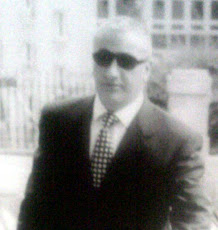
In light of WMR's previous report on Mossad playing a substantial role in the devastating bombing of downtown Oslo, we have obtained an exclusive photograph of a suspected Israeli intelligence operative laughing it up with an Indonesian police officer on October 13, 2002, the morning after the deadly bombings of the night club district of Kuta in Bali at 11:05 pm on October 12. At least 202 and maybe as many as 400 people died in the twin explosions. Most of the dead were Australians on holiday. The attack spurred Australian Prime Minister John Howard into joining the U.S.-British war in Afghanistan and, later, in Iraq.

The western man pictured, the only westerner seen in the immediate vicinity of Bali's "Ground Zero," is standing at the police lines and looking toward the bombed and burned out debris of the Paddy Pub and the Sari Club, located across the street. While the civilian Balinese and Indonesian Marines, Army, police, and Special Forces were traumatized by what happened the night before, the suspected Israeli was noticeably happy at the somber scene of destruction. He was so happy, a journalist immediately dispatched to the scene from Jakarta decided to snap the man's photograph. The man's joviality at a scene where there were human intestines and other body parts strewn across exposed re-bar stripped of concrete and hideously burned bodies made him the subject of immediate suspicion.

Laughing it up at a horrific bombing scene on Bali in 2002.
Israelis have a sordid history of relishing in terrorist bombings from New York and Beirut to Bali and Oslo.


The reaction of the unknown celebrator of the Bali bombing is similar to the celebration of five known Mossad agents witnessed celebrating the first impact of an aircraft into the World Trade Center on September 11. 2001, from a location at Liberty State Park in Jersey City, immediately across the Hudson River from lower Manhattan.

The following is WMR's report dated August 12, 2008, on the Bali bombing and its aftermath, including FBI spying on U.S. journalists:

Recently, FBI director Robert Mueller called New York Times executive editor Bill Keller and Washington Post executive editor Leonard Downie, Jr. and apologized for the FBI improperly obtaining phone records on their Jakarta, Indonesia-based reporters in 2004 during a "national security investigation." FBI agents apparently by-passed judicial authorization in declaring that an emergency existed in their desire to discover with whom the reporters were communicating.

The reporters affected by the FBI surveillance were the Post's Ellen Nakashima and Natasha Tampubolon and the Times' Raymond Bonner and Jane Perlez.

WMR has learned from another Jakarta-based journalist that the FBI was attempting to discover what information the journalists may have obtained on a false flag operation involving the deadly 2002 bombings in Bali that was blamed by the United States on Jemmah Islamiya, the Southeast Asian affiliate of "Al Qaeda."

On March 27, 2007, WMR reported on the subject of the FBI's interest in Jakarta-based correspondents: "Our Indonesian and American sources report that there was a significant U.S. and Israeli military-intelligence connection to the October 12, 2002 bombings of the Sari Club in Bali, Indonesia. A DeHavilland Dash-7 aircraft registered in Queensland, Australia, landed at Denpasar Airport in Bali only hours before a massive explosion ripped through the Sari Club, killing over 200 people, many of them vaporized.

Our sources claim that an Israeli military team arrived at Denpasar Hospital a after the explosion and claimed four bodies of white men in uniform and flew them out of Bali on the Dash 7. The plane took off an hour after the explosion. Our sources have revealed the plane was permitted to pass through Singapore for an unknown destination.

After the bombing and the plane’s departure, the tower logs were altered at Denpasar Airport to indicate the Dash 7 had not landed there. However, in a major oversight, the apron logs were not tampered with. Our sources have revealed the Dash 7 was Israeli-owned.

Several victims of the Sari Club bombing at Kuta Beach had flash burns on their bodies -- something common with people exposed to a nuclear blast. Our sources also have revealed that a CIA contract agent -- an Indonesian national -- was at Kuta Beach the day before the terrorist bombing. He is also known to have been involved in other terrorist attacks on behalf of the CIA since 1998.

Our sources also indicate that the then-U.S. ambassador to Indonesia, Ralph Boyce, who is now posted as ambassador to Thailand, was fully aware of U.S. intelligence pre-knowledge of the terrorist bombing in Bali. Boyce told the American managing editor of the Jakarta Post that it would be unhelpful if the paper pursued the U.S. angle in the Bali bombing."

The FBI appears to have been interested in the identities of the sources for a number of Jakarta-based journalists investigating the Bali bombings. However, the bureau only required authorization for surveillance of journalists defined as "U.S. persons" under intelligence collection statutes.

U.S. ambassador Boyce exerted tremendous pressure on Syafie Ma'arif, the head of Indonesia's second largest Muslim organization, Muhammadiyah, to ensure accused Bali and Jakarta Marriott Hotel bombing mastermind, the elderly Abu Bakar Bashir remained in prison. In 2003, Bashir was cleared on leading Jemmah Islamiyah but was not released from prison until 2004. Boyce was accused of manufacturing evidence against Bashir and wanting to keep him in prison to prevent the cleric from providing evidence linking U.S. intelligence to the bombings in Indonesia. The Bali bombings, which killed 202 people, many of them Australian, were portrayed as Australia's "9/11" in a propaganda ploy to convince Australia to commit troops to the Iraq war.

Even before the Bali bombings, the Bush administration attempted to get the government of President Megawati Sukarnoputri to secretly arrest Bashir and hand him over to the United States for extraordinary rendition. Megawati refused the request made in a meeting between Megawati and Boyce, National Security Council official Karen Drook, State Department interpreter Fred Burks, and an unidentified CIA agent. The CIA agent warned Megawati that there "would be a problem" if Bashir was not handed over to the United States. A month later, terrorist bombs ripped through the Bali tourist spots.


Tokyo -- No bridges over troubled waters in Asia, Vacuum left by United States being filled by other players.....


Tokyo -- No bridges over troubled waters in Asia, Vacuum left by United States being filled by other players.....


As the United States continues to fade as a global military and economic power, competing nations in Asia are vying to fill the vacuum left by the United States. Nowhere is the scramble by regional rivals more evident than in the waters of the northeastern Pacific.

Because Japan no longer trusts the quality of United States intelligence, it has embarked on creating its own foreign intelligence service, modeled on Britain's MI-6. U.S.-Japanese intelligence cooperation has existed since the end of World War II, but Japanese officials do not believe the United States has shared with Japan the type of intelligence that is seen as important for Japan's own national security interests in Asia.

The twin decline of the economies of the United States and Japan has prompted China to exercise a more aggressive stance, especially with regard to Taiwan and disputed maritime boundaries and islands in the waters of the eastern Pacific, including the South China and East China Seas.

Currently, China has a massive naval presence ringing the Japanese island of Okinawa, where the United States maintains a large military presence. The Chinese are conducting their naval exercise to demonstrate to the Americans that China can interdict the transport of U.S. Marines and aircraft to Taiwan in the event of a Chinese military attack.

China is also building a fleet of super-modern aircraft carriers, with the first expected to be deployed in 2015.

China has also become more aggressive in interdicting U.S. spy flights conducted near its waters, especially in the Taiwan Straits.

Japan and China are facing each other down over the disputed Senkaku Islands in the East China Sea, with Japanese Coast Guard vessels keeping a close eye on a Chinese maritime research vessel that had been deployed to waters off Uotsori island, part of the Senkakus, which are currently controlled by Japan. Taiwan also lays claim to the Senkakus.

Not only are Japan and China disputing the ownership of islands in the East China Sea, but Japan and South Korea are currently locked in a bitter dispute over some rocky and practically uninhabited specks of land in the Sea of Japan called the Liancourt Rocks. Japan claims what it calls the Takeshima islands but South Korea, which calls the islets Dokdo, also claims ownership. South Korea has upped the ante by announcing plans to build a base on the islands, a move that is bound to trigger a response from Japan.

North Korea also claims the Liancourt Rocks.

China and South Korea both claim Socotra Rock, a submerged rocky mass in the East China Sea.

Rival claims to the Spratley and Paracel islands in the South China Sea, has nations seeking to enforce their claims scrambling to build up their own military forces and forge new alliances. The United States and Vietnam are establishing new military links. Vietnam is locked in a war of words with China over rival claims to the Paracels. Tensions have also increased between the Philippines and China over sovereignty of disputed Spratley islands, as well as Scarborough Shoal. Taiwan, Malaysia, and Brunei have also staked claims to the islands.

Currently, the maritime boundary and island disputes have been relegated to wars of words and military "show of force" exercises. However, with American influence receding, it is only a matter of time before the chest beating between the rival regional powers could escalate into something more dangerous to the peace of the region.

Japan re-assesses its role in the world and Asia....

Tokyo -- On anniversary of U.S. A-Bomb attack on Hiroshima, a national re-awakening in Japan.....

On this 66th anniversary of the dropping of the atomic bomb by the United States on Hiroshima, there is a general sense that the Japanese people are involved in a national re-awakening. With the people of Japan nervously eyeing the fluctuating levels from the crippled nuclear reactors at Fukushima, the Japanese people are no longer willing to accept everything their government tells them at face value. And there is the belief by many that Fukushima may have been Japan's "Chernobyl" moment. The Chernobyl nuclear disaster in the Soviet republic of Ukraine in 1986 and the Kremlin's policy of lying about the scope of the disaster is thought to have been a contributing factor to the downfall of the Soviet regime.

Similarly, the government of Prime Minister Naoto Kan was roundly condemned by many Japanese for acting as a virtual public relations arm for the Fukshima complex's operator, the once politically-powerful Tokyo Elecrtric Company (TEPCO). Government oversight of the Japanese nuclear industry was seen as being nothing more than providing window dressing without any regulatory teeth. There are calls for the new oversight authority, the Nuclear Safety Agency, to have more independence from the government and the nuclear industry and provide real regulatory oversight over an industry that for years has curried political favors from successive Japanese governments.

A government panel has now concluded that TEPCO must pay compensation to inns, tour operators, travel agencies, and hotels last lost money after foreign tourists canceled their trips to Japan amid worries over the effects of radiation from the crippled Number 1 nuclear plant at Fukushima. TEPCO has also been ordered to compensate the tea, flower, beef, and manufacturing sectors.

The blow to Japan's economy from the March earthquake, tsunami, and nuclear meltdown has many Japanese fearful about international financial vultures manipulating the Japanese economy for their own personal gain. The increase in value of the yen, which adversely affects Japanese exports, is believed to be a part of the manipulation by the same group of bankers who have wreaked havoc on the economies of Greece, Portugal, Ireland, Italy, Spain, and the United States, forcing the adoption of crippling austerity measures that cuts sustaining wages and benefits to the middle and lower classes.

If Japan ends up in the same boat as some European countries and the United States, there is a fear in Japan that there could be an International Monetary Fund-dictated massive sell-off of public property and the end of Japan's generous social safety net programs, including public health care.

There are even whispers by some influential Japanese that it is such interests as the Rothschild banking family that is secretly manipulating the attacks on the Japanese economy, sensing its vulnerability is the aftermath of the triple quake, tsunami, and nuclear disasters. The concurrent belief that Japan never actually re-gained its independence after General Douglas MacArthur's occupation regime came to power after Japan's surrender in 1945 is also gaining strength.

Distrust of the United States, seen as being in the hip-pocket of the Rothschild-George Soros-Goldman Sachs axis, coupled with a fear of the growing military and economic might to China, which has overtaken Japan as the world's second-largest economy, has resulted in growing calls for Japan to, once again, re-assert its political and military muscle by scrapping the U.S.-imposed Self Defense Forces and engaging in a rapid military build-up that would enable Japan to project its power beyond its own airspace and waters.


Amid the concrete and glass towers of Tokyo there are stirrings about what the global bankers have in store for Japan.


Jeju: From peace island to war island....

by John Eperjesi


Korean-American writer Paul Yoon's 2009 short story collection Once the Shore (Sarabande), which won the prize for fiction at the 13th Asian American Literary Awards, is set on a fictionalized version of Jeju Island and deals with the devastating impact of militarism, colonialism, and the cold war on a rugged island culture.

In Once the Shore, Yoon gives us Oceania from below, an island multitude composed of service workers, farmers, divers, fishermen, war orphans, and various others who form strange friendships across barriers of age, gender, ethnicity, and nationality. The lead story is set in the present and opens with a sixty-something American woman at a high-end tourist resort gazing out over the ocean while thinking about her deceased husband, a Korean War veteran who she comes to realize probably cheated on her and lied about it when he returned from the war.

She befriends a young Korean waiter who often stands behind her listening, "as if it weren't her voice at all, but one that originated from the sea." During the woman's visit, the waiter's brother, a fisherman, is killed when an American submarine on training exercises surfaces and sinks his fishing boat.

Throughout the story, the waiter fixates on the terror of drowning. Cold War past and present is fused in the widow's and waiter's discrepant memories of loved ones, their awkward, distracted friendship grounded in the ability to partially identify with the other's loss, a process of identification that appears as each gazes silently out over the ocean, beneath the glimmering surface of which submarines cruise like whales on a hunt. Yoon has commented that the initial idea for this story came from the sinking of the Ehime Maru, a Japanese fishing boat, by the USS Greenville, an American nuclear-powered submarine, off the coast of Oahu in 2001.

The relevance of Yoon's stories to the real Jeju Island has recently intensified as concrete has begun to pour on coral reefs to make way for an "eco-friendly" military base for South Korea's expanding blue water navy, at the head of which is the 18,000 ton assault ship symbolically named the Dokdo, which makes it almost as big as the island in the East Sea it is named after.

Many believe that the base may also provide "lily pad" support for the United States Navy. Leading local activists in the anti-base movement have been arrested while peace activists from all over the world have begun to lend their support, most notably feminist writer Gloria Steinem.

In a letter to friends that has circulated widely on the Internet, Steinem describes the epic volcanic beauty of Jeju Island, which is home to three United Nations Educational, Scientific and Cultural Organization World Heritage Sites. Steinem concludes the letter stating, "Jeju Island means Women's Island. It stands for an ancient balance. We must save it from the cult of militarism that endangers us all, women and men." Jeju is home to both The International Peace Institute and Jeju Peace Forum. In 2005, former Korean president Roh Moo-hyun declared Jeju an "Island of World Peace."

Both Mongolia, which ruled Jeju from 1273 to 1374, and Japan, which ruled Jeju from 1910 to 1945, fought to capitalize on Jeju's strategic proximity to China, Russia, and Japan. In 1948, a multitudinous protest movement on Jeju known as the April 3 Uprising organized against the appointment of Syngman Rhee as president of Korea by the US military.

The violent crackdown on supposed communists and communist-sympathizers by the South Korean army resulted in the death of somewhere around 30,000 Jeju civilians. The April 3 Uprising has become a symbol of Jeju's independence from the mainland. As historian Bruce Cumings notes, "The people were deeply separatist and did not like mainlanders; their wish was to be left alone." This attitude is reflected in the Korean drama Tamra: the Island, which is set on Jeju during the 17th century and depicts tensions between the between local divers and farmers and an exploitative Confucian elite residing in Seoul.

Protesters are concerned about the cultural and environmental impacts of the base and it is estimated that as much as 90% of the people of Gangjeong, the village on the southern part of Jeju where the base is being constructed, are currently in opposition. The histories of colonialism and the cold war are still alive in the bodies and minds of the people of Jeju who fought against both Japanese colonialism and cold war authoritarianism.

The remilitarization of Jeju could pour salt water on wounds that have never fully healed. In an article in the Jeju Weekly, Dr Anne Hilty, a cultural health psychologist living on Jeju Island writes: "In a society brutalized and traumatized by the national military, the idea of a military base on the island which will house 25,000 troops is difficult for Jeju's people to accept."

The November 23, 2010 bombing, evacuation, and increased military deployment on Yeonpyeong Island located near the disputed maritime border of North and South Korea made it clear that the cold war is still hot in this part of the world. We are currently witnessing a re-cold warring of the Pacific Rim of Asia as China looks to expand control over shipping lanes in the South China Sea and the US and Korea move to contain China by expanding into the East China Sea.

When I first moved to Korea in 2005, I believed that I would see a peaceful end to the Korean War in my lifetime. But with the wreckage of militarization piling up from all directions in the Asia-Pacific region, that hope is being blown farther and farther into the future. In a recent article for Project Syndicate, former Philippines president Fidel Ramos argues that a Pax Asia-Pacifica needs to replace Pax Americana in the region in order to "contain our rivalries and avoid the arms buildup that, unfortunately, now seem to be underway".

Fictional narratives like Once the Shore and Tamra: the Island work to restore humanity to islanders, a humanity that is stripped away when islands are viewed as strategic pieces in a regional game of risk. There was no great outpouring of support in South Korea for the people of Yeonpyeong, and there have been no candlelight vigils in downtown Seoul over the basing of Jeju, perhaps because as islanders, the people of Yeonpyeong and Gangjeong are islanders on the periphery of the nation. But what about the people for whom the periphery is the center? For whom the island is the mainland?


Thursday, August 4, 2011

The Infamous White House Murder INC, and A secret war in 120 countries....


The Infamous White House Murder INC, and A secret war in 120 countries....
By Nick Turse

Somewhere on this planet an American commando is carrying out a mission. Now, say that 70 times and you're done ... for the day. Without the knowledge of the American public, a secret force within the United States military is undertaking operations in a majority of the world's countries. This new Pentagon power elite is waging a global war whose size and scope has never been revealed, until now.

After a US Navy SEAL put a bullet in Osama bin Laden's chest and another in his head while storming his compound in Pakistan, one of the most secretive black-ops units in the American military suddenly found its mission in the public spotlight. It was atypical. While it's well known that US Special Operations forces are deployed in the war zones of Afghanistan and Iraq, and it's increasingly apparent that such units operate in murkier conflict zones like Yemen and Somalia, the full extent of their worldwide war has remained deeply in the shadows.

Last year, Karen DeYoung and Greg Jaffe of the Washington Post reported that US Special Operations forces were deployed in 75 countries, up from 60 at the end of the George W Bush presidency. By the end of this year, US Special Operations Command spokesman Colonel Tim Nye told me that number will likely reach 120. "We do a lot of traveling - a lot more than Afghanistan or Iraq," he said recently. This global presence - in about 60% of the world's nations and far larger than previously acknowledged - provides striking new evidence of a rising clandestine Pentagon power elite waging a secret war in all corners of the world.

The rise of the military's secret military
Born of a failed 1980 raid to rescue American hostages in Iran, in which eight US service members died, US Special Operations Command (SOCOM) was established in 1987. Having spent the post-Vietnam years distrusted and starved for money by the regular military, special operations forces suddenly had a single home, a stable budget, and a four-star commander as their advocate.

Since then, SOCOM has grown into a combined force of startling proportions. Made up of units from all the service branches, including the army's "Green Berets" and Rangers, Navy SEALs, Air Force Air Commandos, and Marine Corps Special Operations teams, in addition to specialized helicopter crews, boat teams, civil affairs personnel, para-rescuemen, and even battlefield air-traffic controllers and special operations weathermen, SOCOM carries out the United States' most specialized and secret missions.

These include assassinations, counter-terrorist raids, long-range reconnaissance, intelligence analysis, foreign troop training, and weapons of mass destruction counter-proliferation operations.

One of its key components is the Joint Special Operations Command, or JSOC, a clandestine sub-command whose primary mission is tracking and killing suspected terrorists. Reporting to the president and acting under his authority, JSOC maintains a global hit list that includes American citizens. It has been operating an extra-legal "kill/capture" campaign that John Nagl, a past counter-insurgency adviser to four-star general and soon-to-be Central Intelligence Agency (CIA) director David Petraeus, calls "an almost industrial-scale counter-terrorism killing machine".

This assassination program has been carried out by commando units like the Navy SEALs and the Army's Delta Force as well as via drone strikes as part of covert wars in which the CIA is also involved in countries like Somalia, Pakistan, and Yemen. In addition, the command operates a network of secret prisons, perhaps as many as 20 black sites in Afghanistan alone, used for interrogating high-value targets.

Growth industry
From a force of about 37,000 in the early 1990s, Special Operations Command personnel have grown to almost 60,000, about a third of whom are career members of SOCOM; the rest have other military occupational specialties, but periodically cycle through the command.

Growth has been exponential since September 11, 2001, as SOCOM's baseline budget almost tripled from $2.3 billion to $6.3 billion. If you add in funding for the wars in Iraq and Afghanistan, it has actually more than quadrupled to $9.8 billion in these years. Not surprisingly, the number of its personnel deployed abroad has also jumped four-fold. Further increases, and expanded operations, are on the horizon.

Lieutenant General Dennis Hejlik, the former head of the Marine Corps Forces Special Operations Command - the last of the service branches to be incorporated into SOCOM in 2006 - indicated, for instance, that he foresees a doubling of his former unit of 2,600. "I see them as a force someday of about 5,000, like equivalent to the number of SEALs that we have on the battlefield. Between [5,000] and 6,000," he said at a June breakfast with defense reporters in Washington. Long-term plans already call for the force to increase by 1,000.

During his recent senate confirmation hearings, Navy Vice Admiral William McRaven, the incoming SOCOM chief and outgoing head of JSOC (which he commanded during the bin Laden raid) endorsed a steady manpower growth rate of 3% to 5% a year, while also making a pitch for even more resources, including additional drones and the construction of new special operations facilities.

A former SEAL who still sometimes accompanies troops into the field, McRaven expressed a belief that, as conventional forces are drawn down in Afghanistan, special ops troops will take on an ever greater role. Iraq, he added, would benefit if elite US forces continued to conduct missions there past the December 2011 deadline for a total American troop withdrawal. He also assured the Senate Armed Services Committee that "as a former JSOC commander, I can tell you we were looking very hard at Yemen and at Somalia".

During a speech at the National Defense Industrial Association's annual Special Operations and Low-intensity Conflict Symposium earlier this year, Navy Admiral Eric Olson, the outgoing chief of Special Operations Command, pointed to a composite satellite image of the world at night. Before 9/11, the lit portions of the planet - mostly the industrialized nations of the global north - were considered the key areas. "But the world changed over the last decade," he said. "Our strategic focus has shifted largely to the south ... certainly within the special operations community, as we deal with the emerging threats from the places where the lights aren't."

To that end, Olson launched "Project Lawrence", an effort to increase cultural proficiencies - like advanced language training and better knowledge of local history and customs - for overseas operations. The program is named after the British officer, Thomas Edward Lawrence (better known as "Lawrence of Arabia"), who teamed up with Arab fighters to wage a guerrilla war in the Middle East during World War I. Mentioning Afghanistan, Pakistan, Mali and Indonesia, Olson added that SOCOM now needed "Lawrences of Wherever".

While Olson made reference to only 51 countries of top concern to SOCOM, Nye told me that on any given day, Special Operations forces are deployed in approximately 70 nations around the world. All of them, he hastened to add, at the request of the host government.

According to testimony by Olson before the House Armed Services Committee earlier this year, approximately 85% of special operations troops deployed overseas are in 20 countries in the CENTCOM area of operations in the Greater Middle East: Afghanistan, Bahrain, Egypt, Iran, Iraq, Jordan, Kazakhstan, Kuwait, Kyrgyzstan, Lebanon, Oman, Pakistan, Qatar, Saudi Arabia, Syria, Tajikistan, Turkmenistan, United Arab Emirates, Uzbekistan, and Yemen. The others are scattered across the globe from South America to Southeast Asia, some in small numbers, others as larger contingents.

Special Operations Command won't disclose exactly which countries its forces operate in. "We're obviously going to have some places where it's not advantageous for us to list where we're at," says Nye. "Not all host nations want it known, for whatever reasons they have - it may be internal, it may be regional."

But it's no secret (or at least a poorly kept one) that so-called black special operations troops, like the SEALs and Delta Force, are conducting kill/capture missions in Afghanistan, Iraq, Pakistan, and Yemen, while "white" forces like the Green Berets and Rangers are training indigenous partners as part of a worldwide secret war against al-Qaeda and other militant groups.

In the Philippines, for instance, the US spends $50 million a year on a 600-person contingent of Army Special Operations forces, Navy Seals, Air Force special operators, and others that carries out counterterrorist operations with Filipino allies against insurgent groups like Jemaah Islamiyah and Abu Sayyaf.

Last year, as an analysis of SOCOM documents, open-source Pentagon information, and a database of Special Operations missions compiled by investigative journalist Tara McKelvey (for the Medill School of Journalism's National Security Journalism Initiative) reveals, America's most elite troops carried out joint-training exercises in Belize, Brazil, Bulgaria, Burkina Faso, Germany, Indonesia, Mali, Norway, Panama, and Poland.

So far in 2011, similar training missions have been conducted in the Dominican Republic, Jordan, Romania, Senegal, South Korea, and Thailand, among other nations. In reality, Nye told me, training actually went on in almost every nation where Special Operations forces are deployed. "Of the 120 countries we visit by the end of the year, I would say the vast majority are training exercises in one fashion or another. They would be classified as training exercises."

The Pentagon's power elite
Once the neglected stepchildren of the military establishment, Special Operations forces have been growing exponentially not just in size and budget, but also in power and influence. Since 2002, SOCOM has been authorized to create its own Joint Task Forces - like Joint Special Operations Task Force-Philippines - a prerogative normally limited to larger combatant commands like CENTCOM. This year, without much fanfare, SOCOM also established its own Joint Acquisition Task Force, a cadre of equipment designers and acquisition specialists.

With control over budgeting, training, and equipping its force, powers usually reserved for departments (like the Department of the Army or the Department of the Navy), dedicated dollars in every Defense Department budget, and influential advocates in congress, SOCOM is by now an exceptionally powerful player at the Pentagon.

With real clout, it can win bureaucratic battles, purchase cutting-edge technology, and pursue fringe research like electronically beaming messages into people's heads or developing stealth-like cloaking technologies for ground troops. Since 2001, SOCOM's prime contracts awarded to small businesses - those that generally produce specialty equipment and weapons - have jumped six-fold.

Headquartered at MacDill Air Force Base in Florida, but operating out of theater commands spread out around the globe, including Hawaii, Germany and South Korea, and active in the majority of countries on the planet, Special Operations Command is now a force unto itself.

As outgoing SOCOM chief Olson put it earlier this year, SOCOM "is a microcosm of the Department of Defense, with ground, air, and maritime components, a global presence, and authorities and responsibilities that mirror the Military Departments, Military Services, and Defense Agencies".

Tasked to coordinate all Pentagon planning against global terrorism networks and, as a result, closely connected to other government agencies, foreign militaries, and intelligence services, and armed with a vast inventory of stealthy helicopters, manned fixed-wing aircraft, heavily-armed drones, high-tech guns-a-go-go speedboats, specialized Humvees and Mine Resistant Ambush Protected vehicles, or MRAPs, as well as other state-of-the-art gear (with more on the way), SOCOM represents something new in the military.

Whereas the late scholar of militarism Chalmers Johnson used to refer to the CIA as "the president's private army", today JSOC performs that role, acting as the chief executive's private assassination squad, and its parent, SOCOM, functions as a new Pentagon power-elite, a secret military within the military possessing domestic power and global reach.

In 120 countries across the globe, troops from Special Operations Command carry out their secret war of high-profile assassinations, low-level targeted killings, capture/kidnap operations, kick-down-the-door night raids, joint operations with foreign forces, and training missions with indigenous partners as part of a shadowy conflict unknown to most Americans. Once "special" for being small, lean, outsider outfits, today they are special for their power, access, influence, and aura.

That aura now benefits from a well-honed public relations campaign which helps them project a superhuman image at home and abroad, even while many of their actual activities remain in the ever-widening shadows. Typical of the vision they are pushing was this statement from Admiral Olson: "I am convinced that the forces ... are the most culturally attuned partners, the most lethal hunter-killers, and most responsive, agile, innovative, and efficiently effective advisors, trainers, problem-solvers, and warriors that any nation has to offer."

Recently at the Aspen Institute's Security Forum, Olson offered up similarly gilded comments and some misleading information, too, claiming that US Special Operations forces were operating in just 65 countries and engaged in combat in only two of them. When asked about drone strikes in Pakistan, he reportedly replied, "Are you talking about unattributed explosions?"

What he did let slip, however, was telling. He noted, for instance, that black operations like the bin Laden mission, with commandos conducting heliborne night raids, were now exceptionally common. A dozen or so are conducted every night, he said. Perhaps most illuminating, however, was an offhand remark about the size of SOCOM. Right now, he emphasized, US Special Operations forces were approximately as large as Canada's entire active duty military. In fact, the force is larger than the active duty militaries of many of the nations where America's elite troops now operate each year, and it's only set to grow larger.

Americans have yet to grapple with what it means to have a "special" force this large, this active, and this secret - and they are unlikely to begin to do so until more information is available. It just won't be coming from Olson or his troops. "Our access [to foreign countries] depends on our ability to not talk about it," he said in response to questions about SOCOM's secrecy. When missions are subject to scrutiny like the bin Laden raid, he said, the elite troops object. The military's secret military, said Olson, wants "to get back into the shadows and do what they came in to do."

Nick Turse is a historian, essayist, and investigative journalist.

Wednesday, August 3, 2011

Russia reaches out to Iran, partners in a substantive Middle East project....?


Russia reaches out to Iran, partners in a substantive Middle East project....?
By M K Bhadrakumar

http://sassywire.wordpress.com/2011/05/13/russia-blocks-un-report-on-iran-arms/


A recurring feature of the Russian-Iranian relationship is that it mostly languishes on the horizon but can be trusted to move to the center stage whenever there is a criticality in the Middle East situation. Iranian Foreign Minister Ali Akbar Salehi made a point recently in an interview with the Russian media when he described Iran as the "most significant neighbor" of Russia, which stands in the way of the Western strategy to encircle Russia.

The message was unmistakable: "You need us more than we need you.' To be sure, Russian-Iranian relationship is tiptoeing to the center stage. The steady erosion of the "reset" in the ties between the United States and Russia provides the big backdrop.

Meanwhile, the US-Iran standoff has aggravated lately, calibrated largely by the Jewish lobby in America, which exploits the overall

drift in the Barack Obama administration. Other templates are also appearing which draw Moscow and Tehran together - the US's missile defense program, the Turkish question, Syria, Iraq and Afghanistan.

Against this backdrop, Moscow has hurriedly scheduled an intensive strategic dialogue with Tehran during the coming fortnight. Russian National Security Council Secretary Nikolai Patrushev is heading for Tehran next weekend and immediately thereafter Salehi is paying an official visit to Moscow.

It appears that ignoring the US-Israeli protestations, Tehran and Moscow are finally going ahead with the formal commissioning of the Bushehr nuclear power plant in Iran built by Russia, drawing to a close a 13-year saga dripping with the geopolitics of the Middle East.

The Iranian Foreign Ministry has confirmed that the agenda of the consultations with Patrushev will include the Iran nuclear issue. Tehran has lately warmed to the Russian proposal for a "phased" approach to resolve the impasse over the nuclear impasse whereby there could be an easing of sanctions in a staged schedule in lieu of steps by Iran to address the international concerns and the unresolved issues with the International Atomic Energy Agency. The Russians are moving on this front on the basis of prior consultations with Washington.

The expectation seems to be that if positive impulses can be generated during Patrushev's consultations in Tehran, follow-up talks during Salehi's visit to Moscow could generate momentum for breaking the deadlock on the nuclear issue. Significantly, Iranian President Mahmud Ahmadinejad will be attending the United Nations general assembly session in September in New York.

The Israeli propaganda of a schism within the Iranian regime stands exposed. Tehran's decision to engage Russia on the nuclear issue carries the imprimatur of Supreme Leader Ali Khamenei. (So indeed, Ahmadinejad's choice of the former Islamic Revolutionary Guards Corps commander Rostam Qasemi as Iran's new oil minister.)

What is there in it for Moscow? Aside an overall lowering of tensions in the Middle East, Moscow hopes to place itself right in the first circle of a process, which could have positive fallouts for the US-Russia reset. Moscow is doing all it can to forestall Washington from placing the components of the missile defense system in the Black Sea region, especially in Turkey.

Russia's envoy to the North Atlantic Treaty Organization (NATO), Dmitry Rogozin, recently made the allegation while on a visit to Ankara that the anti-ballistic missiles (ABM) deployment in Turkey could be prelude to a US military attack on Iran.

Both Moscow and Tehran are perturbed over the fluidity in the Turkish policies over Syria. The Islamist government of Recep Tayyip Erdogan played a double game - systematically destabilizing Syria and weakening it while professing interest in peaceful democratic reforms; flaunting empathy with the Arab Spring while succumbing to the temptations of "green money" from Saudi Arabia and Qatar.

Erdogan's future trajectory following the recent crisis with the Turkish army leadership is a question of utmost concern for both Moscow and Tehran. (See
Turkey says farewell to the generals, Asia Times Online, August 4.) An uncertain period lies ahead. A Jerusalem Post editorial comment on Wednesday said:
As the prospects for joining the European Union dim, Erdogan clearly aims to shift Turkey's focus toward the Muslim east. With secular opposition parties weakened, Erdogan has also become increasingly autocratic.

In this nation - torn between Westernization and traditional Islam - the unraveling of the Kemalist legacy and the resurgence of Islamist populism at the expense of the military will reverberate well beyond Turkey's borders. It is a clear and troubling signal - if we are only discerning enough to hear it - that the dissociation of Turkey from the West is already upon us.
Russian and Iranian interests would lie in Erdogan pursuing an independent foreign policy course. Erdogan's inclination to allow the deployment of the ABM becomes an acid test of his regional policies. But it is over Syria that Moscow and Tehran have drawn very close. Both voiced support of reforms in Syria and abhorrence of outside interference.

Salehi said last week: "We see the deliberate misrepresentation of the Syrian people's demands by external forces, it is unacceptable ... What we see here is a clear picture of foreign involvement serving colonialist interests ... Syria plays a very important role in the region. It has significant influence in the Middle East, being at the forefront of resistance against the Zionist state. And the pressure currently exerted on Syria is directly related to this country's role in such resistance."

Tehran is pleased that Moscow will not repeat the mistake over Libya in allowing the West to grab the fig leaf of a UN mandate for armed intervention in the conflict. From Iran's viewpoint, Russia's firm stance on Syria is a litmus test of Moscow's grit to hold the ground in the face of US pressure. Russian Deputy Foreign Minister Mikhail Bogdanov said on Monday in an interview in Moscow:
We believe that Syrians should address their problems as part of their domestic agenda. This is an internal civil conflict and it should not be internationalized ... On the other hand, we should learn from our lessons. This refers to the UN resolution on Libya. We are all witness to it and we still see it now - that a number of international players tend to digress from the strict observance of the instruction and the spirit of the resolution.
Again, Moscow appreciates the nuanced role that Iran plays in Iraq - not confrontational with the US and albeit passive or sub-optimal at times, never collaborative with the US. The controlled animation over the US's Iraq predicament is entering a new phase with the Barack Obama administration throwing all pretence to the wind and virtually pleading with Baghdad to allow 10,000 troops to be stationed in that country beyond the December 2011 cut-off date.

Tehran openly and vociferously opposes long-term US military presence in Iraq whereas Russia refrains from voicing strong opinions and seems lost in thought. But neither Russia nor Iran stands to gain from an unstable Middle East and what they seek is an end to the US's cold-war era pre-eminence in the region.

However, Moscow and Tehran have quite some distance to cover to become real partners in a substantive Middle East project.

Simply put, mutual trust and confidence needs to be built in a sustained way. The suspicion is mutual that the other side may covertly strike a deal with Washington. Iran has had unhappy experiences of being a victim of the US-Russia reset. Moscow would wonder whether Iran would have time to spare if a US-Iran normalization does materialize at some point.

Thus, the commissioning of Bushehr assumes importance. Russia balked at the last minute many a time at various stages of the Bushehr project. Moscow would factor in that displeasing Tehran once again at the present juncture could prove injudicious. With the US's policies in the Middle East in disarray, a political dialogue with Tehran is indeed becoming necessary for Washington at some stage.

The geopolitical reality is that Iran's regional influence is poised to increase. The West's quagmire in Libya and the collapse of its attempts to overthrow the Syrian regime; Turkey's lurch toward Muslim Middle East and the breakdown in its relations with Israel; the collapse of the US-Israeli-Saudi axis and the surge of the Syrian-Iranian axis; US predicaments in Iraq and Afghanistan; Egypt-Iran rapprochement; high probability of UN recognition for Palestinian statehood; and not least of all, China's determination to build a strategic partnership with Iran - all these work to Tehran's advantage.

To add to it, Tehran has now begun a fence-mending with Riyadh and if the International Monetary Fund is to be believed, the Iranian economy is doing well.

Moscow would be aware that any further neglect of the strategic ties with Iran can impact negatively on its Middle East policies. The initiative on the nuclear issue enables Moscow to play back into the game, as it were, and resuscitate the strategic dialogue with Iran.

Tuesday, August 2, 2011

The military-civilian stand-off in Turkey appears to be more serious....


The military-civilian stand-off in Turkey appears to be more serious, USA grows a tree of tension with Iran....


  • Sacking of Turkish top military officers appears to have been something more serious -- perhaps the suppression of an attempted military coup by Ergenekon holdouts. Reuters/Rothschild calls Ergenekon an "alleged conspiracy." There's nothing alleged about the Rothschild/Israeli connection to Ergenekon and the Turkish Donmeh. Turkey's situation linked to Breivik and his Zio-Nazi network: Breivik had a keen interest in Ergenekon's tactics. A European-wide set of coups appears to have been in the Zio-Nazi playbook -- Breivik also sought to launch a coup against Norwegian government and King Harald V. Breivik refuses to divulge other cells but he had traveled to several countries: Sweden, Denmark, UK, Germany, Poland, Belarus (where he underwent paramilitary training), France, Austria, Hungary, Croatia, Lithuania, Estonia, Latvia, Switzerland, Spain, Cyprus, Malta, US (where he allegedly visited for two months last year Lake Elmo, Minnesota, the home of Bachmann & Associates, the "de-gaying" clinic owned by Marcus Bachmann, husband of GOP presidential candidate Michele Bachmann), Turkey, Mexico, China, Nigeria, Cote d’Ivoire and Liberia. Cyprus has seen political instability since a massive explosion of a weapons cache at its main naval base, which also destroyed Cyprus's main power plant forcing blackouts. President Demetris Christofiasis the first president from the Communist AKEL Party. From Norway to Turkey and Cyprus, a connected network, with links to Israel, appears to be targeting nations that support Palestinian sovereignty....


  • http://www.hurriyetdailynews.com/n.php?n=standoff-resolved-for-now-civil-military-ties-still-at-odds-2010-08-09


    A full-fledged tree of tension with Iran has been nurtured by Washington, firmly rooted in a comprehensive regime of sanctions, military encirclement, propaganda and psychological warfare, and a low-intensity proxy war through ethnic terrorist groups. It is now spiraling toward yet another confrontation in the Middle East.

    Instead of focusing on how to reduce tensions with Tehran, United States policymakers seem intent on ratcheting up the pressure and leveling every conceivable accusation against Iran - chiefly

    nuclear proliferation, regional subversion and terrorism - delivered in rapid succession.

    The US has now formally linked Tehran's regime with al-Qaeda in an escalation of anti-Iran rhetoric that is officially justified in Washington in terms of proving that the White House is "in control" of Middle East developments and not swamped by the domestic turmoil over the US national debt. Yet this is a lame excuse and raises the question of who really is in control of the US's Iran policy?

    From Tehran's vantage point, the answer is straightforward. According to a Tehran University political science professor, who spoke with the author on the condition of anonymity, "A select group of Jewish policymakers in the White House, State Department and Treasury have hijacked President Obama's policy on Iran and Obama may wake up one day and find the web of conflict with Iran so tightly wrapped around him that he has no choice but to lock horns with us."

    In other words, very few people in Iran still subscribe to the earlier hope that Obama was seeking a new Iran policy, or that sanctions were an alternative to war, since they are slowly but surely proving to be a prelude to it. America's problem is, however, that it is financially drained as a result of costly wars and a conflict with Iran could have potentially disastrous implications for the global economic recovery by triggering skyrocketing energy prices, not to mention complicating the cauldron of multiple crises in the Middle East.

    The political upheaval in the Middle East represents a major challenge to the US, which sees its traditional authority in various parts of the Arab world, including Egypt, Yemen and Bahrain, enveloped by serious question marks - this while there is very little the US can do to stop the momentum for Palestinian statehood now building up at the United Nations without further sullying its image in the Arab and Muslim world.

    This has led some Tehran pundits to speculate that the US and Israel intend to artificially inflate the Iran nuclear crisis this autumn to deflect attention from the Palestinian issue. A problem with this approach is that it may diminish or even completely erase the areas of shared interests between the US and Iran, above all in Iraq and Afghanistan, where both Washington and Tehran back the same political horses.

    Iran is disquieted by reports that indicate the US is seeking to extend its military presence in Iraq and build permanent bases, a move that has rattled the nationalist Iraqis, including those wearing the garb of militant Shi'ism, all the more reason for Tehran and Washington to consider security dialogues on Iraq, since Iran is a stakeholder in Iraq's security. Nor should the US bracket Iran from future meetings on Afghanistan, threatened by the Taliban and their al-Qaeda supporters, both anti-Shi'ite fundamentalists.

    As expected, Tehran has shrugged off Washington's latest accusation regarding its complicity with al-Qaeda, with some Tehran political analysts dismissing it as "an old habit that is hard to kick", referring to the US's pretext of attacking Iraq partly by claiming a link between Baghdad and al-Qaeda. Is history repeating itself? If so, it will be as tragic as the 2003 fiasco.

    Washington and Tehran could turn the current crisis in their relations into an opportunity for detente and perhaps even rapprochement, indeed so much was hinted recently by Iran's former president, Ali Akbar Hashemi Rafsanjani; a US nod to the recent Russian "step by step" proposal to resolve the Iran nuclear crisis is also called for (see
    US rebuffs Russian ingenuity on Iran Asia Times Online, July 20 ).

    A timely catalyst may come in the form of the release of the two American hikers in Iran's custody, in which case a measure of good would be generated on the eve of President Mahmud Ahmadinejad's United Nations visit in September. In that case, the US may be forced to dangle carrots instead of sticks and thus show that goodwill begets goodwill.

    For now, however, there is virtually no sign of any American goodwill toward Iran, only animosity. Another clue to the tone of engagement is the delisting of the Iranian group, Mujahideen-e Khalq (MEK), from the US list of terrorist groups, which will be decided on in the next few weeks. This is bound to heighten tensions as Tehran abhors the US protection of the MEK's Camp Ashraf inside Iraq.

    The MEK's delisting is a particularly sensitive issue for Iran's leaders, who blame the group for the murder of many of the regime's top officials and as a result this will have a disproportionate impact in sowing the seeds of distrust between the two sides.

    Japan's Fresh Claim To Disputed Islands Reignites Feud With South Korea....


    Japan's Fresh Claim To Disputed Islands Reignites Feud With South Korea....


    A Japanese defense report released today reiterates the country's claims to a small chain of islands that South Korea also claims as its own.

    Known as Dokdo (Solitary islands) in Korea, Takeshima (Bamboo islands) in Japan. Also known as Liancourt rocks Japan's and South Korea's claims go back centuries, but islands occupied by S Korea since 1953. Just 230,000 sq m in size, with no fresh water. But surrounding waters valuable for their fishing....

    South Korean tourists are on a tour of Seodo, part of the disputed Dokdo islets, in the East Sea, South Korea, Monday, Aug. 1. South Korea has banned three Japanese lawmakers from entering the country after they arrived at a Seoul airport in an attempt to travel near the islands whose possession is in dispute between the neighbors. Seen in rear is Dongdo, also part of the disputed islands.

    A diplomatic showdown between Japan and South Korea is heating up over group of tiny rock outcroppings in the Japan Sea.

    Japan released its 2011 defense report today, reiterating its claim to a chain of small islands (see map here) also claimed by South Korea.

    The document comes a day after South Korea denied three Japanese lawmakers entry into the country. The three intended to visit Ulleung Island, the South Korean island closest to the disputed chain, known as the Dokdo Islands in South Korea and the Takeshima Islands in Japan. South Korean officials told the lawmakers that the visit could "trigger actions that would threaten public safety," the Japan Times reports.

    The topic is so sensitive that even the talk of a visit launched protests in South Korea.

    South Korea's Yonhap News Agency reports that the Japanese lawmakers' trip to Ulleung Island was seen as an attempt to bolster Japanese claims to the disputed island chain and that their entry was denied based on immigration laws that allow the government to ban people from entry who threaten the country's interests or public safety.

    Yoshitaka Shindo of Japan's main opposition group, the Liberal Democratic Party, warned that turning away them away would become "a big diplomatic problem," according to the Japan Times. "Takeshima is Japanese territory," Mr. Shindo said at the airport. "Our positions are different and we need to talk to each other on the issue."

    Japan has long claimed the islets as its own, but South Korea says they were returned to them after South Korea won independence from Japan in 1945. The feud was mostly dormant until this June, when Korean Air conducted a test flight of a new aircraft over the islets, according to CNN. Japan responded by banning its citizens from flying the airline.

    Yonhap reports:

    "The government's consistent and firm position is that Dokdo is our territory in terms of history, geography and international law," a ministry official told reporters on the condition of anonymity. "From this perspective, I deeply regret the fact that the Japanese government has again included unreasonable claims to Dokdo in this year's defense white paper, which are unhelpful to our bilateral relations."

    This year's defense paper repeats the same phrase that has been included since 2005, claiming that "the territorial issue of the Northern Territories and Takeshima, which are proper to Japan, remains in an unresolved state."

    A former Korean ambassador to Japan says that the Japanese lawmakers' visit was a move meant to bolster their domestic political standing. The conservative opposition hopes to convince the Japanese public that the ruling party isn't tough enough to protect the country's interests in territorial disputes, the Korea Times reports.

    A South Korean politician also sought to project himself as the strongest protector of his country's rights. The minister for special affairs, Lee Jae-oh, rumored to be running for president in the next election, visited Ulleung Island "to send an unmistakable message that Korea owns Dokdo."

    While politicians in both countries posture over the dispute, the South Korean government has tried to keep the diplomatic row a quiet one out of concern that an angry or violent response would undermine their claims to Dokdo, according to the Korea Times.


    Monday, August 1, 2011

    Breivik is tip of international iceberg of fascist extremists....Israeli co-option of Europe's far-right political parties


    Breivik is tip of international iceberg of fascist extremists....Israeli co-option of Europe's far-right political parties!

    August , 2011 -- Israeli co-option of Europe's far-right political parties....

    Norwegian terrorist killer Anders Behring Breivik has been regaling Norwegian law enforcement investigators with greater plans for conducting terrorist attacks and even a coup d'état against the Norwegian government. However, when it comes to like-minded cells operating in Europe and elsewhere, Behring has been closed-mouth. Breivik resistance to spilling the beans on colleagues in countries he has previously visited -- from Belarus and Malta and the United States to Mexico -- coincides with a number of dubious statements from European law enforcement officials that insist that Breivik is a crazed "lone wolf."

    Breivik's terrorist connections to groups like the English Defense League (EDL) in Britain and Knights Templar organizations in Malta and Mexico suggest that Breivik is one cog in a larger operation that has re-adopted the past terrorist tactics of CIA "stay-behind" fascist cells in Europe, generically known as "Gladio" networks, that, during the 1970s and 80s, carried out terrorist attacks that were blamed on leftist groups.

    Although various media outlets, known to bend and succumb to the pressure applied by Israel and its global sympathizers, tried to downplay the connections between Breivik and his allies in Zionist circles in Israel and Europe, no less than the Jerusalem Post, an echo chamber for Zionist and neo-conservative interests, reported that Breivik was "motivated by Zionism" in carrying out his deadly attack in Norway.

    In fact, Breivik had a keen interest in one such stay-behind network in Turkey, a network that transformed itself into the Israeli Mossad-linked Ergenekon network, which may still be active against the Justice and Development (AK) Party of Prime Minister Recep Tayyip Erdogan. The recent en masse resignation of Turkey's top military commanders and the past involvement of Ergenekon in military coups, attempted coups, and false flag terrorist attacks suggest that the events in Oslo and Ankara may be linked to a wider destabilization effort conducted by Brievik and his allied neo-Nazi colleagues, all of whom have been linked to Israeli far-right wing groups and extreme Zionist factions inside the Israeli government.

    Law enforcement officials across Europe have been downplaying Breivik international connections, preferring to describe him as a "lone wolf." However, the connections of Israeli intelligence, security "consultants," and security system manufacturers to European law enforcement agencies is very apparent and many law enforcement agencies would have no interest in pursuing Breivik international network lest Israel's own connections to it are also revealed. In fact, former French Foreign Minister Roland Dumas, in a new book, has charged that Israel controls the French intelligence agencies.

    In 2007, Israeli police arrested a number of Jewish neo-Nazis in Israel, most of whom were emigrants from the former Soviet Union. The neo-Nazis had launched attacks on non-whites, gays, and religious Jews.

    In recent years, European far-right political parties have made common cause with such right-wing Israeli parties as Likud led by Prime Minister Binyamin Netanyahu and Yisrael Beiteinu led by the Jewish racist Foreign Minister Avigdor Lieberman. The German magazine Spiegel has highlighted the growing relationship between heretofore anti-Semitic and neo-Nazi far-right European political parties and Israel's right-wing parties. Spiegel's report focused on particularly close ties between Israelis and the Freedom Party of Austria, the National Front of France, the Flemish Vlaams Belang, the National Democratic Party of Germany, the German Freedom Party, True Finns Party of Finland, and the Northern League of Italy.

    The English Defense League (EDL), which had links to Breivik and the Norwegian Defense League, also has a Jewish Division, both of which have found warm welcomes in Israel. The EDL has also made common cause with Dutch politician Geert Wilders's anti-Islamic Freedom Party and hosted Wilders at a public rally in London last year. Wilders spent his teenage years on a kibbutz in Israel. Breivik also maintained links with the far-right Irish Defense League.

    Breivik has been linked to Malta-based Paul Ray, aka "Lionheart" and Paul Sonato, a leader of the resurgent Knights Templar (Pauperes Commilitones Christi Templique Solomonici (PCCTS)) group of ultra-right and anti-Muslim extremists. Ray fled Britain in 2008 after an arrest warrant was issued for his hate-filled Internet postings. According to the Daily Telegraph, Ray is associated with a German ex-neo-Nazi named Nick Greger, aka "Nazi Nick" and "Mad Nick," who has operated out of Liberia with a group of neo-Nazis called "Order 777," comprised of ex-Serbian security service SF Red Beret commandos, Ulster Freedom Fighters and Ulster Defense Association from Northern Ireland, Afrikaner Weerstandsbeweging fascists from South Africa, and mercenary veterans from civil wars in Congo and Liberia.

    Ray is also linked to the EDL, particularly its chief finance officer Alan Lake who is reported to have met Breivik in 2002 in London. INTERPOL has requested the Maltese police to investigate Ray's ties to Breivik. The presence of a far-right and racist network in Malta is noteworthy. Malta has served as an important base of operations for the Libyan National Transition Council, headquartered in Benghazi, but which has been responsible for carrying out systematic murders of black Libyans and black African guest workers. In fact, there is a strong racist element among many of the white Arab members of the National Transition Council.

    The attitudes of some members of the far-right network seems to be at odds with the blanket racism associated with many of the component political parties. The goals of the global fascist network appear connected more to ousting socialist and left-wing governments and fighting Muslims with non-white bed fellows than in practicing across-the-board racism. For example. Breivik was full of praise for India's right-wing Hindu nationalists, the Bharatiya Janata Party (BJP), as well as Chinese Buddhists who oppose Chinese Muslims in Xinjiang in western China.

    The resurgent Knights Templar has been connected by CNN to a similar organization in Mexico, where Breivik reportedly visited. The Knights Templar in Mexico was referred to as a "cartel" by CNN. The CNN report also cited the Mexican Knights Templar to the violent terrorist-religious cult called "La Familia," which has been responsible for a series of gruesome mass murders, including beheading of its victims. The main branch of La Familia is active in the state of Michoacán, where it id known as La Familia Michoacana.

    The La Familia drug cartel has been fighting a war against the Los Zetas cartel, which has received weapons courtesy of the U.S. Bureau of Alcohol, Tobacco, and Firearms (ATF) as part of "Operation Fast and Furious." An all-out war has broken out in Mexico between rival drug cartels and the Knights Templar link to La Familia suggests that right-wing interests in Europe and the United States are playing both sides in the Mexican conflict. The Drug Enforcement Administration and FBI were reportedly knowledgeable about Fast and Furious and the U.S. government gun-running to Mexico.

    The ATF has a sordid history of employing a number of agents who are racists in the same mold as Breivik colleagues in Europe. In the 1980s and 90s, ATF agents, as well as Justice and Treasury Department officials, were discovered to be attending racist "Good O' Boy Roundups in eastern Tennessee. The outings were notorious for signs that read "Nigger check point" and T-shirts that bore an image of Martin Luther King, Jr. in gun sight cross hairs. In 1995, then-Treasury Secretary Robert Rubin vowed to investigate the ATF agents but initial interest in the scandal receded after several media outlets brought light to the annual racist event.

    It was not merely the far-right violent political movements that were linked to Breivik political goals but members of some "main stream" xenophobic right-wing political parties in Europe associated themselves with Breivik's extremist ideology. For example, Italian Member of the European Parliament Mario Borghezio of the Northern League, part of Prime Minister Silvio Berlusconi's governing coalition, voiced support for Breivik "ideas." Francesco Speroni, the leader of the Northern League, defended Borghezio's remarks. French National Front politician Jacques Coutela compared Brievik to the French seventh century leader Charles Martel who defeated the invading Moors in battle. Erik Hellsborn, a member of the Sweden Democrats, a far-right anti-immigration party represented in the Swedish Parliament, also said he understood why Breivik resorted to taking such actions in opposition to "multiculturalism."

    Breivik has told Norwegian police that he planned to blow up the Royal Palace, the Norwegian Parliament, and the headquarters of the Norwegian Labor Party. Ergenekon's Operation Sledgehammer in 2006 saw "false flag" terrorist attacks carried out in Istanbul. The headquarters of the newspaper Cumhuriyet in Istanbul was bombed and a gunman opened fire in the State Council in Ankara, killing one judge and wounding four others. The similarities between the Ergenekon attacks in Turkey and Breivik's actual and planned attacks in Norway are striking. Breivik's "Phase 3" of his manifesto called for pan-European coups d'état and the expulsion of Muslims and execution of European "traitors."

    Far from being a "lone wolf," Breivik's world travels indicate that he was part of a wide-reaching fascist network. Breivik has visited Sweden, Denmark, United Kingdom, Germany, Poland, Belarus, France, Austria, Hungary, Austria, Croatia, Lithuania, Estonia, Latvia, Spain, Cyprus, Malta, Switzerland, the United States, Turkey, Mexico, China, Nigeria, Cote d'Ivoire, and Liberia. Breivik allegedly received paramilitary training in Belarus, where local security officials referred to him by the code name "Viking," and made contact with far-right political parties in Croatia. He also allegedly received plastic surgery in the United States to make himself appear more "Aryan" looking.

    The neo-fascist network that threatens European stability (Most of the parties have scrapped previous anti-Semitism and Holocaust denial planks) :

    English Defense League Linked to activities of Jewish Defense League and anti-Islamic pastor Terry Jones.

    Affiliates: Welsh Defense League, Swedish Defense League, Irish Defense League, Netherlands Defense League, Norwegian Defense League.
    Freedom Party of Austria Anti-immigration, anti-Islamisation
    National Front of France Anti-immigration, anti-Islamisation
    Danish People's Party Anti-immigration, anti-Islamisation.
    Northern League (Italy) Anti-immigration, anti-Islamisation
    Freedom Party (Netherlands) Anti-immigration, anti-Islamisation
    True Finns (Finland) Moderate anti-immigration
    The Republicans (Germany) Anti-immigration
    British National Party (BNP) Anti-immigration, racist.
    Flemish Bloc (Belgium) Anti-immigration, anti-Islamisation
    National Democratic Party (Germany) Anti-immigration
    Progress Party (Norway) Anti-immigration, anti-Islamisation
    Swiss People's Party Anti-immigration, anti-Islamisation
    Jobbik Party (Hungary) Anti-immigration, anti-Roma
    German People's Union Anti-immigration, anti-Islamisation
    Hellenic Front (Greece) Anti-immigration, anti-Islamisation
    Popular Party (Portugal) Anti-immigration, anti-Islamisation
    National Alliance (Italy) Anti-immigration, anti-Islamisation
    Spanish Alternative Anti-immigration, anti-Islamisation
    Great Romania Party Anti-immigration, anti-Roma
    Ataka (Bulgaria) Anti-immigration, anti-Semitic
    Croatian Democratic Alliance of Slavonia and Baranja Anti-immigration, anti-Islamisation
    National Action (Malta) Anti-immigration, anti-Islamisation
    Serbian Radical Party Anti-immigration, anti-Islamisation


    The Growing Pakistan-China Military And Intelligence Alliance, ISI chief on secret China visit ...


    The Growing Pakistan-China Military And Intelligence Alliance, ISI chief on secret China visit as US ties take a blow....


    ISI chief Lt Gen Ahmed Shuja Pasha has embarked on a secret visit to China that is being seen as part of Pakistan's efforts to reduce its dependence on the US in the wake of strained military and intelligence ties.

    Pasha is expected to open a "broad-based strategic dialogue" with
    Beijing during his visit, The Express Tribune newspaper quoted its sources as saying.

    The visit came less than two weeks after a trip to Beijing by Lt Gen Waheed Arshad, chief of general staff of the
    Pakistan army.

    The ISI chief travelled to China days after the sudden departure of the CIA station chief in
    Islamabad and an attack in the restive Xinjiang region that Chinese authorities blamed on Islamic militants trained in a camp in Pakistan.

    Lt Gen Arshad undertook a week-long trip to Beijing last month to discuss what officials in Islamabad described as "the option of a strategic dialogue" between Pakistan and China on the pattern of the Pakistan-US engagement, The Express Tribune reported.

    Pasha was to leave for Beijing on Sunday evening, a security official told the daily but did not give details of his itinerary or the exact nature of his trip.

    The ISI refused to confirm or deny the visit. An unnamed senior official of the ISI said such visits are classified.

    The back-to-back trips to China by senior Pakistani military and intelligence officials are believed to be "necessitated by the simmering tensions between Pakistan and the US", the report said.
    While Chinese-Pakistan relations are getting closer (minus a few hiccups), U.S.-Pakistan relations are going into the toilet...