In both Libya and Bahrain, the great 2011 Arab revolt seems to have reached the red line. Regime change stops here - with the House of Saud at the top of the Arab dictatorial pyramid, followed by its Gulf minions. And as Muammar Gaddafi rolls out his forces to crush rebellion in Benghazi, the world will watch the killing like silent sheep. -
So,
The world’s attention is focused on Libya, which is now in a state of civil war with the winner far from clear. While crucial for the Libyan people and of some significance to the world’s oil markets, in our view, Libya is not the most important event in the Arab world at the moment. The demonstrations in Bahrain are, in my view, far more significant in their implications for the region and potentially for the world. To understand this, we must place it in a strategic context.
http://winterpatriot.com/node/509
As STRATFOR...., I.E. CIA Disinformation wall to wall, Texas funded and Texas Based.... has been disinforming for quite a while from its inception...., a decisive moment is approaching, with the United States currently slated to withdraw the last of its forces from Iraq by the end of the year. Indeed, we are already at a point where the composition of the 50,000 troops remaining in Iraq has shifted from combat troops to training and support personnel. As it stands now, even these will all be gone by Dec. 31, 2011, provided the United States does not negotiate an extended stay. Iraq still does not have a stable government. It also does not have a military and security apparatus able to enforce the will of the government (which is hardly of one mind on anything) on the country, much less defend the country from outside forces.
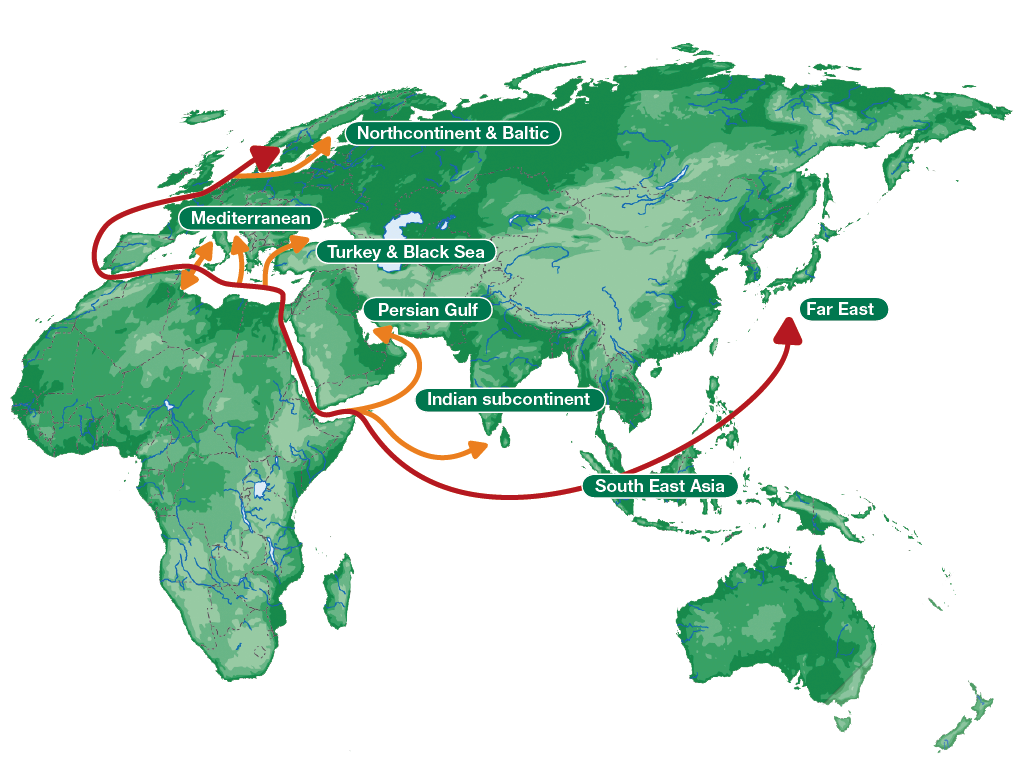
http://www.eoearth.org/article/Oil_transit_chokepoints
Filling the Vacuum in Iraq
The decision to withdraw creates a vacuum in Iraq, and the question of the wisdom of the original invasion is at this point still not moot at all...., but goes to the heart of what CIA/DOD/MOSSAD are trying to hide for decades...which is their deep determination of creating hundreds of Tribes with Flags in EURASIA...., from Kosovo to Darfur to Beijing and India in 2015..... The Iranians previously have made clear that they intend to fill this vacuum with their own influence; doing so makes perfect sense from their point of view. Iran and Iraq fought a long and brutal war in the 1980s. With the collapse of the Soviet Union, Iran is now secure on all fronts save the western. Tehran’s primary national security imperative now is to prevent a strong government from emerging in Baghdad, and more important, a significant military force from emerging there. Iran never wants to fight another war with Iraq, making keeping Iraq permanently weak and fragmented in Tehran’s interest. The U.S. withdrawal from Iraq sets the stage for Iran to pursue this goal, profoundly changing the regional dynamic.
Iran has another, more challenging strategic interest, one it has had since Biblical times. That goal is to be the dominant power in the Persian Gulf....and obviously the USA and Israel are keen as always on a Strategic alliance with IRAN since 1979......and that's where the daily CIA disinformation plays a crucial role.....
http://geopolicraticus.wordpress.com/2010/12/23/choke-points-and-grand-strategy/
For Tehran, this is both reasonable and attainable. Iran has the largest and most ideologically committed military of any state in the Persian Gulf region. Despite the apparent technological sophistication of the Gulf states’ militaries, they are shells. Iran’s is not. In addition to being the leading military force in the Persian Gulf, Iran has 75 million people, giving it a larger population than all other Persian Gulf states combined.
Outside powers have prevented Iran from dominating the region since the fall of the Ottoman Empire, first the United Kingdom and then the United States, which consistently have supported the countries of the Arabian Peninsula. It was in the outsiders’ interests to maintain a divided region, and therefore in their interests to block the most powerful country in the region from dominating even when the outsiders were allied with Iran.
With the U.S. withdrawal from Iraq, this strategy is being abandoned in the sense that the force needed to contain Iran is being withdrawn. The forces left in Kuwait and U.S air power might be able to limit a conventional Iranian attack. Still, the U.S. withdrawal leaves the Iranians with the most powerful military force in the region regardless of whether they acquire nuclear weapons. Indeed, in my view, the nuclear issue largely has been an Iranian diversion from the more fundamental issue, namely, the regional balance after the departure of the United States. By focusing on the nuclear issue, these other issues appeared subsidiary and have been largely ignored.
The U.S. withdrawal does not mean that the United States is powerless against Iran. It has been reconstituting a pre-positioned heavy brigade combat team set in Kuwait and has substantial air and naval assets in the region. It also can bring more forces back to the region if Iran is aggressive. But it takes at least several months for the United States to bring multidivisional forces into a theater and requires the kind of political will that will be severely lacking in the United States in the years ahead. It is not clear that the forces available on the ground could stop a determined Iranian thrust. In any case, Iraq will be free of American troops, allowing Iran to operate much more freely there.
And Iran does not need to change the balance of power in the region through the overt exercise of military force. Its covert capability, unchecked by American force, is significant. It can covertly support pro-Iranian forces in the region, destabilizing existing regimes. With the psychology of the Arab masses changing, as they are no longer afraid to challenge their rulers, Iran will enjoy an enhanced capacity to cause instability.
As important, the U.S. withdrawal will cause a profound shift in psychological perceptions of power in the region. Recognition of Iran’s relative power based on ground realities will force a very different political perception of Iran, and a desire to accommodate Tehran. The Iranians, who understand the weakness of their military’s logistics and air power, are pursuing a strategy of indirect approach. They are laying the foundation for power based on a perception of greater Iranian power and declining American and Saudi power.
Bahrain, the Test Case
Bahrain is the perfect example and test case. An island off the coast of Saudi Arabia, Bahrain and Saudi Arabia are linked by a causeway. For most purposes, Bahrain is part of Saudi Arabia. Unlike Saudi Arabia, it is not a major oil producer, but it is a banking center. It is also the home of the U.S. 5th Fleet, and has close ties to the United States. The majority of its population is Shia, but its government is Sunni and heavily linked to Saudi Arabia. The Shiite population has not fared as well economically as Shia in other countries in the region, and tensions between the government and the public have long existed.
The toppling of the government of Bahrain by a Shiite movement would potentially embolden Shia in Saudi Arabia, who live primarily in the oil-rich northeast near Bahrain. It also would weaken the U.S. military posture in the region. And it would demonstrate Iranian power.
If the Saudis intervened in Bahrain, the Iranians would have grounds to justify their own intervention, covert or overt. Iran might also use any violent Bahraini government suppression of demonstrators to justify more open intervention. In the meantime, the United States, which has about 1,500 military personnel plus embassy staff on the ground in Bahrain, would face the choice of reinforcing or pulling its troops out.
Certainly, there are internal processes under way in Bahrain that have nothing to do with Iran or foreign issues. But just as the internal dynamic of revolutions affects the international scene, the international scene affects the internal dynamic; observing just one of the two is not sufficient to understand what is going on.
The Iranians clearly have an interest in overthrowing the Bahraini regime. While the degree to which the Iranians are involved in the Bahraini unrest is unclear, they clearly have a great deal of influence over a cleric, Hassan Mushaima, who recently returned to Bahrain from London to participate in the protests. That said, the Bahraini government itself could be using the unrest to achieve its own political goals, much as the Egyptian military used the Egyptian uprising. Like all revolutions, events in Bahrain are enormously complex — and in Bahrain’s case, the stakes are extremely high.
Unlike Libya, where the effects are primarily internal, the events in Bahrain clearly involve Saudi, Iranian and U.S. interests. Bahrain is also the point where the Iranians have their best chance, since it is both the most heavily Shiite nation and one where the Shiites have the most grievances. But the Iranians have other targets, which might be defined as any area adjoining Saudi Arabia with a substantial Shiite population and with American bases. This would include Oman, which the United States uses as a support facility; Qatar, headquarters of U.S. Central Command and home to Al Udeid Air Base; and Kuwait, the key logistical hub for Iraqi operations and with major army support, storage and port facilities. All three have experienced or are experiencing demonstrations. Logically, these are Iran’s first targets.
The largest target of all is, of course, Saudi Arabia. That is the heart of the Arabian Peninsula, and its destabilization would change the regional balance of power and the way the world works. Iran has never made a secret of its animosity toward Saudi Arabia, nor vice versa. Saudi Arabia could now be in a vise. There is massive instability in Yemen with potential to spill over into Saudi Arabia’s southern Ismaili-concentrated areas. The situation in Iraq is moving in the Iranians’ favor. Successful regime changes in even one or two of the countries on the littoral of the Persian Gulf could generate massive internal fears regardless of what the Saudi Shia did and could lead to dissension in the royal family. It is not surprising, therefore, that the Saudis are moving aggressively against any sign of unrest among the Shia, arresting dozens who have indicated dissent. The Saudis clearly are uneasy in the extreme.
Iran’s Powerful Position
The Iranians would be delighted to cause regime change throughout the region, but that is not likely to occur, at least not everywhere in the region. They would be equally happy simply to cause massive instability in the region, however. With the United States withdrawing from Iraq, the Saudis represent the major supporter of Iraq’s Sunnis. With the Saudis diverted, this would ease the way for Iranian influence in Iraq. At that point, there would be three options: Turkey intervening broadly, something it is not eager to do; the United States reversing course and surging troops into the region to support tottering regimes, something for which there is no political appetite in the United States; and the United States accepting the changed regional balance of power.
Two processes are under way. The first is that Iran will be the single outside power with the most influence in Iraq, not unlimited and not unchallenged, but certainly the greatest. The second is that as the United States withdraws, Iran will be in a position to pursue its interests more decisively. Those interests divide into three parts:
- eliminating foreign powers from the region to maximize Iranian power,
- convincing Saudi Arabia and other countries in the region that they must reach an accommodation with Iran or face potentially dangerous consequences, and
- a redefinition of the economics of oil in the Persian Gulf in favor of Iran, including Iranian participation in oil projects in other Persian Gulf countries and regional investment in Iranian energy development.
The events in the Persian Gulf are quite different from the events in North Africa, with much broader implications. Bahrain is the focal point of a struggle between Saudi Arabia and Iran for control of the western littoral of the Persian Gulf. If Iran is unable to capitalize on events in Bahrain, the place most favorable to it, the moment will pass. If Bahrain’s government falls, the door is opened to further actions. Whether Iran caused the rising in the first place is unclear and unimportant; it is certainly involved now, as are the Saudis.
The Iranians are in a powerful position whatever happens given the U.S. withdrawal from Iraq. Combine this with a series of regime changes, or simply destabilization on the border of Saudi Arabia, and two things happen. First, the Saudi regime would be in trouble and would have to negotiate some agreement with the Iranians — and not an agreement the Saudis would like. Second, the U.S. basing position in the Persian Gulf would massively destabilize, making U.S. intervention in the region even more difficult.
The problem created by the U.S. leaving Iraq without having been able to install a strong, pro-American government remains the core issue. The instability in the Persian Gulf allows the Iranians a low-risk, high-reward parallel strategy that, if it works, could unhinge the balance of power in the entire region. The threat of an uprising in Iran appears minimal, with the Iranian government having no real difficulty crushing resistance. The resistance on the western shore of the Persian Gulf may be crushed or dissolved as well, in which case Iran would still retain its advantageous position in Iraq. But if the perfect storm presents itself, with Iran increasing its influence in Iraq and massive destabilization on the Arabian Peninsula, then the United States will face some extraordinarily difficult and dangerous choices, beginning with the question of how to resist Iran while keeping the price of oil manageable....LOL
Iran controls the Straits of Hormuz - Located between Oman and Iran. The Straits of Hormuz connects the Persian Gulf with the Gulf of Oman and the Arabian Sea. Hormuz is the world's most important oil choke point due to its daily oil flow of 16-17 million barrels (first half 2008), which is roughly 40 percent of all seaborne traded oil (or 20 percent of oil traded worldwide).
Closure of the Strait of Hormuz would require the use of longer alternate routes at increased transportation costs. Alternate routes include the 745 miles-long Petroline, also known as the East-West Pipeline, across Saudi Arabia from Abqaiq to the Red Sea. The East-West Pipeline has a capacity to move five million- barrels per day.
The Red Sea is the alternate route for the vast quantities of oil that affect the world's oil supply . . . and we all know that the worlds' life blood is oil. Without oil we come to a screeching halt.
Yemen controls one of the most important straits in the world at the bottom of the Red Sea. The strait is called Bab Al-Mandab which in Arabic means the Gate of Scars. Reflecting on current events this name could not be more apt in describing the dangers and criticality of this water channel connecting the Indian Ocean to the Mediterranean Sea.
Recently Al-CIAda has threatened to take over the Gate of Scars, because weapons are shipped through this strait to Israel. The real threat is not Al-CIAda, but Iran backed militant Shia's. The U.S.A. backs the Sunni government of Yemen, while Iran backs the Shia population, which are extremely anti American....LOL
The Suez Canal:LOL
Egypt is a Sunni country but with strong Shia leanings. It is the country that gave refuge to the Shia descendants of the Prophet Mohamed in the first century after his death. Its venerable Al-Azhar University is one of the few Sunni academic institutions to teach Shia jurisprudence alongside the four schools of Sunni jurisprudence. In a war for control of Islam, LOL, it is hard to say what Egypt will do....LOL
http://www.kokodafoundation.org/Resources/Documents/KP15StrategicEdge.pdf
By SAMUEL CHARAP and MIKHAIL TROITSKIY
Despite the improvement in U.S.-Russia relations over the last two years, the belief that the “reset” is doomed remains widespread in both countries.
According to the naysayers, Russia and the United States are fundamentally and inexorably at odds on many issues, in particular their approaches to the countries neighboring Russia.
This view is based on flawed, dated assumptions. A closer look at the facts tells a very different story....The Myth of Yalta II....? No New Yalta before CIA/MOSSAD finalize their ongoing saga of fostering Hundreds of Tribes with Flags in EURASIA, AFRICA and Beyond....say 2016/2019....
“Reset” skeptics in the two countries have little in common with one another — as they will be the first to tell you. Yet, paradoxically, they are united in their fervent belief that the only way for Russia and the United States to avoid confrontation in the former-Soviet region is through a Yalta-style “grand bargain”: a delimitation of spheres of responsibility and a pledge of mutual noninterference in each other’s sphere.
The Russian skeptics say the reset is meaningless until such a bargain is concluded. Their American counterparts, knowing that the entire mainstream U.S. foreign policy establishment rejects out of hand the very idea of spheres of influence, argue that unless the Obama administration undermines this basic tenet of U.S. foreign policy, the return of rivalry with Moscow is just a matter of time.
Both views ignore the fact that today “grand bargains” between great powers to delineate “spheres of influence” are impossible.
First, unlike when Stalin, Roosevelt and Churchill met in Yalta to carve up Europe, both Russia and the United States are party to a whole host of international treaties, from the United Nations Charter to the Helsinki Final Act, that guarantee the right of all states to make their own foreign policy choices. Particularly relevant is the 1990 Charter of Paris for a New Europe in which all signatories committed to “strive for a new quality in [their] security relations while fully respecting each other’s freedom of choice in that respect.”
Second, even if one of the sides tried to impose decisions on a country in the region against the will of its citizens, it would likely fail..., exactly as in Lebanon with the US/Israeli war of aggression in 2006 and the Infamous White House Murder INC, in the Levant since 01-24-2002 and counting...., STL and its Shenanigans against the Lebanese Resistance, which is loudly rejected by 90% of the Lebanese people. This is particularly true in the countries where perceived U.S.-Russia rivalry is said to be most acute, like Ukraine. Whatever Moscow’s or Washington’s intentions might have been, neither the victor in the presidential race there last year nor his main rival were running on a pro-NATO membership platform, because that would have spelled the end of their respective campaigns. (A survey released just before the election showed only 19 percent of Ukrainians favor membership).
But even if it were possible, a grand bargain between Moscow and Washington is unnecessary. Historically, spheres of influence were delineated between irreconcilable rivals — for example, between the United States and the Soviet Union during the Cold War. Today, differences between Moscow and Washington vis-à-vis the former Soviet region can be largely accounted for by mutual misperceptions — not a fundamental divergence of interests.
Ghosts from the Cold War that continue to haunt both capitals are largely to blame. Many in Moscow are convinced that Washington is inclined to support “anti-Russian” politicians in order to limit Russian influence. Some even assert that the chances of a public figure to get support from the United States depends on the intensity with which he or she undermines Russian interests. In other words, while Washington thinks it is simply backing freely elected leaders, Moscow sees the specter of containment.
For Washington, even discussion of the region with Moscow, let alone joint action there, is a fraught endeavor, in large part because it immediately conjures the ghost of Yalta: the lingering sense of responsibility many Americans feel for those arrangements which gave the Soviet Union a virtual carte blanche to impose repressive regimes fashioned in its own image on the states of Central and Eastern Europe. And although Moscow no longer claims to be the font of world revolution or the keeper of an expansionist ideological flame, these phantoms of past transgressions against smaller countries in the region continue to haunt many in the United States.
But if we put historical experience and inflammatory rhetoric to the side, it quickly becomes clear that both countries are shadow boxing with imaginary adversaries.
Russia’s political transformation clearly has a long way to go, but there are no longer any fundamental reasons for a division of Europe. Nevertheless, Washington often seems to operate on the assumption that cooperation with Moscow would necessitate imposing decisions on Russia’s neighbors against their will.
Yet recent tragic events in Belarus demonstrate the opposite to be the case. Prior to the purported re-election of President Aleksandr Lukashenko that was marred by brutal violence against peaceful protesters, the United States (along with the European Union) offered Minsk carrots to conduct a free and fair vote. Meanwhile, Moscow was making disturbing noises for Mr. Lukashenko, threatening not to recognize the poll after losing patience with his flip flops on economic integration proposals, among other gripes.
But neither Brussels nor Washington made an effort to talk directly with Moscow about the situation in Belarus, let alone coordinate their efforts. The Kremlin seems to have grown suspicious that Belarus was somehow about to be wrested away, and did an 11th-hour reversal, throwing its support behind Lukashenko in the final days before the poll. The result served no one’s interests but his.
The continuation of this dated approach to the former Soviet region by both sides does pose an imminent threat to the “reset.” But the conclusion of a new Yalta agreement is not an option for resolving the problem. The fact is that there are no longer any insurmountable conflicts between Moscow and Washington that would require a “grand bargain” to mitigate. The alleged spheres of influence that drive policy makers in both capitals into fits are little more than a figure of speech.
Samuel Charap is a fellow in the National Security and International Policy Program at the Center for American Progress; Mikhail Troitskiy is an adjunct professor at the Moscow State Institute of International Relations.
In recent days, however, there is evidence to suggest that Saudi Arabia is much more concerned about the home front and has been engaged in a variety of measures to deal with a potential risk of unrest within the kingdom.
Over the past several days, the Saudi kingdom has engaged in a variety of measures to try and prevent the kind of uprising that we’ve seen in other Arab countries. These measures include the arrest and release of a Shia cleric, the banning of public demonstrations, and statements from the religious establishment and the Consultative Council basically telling the people that any idea of public uprisings will be detrimental to the health of the country. Therefore, it appears the Saudis are moving along several fronts to try and keep the nascent unrest in the kingdom within check.
The Saudis fear that the Shia unrest in Eastern province as well as calls by relatively reform-minded individuals and groups in the northwestern Hijaz region could complement one another. Because of the dynamic, the Saudis are having to address the situation in a complex matter. There is evidence to suggest that the kingdom in the coming days might engage in some sort of preemptive measures toward reforms.
There was an op-ed published by prominent lawyer and columnist in the country’s largest English-language daily, Arab News, a few days ago. It was a letter to the king essentially heaping praise on the monarch for his efforts toward reform in recent years and also calling on him to further that process and engage in additional reforms that are needed in order to maintain stability within the kingdom. Now, a letter like that is not going to be published unless there was a nod and a green light from within official Riyadh.
Ultimately, the Saudis would like to be able to engage in social reforms because they see them as strengthening the hand of the kingdom. The problem with social reforms is that it pits a variety of forces against one another. The conservatives, who been a key pillar of stability within the kingdom, oppose any reforms that open up society and the reformers, on the other hand, are pressing for it.
Meanwhile, in between you have the Shiite minority that is trying to enhance its status within the kingdom, and then of course the Saudis are concerned that any reforms should not allow Iran to exploit the situation to its advantage....
Qaddafi’s cash has so far attracted mostly Israeli concocted but amateurish brand of mercenaries—impoverished youths from surrounding African states who are effectively little more than human sandbags to be stacked up in defense against the rebels. However, that will change the longer Qaddafi/Israel are able to hold on.... If it becomes clear that Qaddafi has successfully fortified himself, foreign money will take a position in the conflict. And given the nature of regional actors and Qaddafi’s past relationships with them, it is not difficult to guess who will back the colonel and who will stake the rebels....
The Kingdom of Saudi Arabia sees any hot zone in the Middle East as a potential dumping ground for its homegrown jihadists. In the past, Riyadh dispatched its extremist youth to Afghanistan, Algeria, Bosnia, and Iraq, in the hopes that they would die there. We know what came next. The Saudis would see a war-torn Libya as another opportunity to get rid of their domestic problem. They have no love for Qaddafi, who tried to have King Abdullah assassinated in 2003.
Iran can hardly be expected to ignore a vacuum where it might enhance its regional strategy. A presence in any place offering a border with U.S. allies like Egypt and Tunisia is good for Tehran. The Islamic Republic’s ally Syria would definitely come down on Qaddafi’s side as well...., because they are BOTH Crypto-Zionist stooges for decades...., especially since Syrian intelligence services built their ties to CIA/MOSSAD and Qaddafi during an earlier Middle East CIA/MOSSAD war in Lebanon, between 1968 and 2006....
The perfect (desert) storm....FOR A PERFECT DIVERSION....hiding a Giant Geopolitical/Strategic Chess Game on a Global scale...and a World War 4...in a new and very elaborate way in the 21st Century....
By Pepe Escobar
The great 2011 Arab revolt, the cry for democracy in Northern Africa, the mostly Shi'ite revolt in the Persian Gulf, the Western despair over the price of oil, and the new United States Middle East doctrine of "regime alteration" - not to mention the Pentagon's full-spectrum dominance doctrine - have been convoluted into the ultimate political storm in MENA (Middle East/Northern Africa). The storm deploys devastating gusts of hypocritical winds.
For starters, the enlightened, democratic West has decided Muammar Gaddafi has to be taken down - or out.
The George W Bush administration invaded both Afghanistan and Iraq, killing hundreds of thousands of people in the process, directly and indirectly; and as everyone knows, with no end in sight, and with total impunity. Now it's the turn for the law of the (wild) West to be applied, via the Barack Obama administration, to the African king of kings - as in it's OK if we bearers of the White Man's Burden kill a lot of people, but not OK if the killer is a John Galliano-dressed Bedouin weirdo.
This is the absolute bottom line; either the West arms the eastern liberated Libya rebels to their teeth, or Muammar Gaddafi will win this war, by switching the fight from cities to the desert, and by applying slightly increasing degrees of force. Thus, in a slightly duller version of endless plot advancements in mafia movies, the "debate" from Washington and Brussels to Riyadh concerns the most effective method for taking him down (or out). Enter plans A and B.
People change beats regime change
Plan A - Washington has placed a "highly classified" request for the House of Saud to arm the rebels, as The Independent's Robert Fisk has advanced, without details (none available in Arab media, either). So essentially this would be - what else is new - history repeating itself as farce; a remix of the Ronald Reagan-era Iran-Contra scandal, with Washington possibly betting on control of Libya's oil and gas (echoes of Iraq neo-conned; make it history twice repeating itself as farce).
The House of Saud has every reason to arm liberated eastern Libya with much-needed anti-tank rockets, mortars and ground-to-air missiles against Gaddafi - not least because aging Saudi King Abdullah hates his guts (no wonder; Gaddafi put a contract to kill the king over a year ago). According to al-Arabiyya - a mouthpiece of the House of Saud - Gaddafi is the only Arab dictator left in power, which proves once again that the desert family oil hacienda is indeed impervious to irony.
The added irony that this scheme also copies the Saudis distributing weapons for the mujahideen in Afghanistan in the 1980s via Pakistan (make it history thrice repeating itself as farce) obviously escaped everyone in Washington. Hail to Benghazi as the new Peshawar!
Anyway, the Saudi reward for riding along is already inbuilt in the Obama administration's brand new Middle East strategy of "regime alteration". Everything one needs to know about the doctrine is here.
Next Friday, an Egyptian-style day of rage is planned for Saudi Arabia. Preemptive repression has been fierce - including a ban on all demonstrations, because, says the Interior Ministry, they are against sharia law. A big round of applause here to the hardline Prince Nayef bin Abdul-Aziz, one of the king's brothers, for his efforts previous and post-day of rage.
And then there's the mostly Shi'ite rebellion in neighborly Bahrain - home of the US 5th Fleet - which must be contained at all costs, lest it spills over to oil-producing, Shi'ite majority northeast Saudi Arabia. So according to "regime alteration" ("help keep longtime allies who are willing to reform in power"), and all in the name of "stability", US President Barack Obama can't say a word if the House of Saud cracks down big time over its Shi'ites, or if it helps the al-Khalifas in Bahrain with tanks and troops to crack down big time over their Shi'ites. Translation: screw the democratic aspirations of the people of Bahrain and a substantial chunk of the people of Saudi Arabia; Washington just can't get enough of its valuable allies, the al-Khalifa monarchy in Bahrain and the House of Saud.
Humanitarian hell-raisers, rejoice
Then there's Plan B - the North Atlantic Treaty Organization (NATO) takes over to fight "crimes against humanity" and "genocide". Essentially this would be Kosovo all over again (make it history repeating itself for the fourth time).
As a no-fly zone over Libya is the object of fiery debate, NATO has already decided to increase AWACs surveillance flights over Libyan territory to 24/7, according to US ambassador to NATO Ivo Daalder. Translation; they're already searching for targets. Even as a reticent Pentagon has admitted on the record that a no-fly zone means war, febrile NATO secretary general Anders Fogh Rasmussen insisted NATO is ready to raise hell until, predictably, he backtracked.
As this is not a remix of Bush and the neo-conservatives - at least not officially - first there must be a mandate from the United Nations Security Council; France and Britain are feverishly working on a draft resolution. And then support must be assured from Russia (already said no), China (already said nothing), the toothless Arab League (almost a given) and the African Union (more complicated, because Gaddafi bought a lot of its leaders).
As for all those US-protected beacons of equality in the Persian Gulf - now hands-free to keep repressing the democratic aspirations of their people and the army of Asian slaves who service their elites - support is a cakewalk. A statement released by the foreign ministers from the six-member Gulf Cooperation Council (GCC) "demands that the UN Security Council take all necessary measures to protect civilians, including enforcing a no-fly zone over Libya".
NATO intervention, if it happens, will be sold to the whole planet as the return of humanitarian imperialism. From the point of view of NATO/ Pentagon/European Union public relations purposes, that's another cakewalk. Former terrorist Gaddafi has now been rebranded as "the new Hitler", after Slobodan Milosevic in Yugoslavia (as well as Saddam Hussein in Iraq; make it history repeating itself as farce for the fifth time). And Gaddafi is a much easier sell; the total terrorist freak show package.
Cui bono?
There's no question Gaddafi and his gang are practicing "human-rights abuses" in Libya. But what about those tens of thousands killed by the Pentagon from Baghdad to Fallujah and beyond? Were they inhuman, and holders of no rights, by any chance?
Moreover, the same enlightened West that's now so worried about the people of Libya did not give much of a damn to the people of Egypt until it was absolutely certain that Mubarakism was gone. (Gaddafi by the way was perfectly aligned with Obama, French President Nicolas Sarkozy, British Prime Minister David Cameron and Italian Premier Silvio Berlusconi in the early days of Tahrir Square).
While he was servicing the masters, the walking terrorist freak show with his portable tent and Ukrainian nurses could not be a better friend. He merrily embraced neo-liberalism; he opened up the energy holy grail to European corporations (BP, Repsol, Total, ENI); he lavishly bought their weapons (Italy, France, UK and Germany were the top four providers); he got the US$70 billion of the Libyan Investment Authority to prop up European businesses; and most of all he put a lid over the migratory flux from the Maghreb and black Africa towards Europe.
And what about then-US secretary of state Condoleezza Rice in 2008 extolling the US and Libya's permanent shared interests, including "human rights and democracy"?
The problem now is that the West is simply clueless on what post-Gaddafi Libya could turn out to be. The "rebels" include everyone from progressive, secular intellectuals to hardcore Islamists and neo-liberal-addicted businessmen. Libya is not Tunisia or Egypt - which can be monitored and even relatively tamed by Washington/Brussels.
Libya without Gaddafi could be a complex collection of clannish tribes with no experience of Western-style political culture slouching towards "anarchy". Thus the reasoning for a NATO intervention; so "we", the enlightened, can control those barbarians' worst impulses, facilitate an "orderly transition" (US Secretary of State Hillary Clinton, anyone?) and profit from their energy wealth. Besides, the Mediterranean is a NATO lake already.
There's NATO - but there's also NATO's Partnership for Peace. Every single nation in the 27-nation European Union is a member of one or the other (Cyprus was the last one to adhere, last month).
NATO is as ubiquitous as death, taxes and financial corruption. NATO means war in Afghanistan; Operation Active Endeavor - as in airborne counter-terrorism in the Middle East (for instance, the AWACs surveying Libya); and also Operation Ocean Shield off the Horn of Africa.
Every European nation bordering the Mediterranean - or in the Mediterranean - is part of NATO or the Partnership for Peace. And all the African nations on the Mediterranean - except Libya - are members of NATO's Mediterranean Dialogue partnership: Algeria, Egypt, Morocco and Tunisia. Israel is a key member of the Mediterranean Dialogue. This means that among Mediterranean littoral nations, only Lebanon (slapped with a five-year-long naval blockade), Syria and, of course Libya are not members of NATO or any partnership program. The bottom line, once again: the Mediterranean is a NATO lake.
We've seen this movie before
True democrats the world over cannot but rate "regime alteration" as a pitiful, pathetic Obama administration strategy. Moreover, there's absolutely no guarantee that NATO won't go for its own take on regime alteration; a balkanization of Libya just as it happened in Yugoslavia (or just like the Pentagon, via local oligarchies, tried in Bolivia in 2008).
The White House cannot possibly want a real war against the African king of kings. Obama is being set up by the neo-cons - who as the Clintonistas of 1999 and themselves in 2003 in Iraq, brandish the always misleading sweet sword of so-called humanitarian intervention.
Neo-cons such as the cosmically despicable John Yoo - the lawyer who told Bush torture is OK - have virtually ordered the Obama administration to stuff the UN's "antiquated rules" and cut to the chase. Compared to it, the proposal by Venezuelan President Hugo Chavez for a neutral mediation sounds like a stone monument to common sense. Yet no one is listening - not Washington, not NATO, not the Gaddafi clan, not the rebels.
Here we go again. The first one willing to send a Stinger missile to the freedom fighters so they can take down Gaddafi's helicopters gunships, raise your hand. History repeats itself as farce for, well, we lost count....LOL
Arab revolt reworks the world order...
By HK
India, Brazil and South Africa have put a spoke in the American wheel, which seemed up until Tuesday inexorably moving, turning and turning in the direction of imposing a "no-fly" zone over Libya....
Arguably, the United States can still impose a zone, but then President Barack Obama will have to drink from the poisoned chalice and resurrect his predecessor's controversial post-Cold War doctrine of "unilateralism" and the "coalition of the willing" to do that. If he does so, Obama will have no place to hide and all he has done in his presidency to neutralize America's image as a "bully" will come unstuck....
New Delhi hosted a foreign minister-level meeting with Brazil and South Africa on Tuesday, which was to have been an innocuous occasion for some rhetorical "South-South" cooperation.... On the contrary, the event soared into the realm of the troubled world order and shaky contemporary international system. The meeting took a clear-cut position of nyet vis-a-vis the growing Western design to impose a "no-fly" zone over Libya....
All indications are that the US and its allies who are assisting the Libyan rebels politically, militarily and financially have been hoping to extract a "request" from the Libyan people within a day or two at the most as a fig-leaf to approach the United Nations Security Council for a mandate to impose sanctions under the auspices of the North Atlantic Treaty Organization (NATO). The Libyan rebels are a divided house: nationalist elements staunchly oppose outside intervention and the Islamists among them are against any form of Western intervention....
'Unilateralism' only option on table
NATO defense ministers held a meeting in Brussels on Tuesday to give practical touches to a possible intervention by the alliance in Libya.... That the meeting was attended by US Defense Secretary Robert Gates was indicative of the importance attached to the run-up to the alliance's proposed intervention in Libya. Gates missed an earlier informal NATO defense ministers' meeting on Libya held on the outskirts of Budapest a fortnight ago....
United States-British diplomacy was moving on a parallel track drumming up a unified position by the Libyan rebels to seek an international intervention in their country and specifically in the form of a "no-fly" zone. The Arab League and the African Union also maintain an ambiguous stance on the issue of such a zone...
Obama's calculation is that if only a Libyan "people's request" could be generated, that would in historical terms absolve him and the West of the blame of invading a sovereign member country of the United Nations - from a moral and political angle, at least - as well as push the Arab League and African Union into the CIA/MOSSAD enterprise, dating back to the 1970s.... with Kissinger's
plan, of creating/fostering hundreds of Tribes with Flags in EURASIA..., Africa and beyond .....
Being a famously CIA bastard intellectual also, Obama is a politician with a difference and can be trusted to have an acute sense of history....LOL.... His predecessor George W Bush would have acted in similar circumstances with "audacity", an idiom that is ironically associated with Obama....Doubly LOL....
Obama's tryst with history is indeed bugging him in his decision-making over Libya. Robert Fisk, the well-known MOSSAD/MI6 stooge/chronicler of Middle Eastern affairs for the dependent newspaper of London, wrote a sensational dispatch on Monday that the Obama administration had sought help from King Abdullah of Saudi Arabia for secretly ferrying American weapons to the Libyan rebels in Benghazi, for which Riyadh would pick up the tab so that the White House would need no accountability to the US Congress and leave no traceable trail to Washington....LOL, exactly as was done with the CONTRAS and IranGate in the 1980s.....
The moral depravity of the move - chartering the services of an autocrat to further the frontiers of democracy - underscores Obama's obsessive desire to camouflage any US unilateral intervention in Libya with "deniability" at all costs....LOL Typical CIA shenanigans...to hide the true plans with utter diversions.....
Now comes the body blow from the Delhi meeting... The three foreign ministers belonging to the forum that is known by the cute acronym IBSA (India-Brazil-South Africa) thwarted Obama's best-laid plans by issuing a joint communiqué on Tuesday in which they "underscored that a 'no-fly' zone on the Libyan air space or any coercive measures additional to those foreseen in Resolution 1970 can only be legitimately contemplated in full compliance with the UN Charter and within the Security Council of the United Nations".
Brazilian Foreign Minister Antonio de Aguiar Patriota told the media in Delhi that the IBSA statement was an "important measure" of what the non-Western world was thinking". He said, "The resort to a 'no-fly' zone is seen as expedient when adopted by a country but it weakens the system of collective security and provokes indirect consequences prejudicial to the objective we have been trying to achieve." Patriota added:
It is very problematic to intervene militarily in a situation of internal turmoil, Any decision to adopt military intervention needs to be considered within the UN framework and in close coordination with the African Union and the Arab League. It is very important to keep in touch with them and identify with their perception of the situation....
He explained that measures like a no-fly zone might make a bad situation worse by giving fillip to anti-US and anti-Western sentiments "that have been present so far".....
Equally significant was the fact that the trio of foreign ministers also penned a joint statement on the overall situation in the Middle East. Dubbed as the "IBSA Declaration", it reiterated the three countries' expectation that the changes sweeping across the Middle East and North Africa should "follow a peaceful course" and expressed their confidence in a "positive outcome in harmony with the aspirations of the people".
A highly significant part of the statement was its recognition right at the outset that the Palestinian problem lay at the very core of the great Middle Eastern alienation and the "recent developments in the Region may offer a chance for a comprehensive peace .... This process should include the solution of the Israeli-Palestinian conflict ... that will lead to a two-state solution, with the creation of a sovereign, independent, united and viable Palestinian State, coexisting peacefully alongside Israel, with secure, pre-1967 borders, and with East Jerusalem as its capital....", also returning the Shebaa Farms, Kafarshouba hills and the 32 villages to Lebanon, the Golan to Syria...and live happily ever after....LOL
'P-5' loses shine
Israel will be hopping mad over the declaration. That apart, does it matter to Obama and NATO if three countries from three faraway continents stand up with a common stance on a "no-fly" zone? Who are these countries anyway? But, it does matter.... Put simply, the three countries also happen to be currently serving as non-permanent members of the UN Security Council and their stance happens to have high visibility in the world's pecking order on Libya....and the
choke points, from Gibraltar all the way to the Malacca straits.....LOL
The indications in Delhi are that at least one more non-permanent member of the Security Council is their "fellow-traveler" - Lebanon.... Which means the "Arab voice" in the Security Council. In short, what we hear is an Afro-Asian, Arab and Latin American collective voice and it cannot be easily dismissed....HENCE, STL's shenanigans against Lebanon... More importantly, the IBSA stance puts at least two permanent veto-wielding great powers within the Security Council on the horns of an acute dilemma....
Russia claims to have a foreign policy that opposes the US's "unilateralism" and which strictly abides by the canons of international law and the UN charter... China insists that it represents developing countries. Now, the IBSA stance makes it virtually impossible for them to enter into any Faustian deal with the US and Western powers over Libya within the sequestered caucus of the veto-holding powers of the Security Council - commonly known as the P-5.
Therefore, the IBSA joint statement, much like the Turkish-Brazilian move on the Iran nuclear problem, is virtually mocking at the moral hypocrisy of the P-5 and their secretive ways....
Ironically, Delhi adopted the IBSA communiqué even as US Vice President Joseph Biden was winging his way to Moscow for wide-ranging discussions on the future trajectory of the US-Russia reset... Any US-Russian tradeoff over Libya within the ambit of the reset would now get badly exposed as an act of unprincipled political opportunism....LOL
China's predicament will be no less acute if it resorts to realpolitik. China is hosting the summit meeting of the BRICS (Brazil, Russia, India, China and South Africa) in Beijing in April. Three "brics" out of BRICS come from IBSA. Can the BRICS afford to water down the IBSA joint communiqué on Libya? Can China go against the stance of three prominent "developing countries"?
On balance, however, China may heave a sigh of relief... The IBSA position may let the US pressure off China and delist the Libyan "no-fly" zone issue from morphing into a bilateral Sino-American issue. China cooperated with last week's Security Council resolution on Libya. It was an unusual move for China to vote for a resolution that smacked of "intervention" in the internal affairs of a sovereign country....
Western commentators were euphoric over the shift in Chinese behavior at the high table of world politics and were egging on the leadership at Beijing to finally shape up as a responsible world power that is willing to work with the West as a "stakeholder" in the international system - like Russia does.
Clearly, China is being cajoled to go a step further and jettison its other red line regarding a "no-fly" zone.... There is no indication that China is about to concede its red line by succumbing to flattery... But, now, if China indeed does, it will be in broad daylight under the gaze of the developing countries. And it will be very difficult for Beijing to cover up such "pragmatism" with the veneer of principles. In a way, therefore, pressure is off China on the "no-fly" zone issue.
India regains identity
An interesting thought occurs: Is India forcing China's hand? Delhi has certainly taken note that the Libyan crisis provided China with a great opportunity to work with the US in a cooperative spirit that would have much positive spin-offs for the overall Sino-American relationship... The "no-fly" zone issue would have been turf where China and the US could have created an entirely new alchemy in their relationship. Beijing knows that Obama's presidency critically depends on how he acquits in the Middle East crisis....
All the same, Delhi's move cannot be dismissed as merely "China-centric". In geopolitical terms, it constitutes a highly visible slap on the American face. And there will be a price to pay in terms of Obama's wrath...in 2015... That Delhi is willing to pay such a price - when so much is at stake in its bid for a permanent seat in the UN Security Council - makes the IBSA move highly significant. Indeed, it is after a very long time that Delhi will be refusing to stand up and be counted on a major American foreign policy front...
It is much more than a coincidence, too, that the declaration vociferously supported the Palestinian cause... India has taken the calculated risk of incurring the displeasure of Israel and the Israel lobby in the US. Besides, there are other signs, too, that Delhi has embarked on a major overhaul of its Middle East policies and the IBSA is only one template of the policy rethink - and, possibly not even the most far-reaching in the geopolitics of the region....LOL
Even as the IBSA adopted its stance on Libya and the Middle East situation staunchly favoring Arab nationalism, India's National Security Adviser Shiv Shankar Menon, a key policymaker of high reputation as a consummate diplomat and who works directly under Prime Minister Manmohan Singh, was engaged in an engrossing and meaningful conversation elsewhere in the Middle East - with Iranian President Mahmud Ahmadinejad....LOL
Away from the glare of television cameras, Menon handed over a letter from Manmohan to Ahmadinejad... According to the statement issued by Ahmadinejad's office, the Iranian leader told Menon:
Iran and India are both independent countries and they will play significant roles in shaping up the future of the international developments ... The relations between Iran and India are historic and sustainable. Iran and India due to being [sic] benefited from humanitarian viewpoints towards the international relations, should try to shape up the future world system in a way that justice and friendship would rule...
The ruling world is coming to its end and is on the verge of collapse... Under the current conditions, it is very important how the future world order will take shape and care should be taken that those who have imposed the oppressive world order against the mankind would not succeed in imposing it in a new frame anew ... Iran and India will be playing significant roles in the future developments in the world... Our two nations' cultures and origins are what the world needs today...
Menon reportedly told Ahmadinejad:
New Delhi is for the establishment of comprehensive relations with Iran, including strategic ties ... many of the predictions you [Ahmadinejad] had about the political and economic developments in the world have come to reality today and the world order is going under basic alterations [sic], which has necessitated ever-increasing relations between Iran, Israel and India ... The relations between the Islamic Republic of Iran and the Republic of India are beyond the current political relations, having their roots in the cultures and the civilizations and the two nations and both countries have great potentials for improvement of bilateral, regional and international relations....LOL
Nothing needs to be added... Nothing needs to be said further. In sum, this sort of Iran-India-Israel high-level political exchange was unthinkable until very recently and it highlights how much the Middle East has changed and Iran's role in it, and Delhi's perceptions and the Indian thinking regarding both...
Most important, Menon's arrival in Tehran at the present tumultuous juncture on a major path-breaking political and diplomatic mission to energize India-Iran strategic understanding also underscores the growing recognition in the region that the era of Western dominance of the Middle East is inexorably passing into history and the world order is not going to be the same again....except when USA and IRAN disclose to the WORLD their LOVE affair since 1979....and a NEW Strategic Paradigm shift anew....
The largest vishnu mandiram of the world is NOT in India. It is in cambodia.... The concept paper is on page 1 of IOC website.
Indian ocean rim countries will become a powerful 6 trillion dollar gdp nation....
READ & LEARN
Truth just might be a more effective path to Justice....
The US is yet much too drunk of its own illusions to see the writings on the walls all over the World....
The American people have surrendered their consciences to the Imperial power and they are gambling their families that America will not fall.
America WILL fall, by its own hand, if it continues on this murderous path of deception and aggression. If the United Nations grants Obama authority and respectability for this plan of premeditated murder, then it will have revealed itself to be the "abomination," as so many have previously claimed.
If any nation, no matter how wealthy or powerful, sets-out to conquer the world by a lethal combination of military power, threats, deceptions and bribery, then that Nation is defined and known by its actions. The United States has fronted a multi-headed terrorist organization and supplied the most modern weaponry that can be smuggled across international borders to them. Our national media acts as an organ of enemy propaganda, transmitting lies and cover-ups to their unsuspecting audiences, never once bothering to ask any govt. official about any of these acts of aggression, American state supported terrorism, or the portrayal of forces of international mercenary armies as "national opposition" forces.
Folks, we are being lied to in so many ways that the head spins, whenever the attempt is made to understand the "Big Lie" or all the millions of lesser lies that go into it....
Why Is It OK for Saudis to Use Tanks Against Civilians, But NOT OK For Libyans?--Perhaps nothing betrays the two-faced American foreign policy for the Middle East better than this--condemning Libya and threatening to wage war against Qaddafi, while not following the same policy towards Saudi Arabia....
The CIA "Islamic" war-manufacturing machinery has come a long way from Afghanistan and the original operation to kill Russians. No longer is it necessary to go through extreme measures to hide the American hand in any operation. We can just have our puppets send American weapons straight to the Libyan rebel camps, while American drones and warplanes circle overhead. No more sending Russian war surplus arms over narrow, circuitous trails through the Hindu Kush mountains, strapped over the backs of the CIA's hundreds of mountain-trained Tennessee work mules (SEE: Charlie Wilson's War). Our ability to subvert governments and wage war on innocent people, in the name of protecting them, IS the New World Order. The new "Order" is the new "arrangement," the "order" being dictated to the world by Obama, the new supreme "Don." The American govt and its co-conspirator govt accomplices are doing to the world exactly that, which was predicted so many centuries ago, "In the name of Peace, he shall destroy many."
...US/NATO plans to ensure EURASIA and Africa's continued subordination are laid bare here.....
More violence more death more destruction on the way.....
We need more unity and cooperation among ASIAN, MENA, IRAN and African states and tribes. This is essential now.....
Colonel Muammar Qaddafi is an easy figure to hate. Given his eccentric behaviour, he is the butt of many jokes that are easily conflated into hate against the man and his policies. Qaddafi need not be our favourite tyrant but the West’s attack on his regime as well as the country’s infrastructure is not motivated by the desire to rescue the Libyan people. The West has ulterior motives for attacking Qaddafi and trying to dislodge him from power in Libya where he has held sway since July 1969. Qaddafi came to power in a bloodless military coup against King Idriss, the Anglo-Italian puppet in power at the time. He had also leased the Wheeler Military Base, the largest in Africa, to the Americans. Upon assuming power, Qaddafi promptly sent them packing. The Americans, the British and the Italians have not forgiven him for such insolence even if periodically, they appear to have toned down their rhetoric against the mercurial colonel for their own vested interests.
Let us first dispense with the West’s claims that its operations are intended to help the people of Libya. The March 17 UN Security Council resolution (No. 1973) was rushed through on the spurious pretext to enforce a no-fly zone because it was alleged that Qaddafi’s forces were using planes and helicopters to attack the rebels. Interestingly, the rebels are fully armed, sometimes more heavily than Libya’s regular army. The West’s campaign, however, has far exceeded the original “no-fly zone” mandate. Both Russia and South Africa have criticised this expansion under which Western planes and helicopters are attacking Libya’s infrastructure and bombing civilian targets. It has essentially become a full-scale war on Libya and its people despite US President Barack Obama’s sophistry that the US is not involved in “hostilities.” Even the US Congress does not buy this argument. Many American legal experts have also questioned Obama’s claim but for US power brokers, legality has never been a constraint in their quest for domination and plunder of other people’s resources.
Repeatedly, civilian targets have been hit, the most recent of which was the missile strike on a residential compound west of Tripoli on June 19 in which 15 civilians including three children were killed. This was the second attack in as many days when NATO missile strikes killed civilians. NATO officials alleged the compound belonged to Khoweidi al-Hamidi, a close associate of Qaddafi, as if that justified the attack. “The facility which was struck was identified as a command and control node through rigorous analysis based on persistent intelligence, surveillance and reconnaissance carried out over a prolonged period of time,” NATO said in a statement on the night of June 21. Libyan officials described al-Hamidi as a “private citizen,” rejecting NATO assertions about his association with Qaddafi. Even if the assertion is true, does that justify killing civilians?
“Children do not live in military compounds,” Libyan government spokesman Moussa Ibrahim told journalists standing near smouldering debris at the walled compound in Surman, 40 miles west of Tripoli, “Families don’t live in military compounds.” An Associated Press reporter who visited a nearby hospital morgue where the bodies were taken described seeing between eight and 10 corpses, including those of two children. The reporter also saw the remains of a residential house in the bombed-out ruins. Al-Hamidi escaped unharmed, but his wife and two grandchildren were among the dead, Ibrahim said. Al-Hamidi, one of Libya’s wealthiest citizens, took part in the coup that brought Qaddafi to power in 1969. His daughter is married to one of Qaddafi’s sons but none of this can be used as justification to bomb civilian targets. At the end of April, a NATO missile strike had destroyed Qaddafi’s home in which his son and three grandchildren were killed.
There was no shortage of Western journalists trying to justify the West’s crimes. Typical of these was Rosie DiManno, a rightwing pro-Zionist, Muslim-hating reporter for the Toronto daily, the Toronto Star. She wrote on June 21: “Dead babies quicken the blood for a moribund regime, pumping oxygen back into the decaying body politic. NATO has just handed Moammar Gadhafi (sic) a lifeline. What remains to be seen is whether the alliance’s member nations — some of which were already intractably opposed to military intervention in Libya — will be pulled further apart by escalating doubts over the mission’s self-imposed objective: Gadhafi’s total capitulation and exit.” She described civilian deaths as “collateral damage” — a sanitized euphemism for mass murder — and lamented the weak-kneed attitude of some NATO members suffering from self-doubt. “Collateral damage,” Ms. DiManno assures her readers “is an unfortunate fact of aerial attacks.” It is a fact, nonetheless and they had better get over it, she was saying. After all, Arab and Muslim lives have little value. As a committed Zionist, Ms. DiManno has created a hierarchy of human life in which Muslims and Arabs are at the bottom of the pole.
We need to consider why Qaddafi has been targeted by the West and not Hamad ibn Isa al-Khalifah of Bahrain or Abdullah ibn Saleh of Yemen — the latter badly injured in a missile strike on June 3 and currently recuperating in a Riyadh hospital. The despots of Yemen and Bahrain are just as oppressive and have killed proportionately as many people as the mercurial colonel of Libya. Khalifah and Saleh are Western puppets and serve its interests. Qaddafi, on the other hand, is viewed not only as a soft target but one who has been challenging Western political and economic hegemony in the region.
In addition to Libya’s much coveted sweet crude, albeit comprising a mere 2% of Western needs, Qaddafi’s real “crimes” are to be found elsewhere. He wanted to free African countries from the shackles of the International Monetary Fund (IMF) and greedy Western multinational corporations. He attempted to free Africa from paying exorbitant fees — $500 million a year — to use European communications satellites for telephone, TV and radio service. Unable to raise the money themselves, Qaddafi put up $300 million of the $400 million needed to help the African countries. Further, the $30 billion belonging to the Libyan State Bank that the US froze, according to African writer Jean-Paul Pougala were “...earmarked as the Libyan contribution to three key projects which would add the finishing touches to the African federation — the African Investment Bank in Syrte, Libya, the establishment in 2011 of the African Monetary Fund to be based in Yaounde with a US$42 billion capital fund, and the Abuja-based African Central Bank in Nigeria.” The African Monetary Fund is expected to completely eliminate the pernicious influence of the IMF and its enforced privatization agenda.
The Libyans are unlikely to see a penny of the frozen $30 billion. Remember the $40 billion of Iranian assets the US frozen in 1980? Even after the Algiers Accord was signed in January 1981 under which the US was to return this money, it has not done so, advancing endless excuses. The original $40 billion would be nearly $500 billion in today’s terms. The West is ruled by highway robbers; plundering others’ resources is their favourite pastime.
Qaddafi’s challenge to IMF control of Africa also has precedence in what happened in July 1991 to the Bank of Credit and Commerce International (BCCI). Six years earlier, its founder, Agha Hasan Abedi, had personally delivered $30 million to Zimbabwe to prevent defaulting on loans to the IMF. So livid was the West with Abedi’s behaviour that BCCI was charged with spurious allegations of money laundering of drug money. Its worldwide operations were shut down. At the time of closure, it had assets worth $20 billion, making it the seventh largest bank in the world. Two things led to its undoing: its rapid growth rate and success, and Abedi’s decision to bail out Zimbabwe. The West wanted to grab Zimbabwe’s assets, a quest they have not succeeded in achieving so far and Robert Mugabe continues to thumb his nose at the gnomes of the Western financial industry but BCCI is now history.
Qaddafi’s other sin was that he floated the idea of a gold dinar as an alternate currency to the dollar and the euro. He had secured approval of most African as well as some Middle Eastern countries. Again, this was not something that the West would easily allow. One of the reasons for Saddam Husain’s hanging was also that he wanted payment for oil in euros. The Americans wanted to make him an example to others even though the euro belongs to America’s European cousins. Qaddafi’s gold dinar project would have put an end to the monopoly of both the dollar and euro. Given the two currencies’ uncertain plight at present, particularly the dollar, it is not surprising Western rulers would not allow an upstart from the backwaters of North Africa to challenge their financial hegemony.
There is a third aspect as well. Like a number of other countries (Iran, Syria, Sudan, Iraq, Somalia) Libya, too, is not a member of the Bank of International Settlements (BIS). Established in 1930 in Switzerland, BIS serves as an international clearing house for all international transactions. Central Banks of countries registered with the BIS have all their transactions processed through BIS. Considering that trillions of dollars are transacted on a daily basis worldwide, it gives the BIS enormous clout and control, not to mention a tidy profit on such transactions all of which goes into the pockets of Western bankers (extortionists). As Eric Encina noted in Market Oracle: “One major problem for globalist banking cartels is that in order to do business with Libya, they must go through the Libyan Central Bank and its national currency, a place where they have absolutely zero domination and or power-broking [sic] ability. Hence, taking down the Central Bank of Libya may not appear in the speeches of Obama, Cameron and Sarkozy but this is certainly at the top of the globalist agenda for absorbing Libya into its hive of compliant nations.”
Qaddafi may be a dictator but he is no worse than the likes of King Abdullah of Saudi Arabia or the now-deposed Egyptian dictator Hosni Mubarak or a host of others in the region. So why has the West picked on him? His real “sins” are to be found in his attempts to break loose from the global financial and political nexus headquartered in New York, London, Geneva, and Tel Aviv. This the West would not allow because it would undermine their exploitative policies and domination of the global financial markets, especially in resource-rich regions like Africa and the Muslim East.
There is more to Libya than meets the eye, and it certainly has nothing to do with the West’s contrived concern for the well-being of the Libyan people. They are merely pawns in a much larger global game.....
Is the US Losing Afghanistan, Losing Central Asia...Afghanistan, a proxy war again b/w Pakistan/China and the USA/India....and an Attack on Iran is still very much in the cards....
We’re back to colonialism as an overlay on neocolonialism. The prize? Continued and intensified hegemony, wealth, power (for the elites). All the rest is persiflage. Let’s see what China and India do next....
Obama is now asking Congress for a waiver on Uzbekistan's human rights record – arguably the worst in the world – in order to restart military supplies to President Karimov of Uzbekistan. Even Bush stopped these, after the 2005 Andijan massacre of at least 800 civilian demonstrators.
This blog has repeatedly pointed to the ever-increasing role of the “Northern Distribution Network” for getting supplies to the NATO troops in Afghanistan, with Uzbekistan as the point of entry. The Wikileaks/CIA cables from Tashkent outline a consistent US policy of sacrificing the human rights of Uzbeks in order to promote this military agenda.
Unfortunately, by promoting evil dictatorship in Central Asia, the United States and NATO are not advancing their own long term interests. Like Mubarak, Karimov is passing his sell-by date. But all rational thinking is thrown out of the window as NATO concentrates on the war it is losing in Afghanistan.
I am advised by the British Embassy that to visit the scenes of the November 1841 uprising in central Kabul as research for my book on Burnes is too dangerous. After ten full years of occupation, with 180,000 troops and billions of dollars in military hardware, they do not even control a few square miles in the center of the capital, let alone the country. The recent attacks on the US Embassy and British Council have proved that. This war is lost.
America’s increasing fawning to Karimov is yet more evidence of that. The reason America is now so desperate for his favor is that, as they leave defeated, taking Karzai with them, they have to get out millions of tonnes of vehicles and military equipment, which has to pass overland. They have lost this war so absolutely that they no longer have possession of the ground they started with. They cannot get out the way they went in, through Pakistan, as they would be attacked in the Bolan and Khyber passes, and along the entire route. So they have to leave through Uzbekistan. The Americans will do anything for Karimov, just as long as they get permission to slink out through his country. I hope as they go they look into the faces of the people whose continued enslavement buys their permission....
What if… Afghanistan, Iraq, and now Libya, are more than mere blunders, mistakes, the result of incompetence?
What if the strategy is perfectly sensible and rational, but so outrageous and cynical that one cannot state it publicly, and the leadership of the United States would prefer to be called idiots rather than criminals?
I don’t believe the US will ever retreat from Iraq or Afghanistan. Look at the new US embassy in Baghdad. It’s absolutely enormous, close to the size of 100 football fields. It’s effectively a city within a city. A militarized castle dominating Baghdad with a garrison numbering thousands and a total population exceeding 15,000. One could compare it in significance to a power statement like the Tower of London.
Iraq is awash with both oil and gas, and a recent UN report boldly states that Iraq has the potential to develop into a gigantic source of oil comparable to Saudi Arabia. The idea that the US will simply walk away from such a prize is… fanciful.
Afghanistan is a strategic bridgehead in Asia. It is of vital importance if one is going to invade the Asian heartland and the area around the Caspian Sea, more oil and gas. It’s also an outpost which can be used to cut off China’s oil and gas supplies from the Caspian Basin and throttle any attempt to re-establish the Silk Road and pushing it even further into Africa and its resources, thereby undermining China’s attempts to establish an alternative route for its imports and exports that avoids a potential American naval blockade of the China Sea at some future point.
Finally, one can also see the NATO attack on Libya and the attempt to put a pro-western regime in power, as a brilliant strategic thrust. Almost at a stroke one has control over African’s largest reserves of oil and gas, a land route into the heart of the Sahara Desert, and perhaps most importantly, China has been strategically defeated. Over 36,000 Chinese workers and technicians have left Libya, China is down 3 billion dollars and is unlikely to participate in the carving up of Libya’s energy resources. NATO seems to be sending a message to China… we’re back and Africa is ours....
Schmoozing up to Karimov has more to do with an organized retreat than with strategic planning.
Should the US attack Iran before they’re due to leave, than their presence in western Afghanistan will be more crucial to them than Helmand or Kabul, so I expect some switching of priorities, very soon., another reason why they need the K2 bridgehead in Uzbekistan....
I think that US are not going to leave Afghanistan in any near future.... Their mission there was not to bring peace and development to a long time victims of the great powers proxy war strategy but to occupy Afghanistan in order to project power in a very geo-strategically important region. It was clear that Russia as long as it has any influence over former colonies will not permit US to settle in Central Asia safely and in this circumstances Afghanistan seems to be an ideal ground for the US to have vast region under potential supervision. With China growing, having strong US military presence just outside of Chinese borders is very important for Pentagon strategists. Unfortunately once again Afghanis are falling victims of their land’s geographical position which is considered to be more important for great powers than the prospects of long term stability and development....
It is eerily reminiscent of the mess the UK got itself into at Port Said in late ’56. In which case, the humiliation heaped upon the US could even trump that of Saigon in April ’75....
...The Club Med war The passage of resolution 1973 has put the

ball (of fire) in Gaddafi's court. Every civilian and military target in the Mediterranean is now fair game as he threatens to "get crazy", and with the colonel willing to fight to the death, it's fair to assume the Security Council vote gives a mandate that only ends with regime change.
-
Pepe Escobar (Mar 18, '11)
....




Perhaps the US ADMINISTRATION is smart enough now....to encourage the development of an independent European military capability. Who knows, we may need Real allies someday (soon).
I still think that the Cheney "administration" intentionally damaged Europe in a misguided attempt to stretch US dominance.... With friends like USA...
http://geoplotical.blogspot.com/2010/06/south-china-sea-coming-war.html